

6.4 Exposure Assessment (Step 2)
129
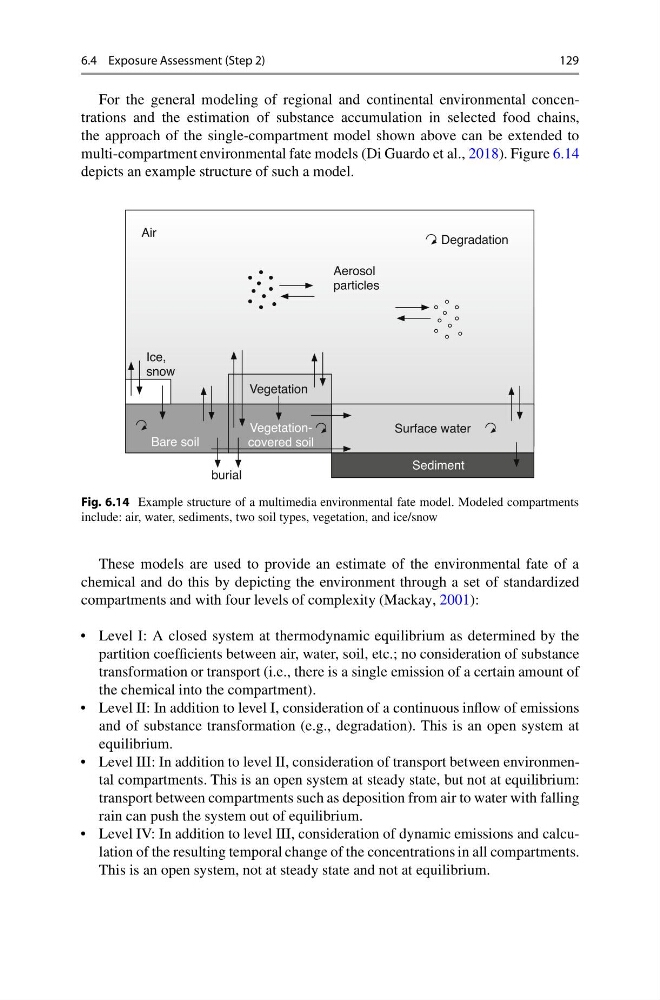
For the general modeling of regional and continental environmental concentrations and the estimation of substance accumulation in selected food chains,
the approach of the single-compartment model shown above can be extended to
multi-compartment environmental fate models (Di Guardo et al., 2018). Figure 6.14
depicts an example structure of such a model.
Fig. 6.14 Example structure of a multimedia environmental fate model. Modeled compartments
include: air, water, sediments, two soil types, vegetation, and ice/snow
These models are used to provide an estimate of the environmental fate of a
chemical and do this by depicting the environment through a set of standardized
compartments and with four levels of complexity (Mackay, 2001):
• Level I: A closed system at thermodynamic equilibrium as determined by the
partition coefficients between air, water, soil, etc.; no consideration of substance
transformation or transport (i.e., there is a single emission of a certain amount of
the chemical into the compartment).
• Level II: In addition to level I, consideration of a continuous inflow of emissions
and of substance transformation (e.g., degradation). This is an open system at
equilibrium.
• Level III: In addition to level II, consideration of transport between environmental compartments. This is an open system at steady state, but not at equilibrium:
transport between compartments such as deposition from air to water with falling
rain can push the system out of equilibrium.
• Level IV: In addition to level III, consideration of dynamic emissions and calculation of the resulting temporal change of the concentrations in all compartments.
This is an open system, not at steady state and not at equilibrium.
129
For the general modeling of regional and continental environmental concentrations and the estimation of substance accumulation in selected food chains,
the approach of the single-compartment model shown above can be extended to
multi-compartment environmental fate models (Di Guardo et al., 2018). Figure 6.14
depicts an example structure of such a model.
Fig. 6.14 Example structure of a multimedia environmental fate model. Modeled compartments
include: air, water, sediments, two soil types, vegetation, and ice/snow
These models are used to provide an estimate of the environmental fate of a
chemical and do this by depicting the environment through a set of standardized
compartments and with four levels of complexity (Mackay, 2001):
• Level I: A closed system at thermodynamic equilibrium as determined by the
partition coefficients between air, water, soil, etc.; no consideration of substance
transformation or transport (i.e., there is a single emission of a certain amount of
the chemical into the compartment).
• Level II: In addition to level I, consideration of a continuous inflow of emissions
and of substance transformation (e.g., degradation). This is an open system at
equilibrium.
• Level III: In addition to level II, consideration of transport between environmental compartments. This is an open system at steady state, but not at equilibrium:
transport between compartments such as deposition from air to water with falling
rain can push the system out of equilibrium.
• Level IV: In addition to level III, consideration of dynamic emissions and calculation of the resulting temporal change of the concentrations in all compartments.
This is an open system, not at steady state and not at equilibrium.