

6.4 Exposure Assessment (Step 2)
125
6. Estimate the environmental concentration at the location of the emission, considering the immediately occurring dilution; these estimates lead to the PEC local in
the various compartments.
For existing products, often only sales data are known (e.g., monetary sales
figures, customs statistics, etc.), but not data describing the quantities released into
the environment. In the case of new products, these data can only be estimated by
taking into account the characteristics of application and use.
A simply estimated PEC local is often sufficient in the worst case for an initial
assessment of the risk quotient, provided that it is not expected that the substance
will be transferred to a different environmental compartment considered more
critical to protect. Here, some simple approaches for the calculation of the PEC local
for the water compartment are presented through two examples.
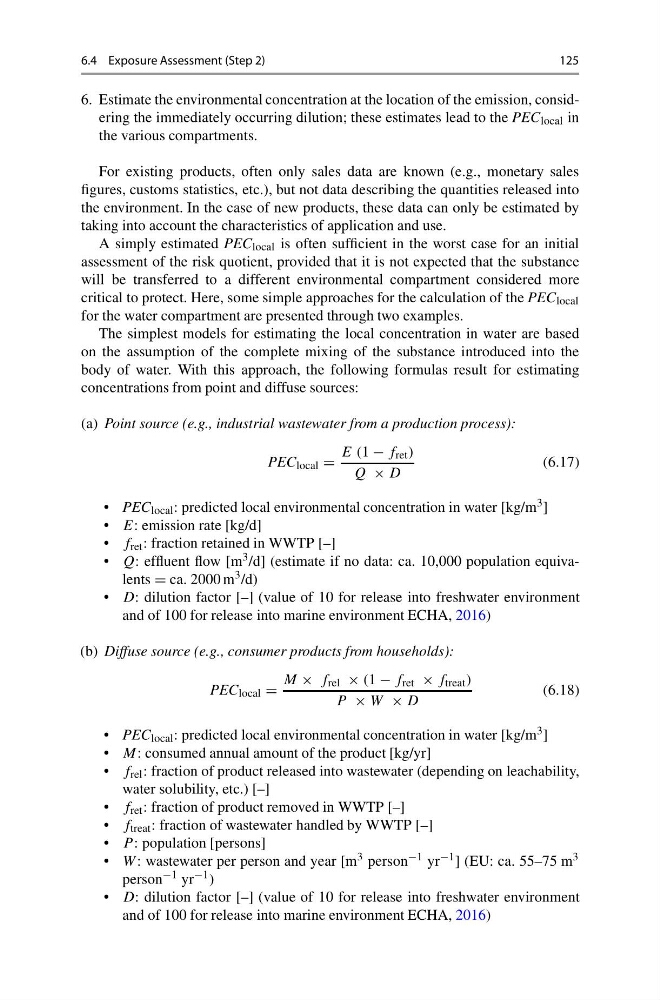
The simplest models for estimating the local concentration in water are based
on the assumption of the complete mixing of the substance introduced into the
body of water. With this approach, the following formulas result for estimating
concentrations from point and diffuse sources:
(a) Point source (e.g., industrial wastewater from a production process):
PEC local =
E (1 − f ret )
Q × D
(6.17)
• PEC local : predicted local environmental concentration in water [kg/m 3 ]
• E: emission rate [kg/d]
• f ret : fraction retained in WWTP [–]
• Q: effluent flow [m 3 /d] (estimate if no data: ca. 10,000 population equivalents = ca. 2000 m 3 /d)
• D: dilution factor [–] (value of 10 for release into freshwater environment
and of 100 for release into marine environment ECHA, 2016)
(b) Diffuse source (e.g., consumer products from households):
PEC local =
M × f rel × (1 − f ret × f treat )
P × W × D
(6.18)
• PEC local : predicted local environmental concentration in water [kg/m 3 ]
• M: consumed annual amount of the product [kg/yr]
• f rel : fraction of product released into wastewater (depending on leachability,
water solubility, etc.) [–]
• f ret : fraction of product removed in WWTP [–]
• f treat : fraction of wastewater handled by WWTP [–]
• P : population [persons]
• W : wastewater per person and year [m 3 person −1 yr −1 ] (EU: ca. 55–75 m 3
person −1 yr −1 )
• D: dilution factor [–] (value of 10 for release into freshwater environment
and of 100 for release into marine environment ECHA, 2016)
125
6. Estimate the environmental concentration at the location of the emission, considering the immediately occurring dilution; these estimates lead to the PEC local in
the various compartments.
For existing products, often only sales data are known (e.g., monetary sales
figures, customs statistics, etc.), but not data describing the quantities released into
the environment. In the case of new products, these data can only be estimated by
taking into account the characteristics of application and use.
A simply estimated PEC local is often sufficient in the worst case for an initial
assessment of the risk quotient, provided that it is not expected that the substance
will be transferred to a different environmental compartment considered more
critical to protect. Here, some simple approaches for the calculation of the PEC local
for the water compartment are presented through two examples.
The simplest models for estimating the local concentration in water are based
on the assumption of the complete mixing of the substance introduced into the
body of water. With this approach, the following formulas result for estimating
concentrations from point and diffuse sources:
(a) Point source (e.g., industrial wastewater from a production process):
PEC local =
E (1 − f ret )
Q × D
(6.17)
• PEC local : predicted local environmental concentration in water [kg/m 3 ]
• E: emission rate [kg/d]
• f ret : fraction retained in WWTP [–]
• Q: effluent flow [m 3 /d] (estimate if no data: ca. 10,000 population equivalents = ca. 2000 m 3 /d)
• D: dilution factor [–] (value of 10 for release into freshwater environment
and of 100 for release into marine environment ECHA, 2016)
(b) Diffuse source (e.g., consumer products from households):
PEC local =
M × f rel × (1 − f ret × f treat )
P × W × D
(6.18)
• PEC local : predicted local environmental concentration in water [kg/m 3 ]
• M: consumed annual amount of the product [kg/yr]
• f rel : fraction of product released into wastewater (depending on leachability,
water solubility, etc.) [–]
• f ret : fraction of product removed in WWTP [–]
• f treat : fraction of wastewater handled by WWTP [–]
• P : population [persons]
• W : wastewater per person and year [m 3 person −1 yr −1 ] (EU: ca. 55–75 m 3
person −1 yr −1 )
• D: dilution factor [–] (value of 10 for release into freshwater environment
and of 100 for release into marine environment ECHA, 2016)