

6.4 Exposure Assessment (Step 2)
123
While the examples provided here are fairly simple, much more complex models
exist for determining the exposures of entire populations considering multiple
exposure routes across hundreds of different product types and diets (Trudel et al.,
2011; Ritter et al., 2009). For the analysis of indirect exposures via the environment,
further models are needed that can describe concentrations and intake via respiratory
air, drinking water, food (meat, fish, dairy products, cereals, and vegetables), etc.
(Trudel et al., 2011; Ritter et al., 2009).
6.4.2 Environmental Exposure
The exposure assessment step also aims to identify the extent to which the environment is exposed to a chemical. Most commonly, exposures in the environmental
compartments of air, water (including sediment), and soil are considered, with the
focus often first placed on investigating the water compartment. The starting point
for this step is understanding the emissions to each compartment, which can be
characterized by the types of sources, e.g., continuous vs. intermittent, the emission
rate, or the amounts released, as well as by the chemical’s ability to be diluted
and potential to react and degrade. Experimentally, the exposure can be quantified
through environmental analysis or by using biomarkers, which are measurements
of biochemical, structural, and functional changes within exposed test organisms.
Compartment-specific exposure can be estimated through the calculation of the
predicted environmental concentration (PEC) by means of models. Units of the
PEC are for air mg/m 3 , for water mg/L, and for soil mg/kg. The PEC is specific
to an environmental compartment. Wherever possible, emissions should be reduced
by treatment processes, and treatment processes therefore need to be reflected by
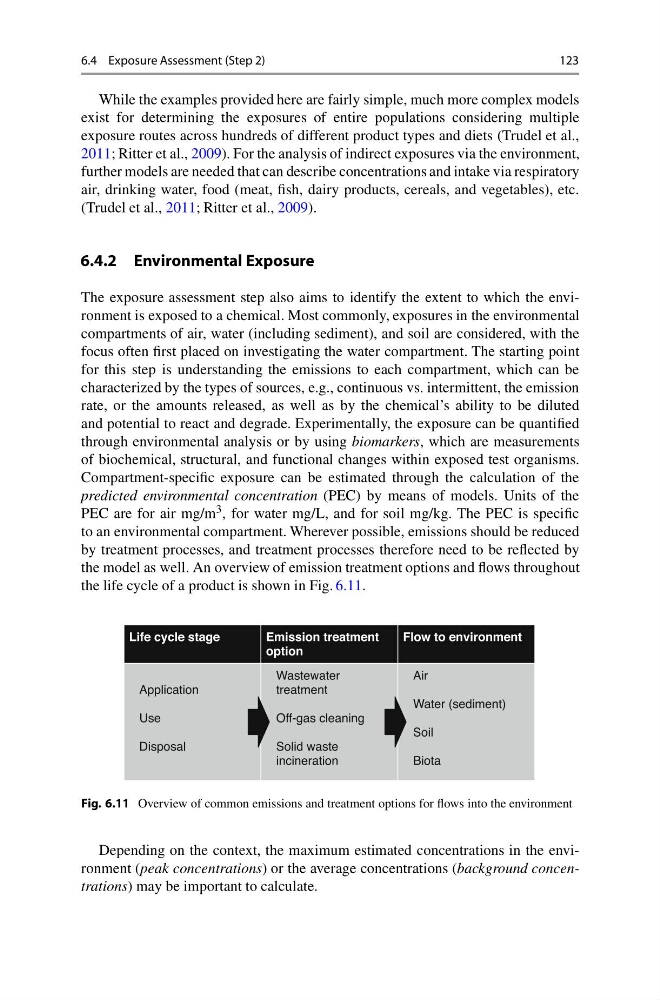
the model as well. An overview of emission treatment options and flows throughout
the life cycle of a product is shown in Fig. 6.11.
Fig. 6.11 Overview of common emissions and treatment options for flows into the environment
Depending on the context, the maximum estimated concentrations in the environment (peak concentrations) or the average concentrations (background concentrations) may be important to calculate.
123
While the examples provided here are fairly simple, much more complex models
exist for determining the exposures of entire populations considering multiple
exposure routes across hundreds of different product types and diets (Trudel et al.,
2011; Ritter et al., 2009). For the analysis of indirect exposures via the environment,
further models are needed that can describe concentrations and intake via respiratory
air, drinking water, food (meat, fish, dairy products, cereals, and vegetables), etc.
(Trudel et al., 2011; Ritter et al., 2009).
6.4.2 Environmental Exposure
The exposure assessment step also aims to identify the extent to which the environment is exposed to a chemical. Most commonly, exposures in the environmental
compartments of air, water (including sediment), and soil are considered, with the
focus often first placed on investigating the water compartment. The starting point
for this step is understanding the emissions to each compartment, which can be
characterized by the types of sources, e.g., continuous vs. intermittent, the emission
rate, or the amounts released, as well as by the chemical’s ability to be diluted
and potential to react and degrade. Experimentally, the exposure can be quantified
through environmental analysis or by using biomarkers, which are measurements
of biochemical, structural, and functional changes within exposed test organisms.
Compartment-specific exposure can be estimated through the calculation of the
predicted environmental concentration (PEC) by means of models. Units of the
PEC are for air mg/m 3 , for water mg/L, and for soil mg/kg. The PEC is specific
to an environmental compartment. Wherever possible, emissions should be reduced
by treatment processes, and treatment processes therefore need to be reflected by
the model as well. An overview of emission treatment options and flows throughout
the life cycle of a product is shown in Fig. 6.11.
Fig. 6.11 Overview of common emissions and treatment options for flows into the environment
Depending on the context, the maximum estimated concentrations in the environment (peak concentrations) or the average concentrations (background concentrations) may be important to calculate.