

112
6 Risk Assessment and Management of Chemical Products
and chronic toxicity, a wide range of adverse effects could be examined including
effects on body weight and various internal organs. Acute toxicity of a substance
is often described using the lethal dose (or concentration) of the product that kills
50% of the studied population (abbreviated as LD 50 or LC 50 ). The concentration
that elicits a certain effect on x% of the studied population can also be determined
and communicated as the effect concentration (EC x ). For chronic toxicity, a first
estimate is commonly made using standardized 28-day or 90-day tests with rats.
These testing methods and effects are further reviewed within the effect assessment
step (see Sect. 6.5).
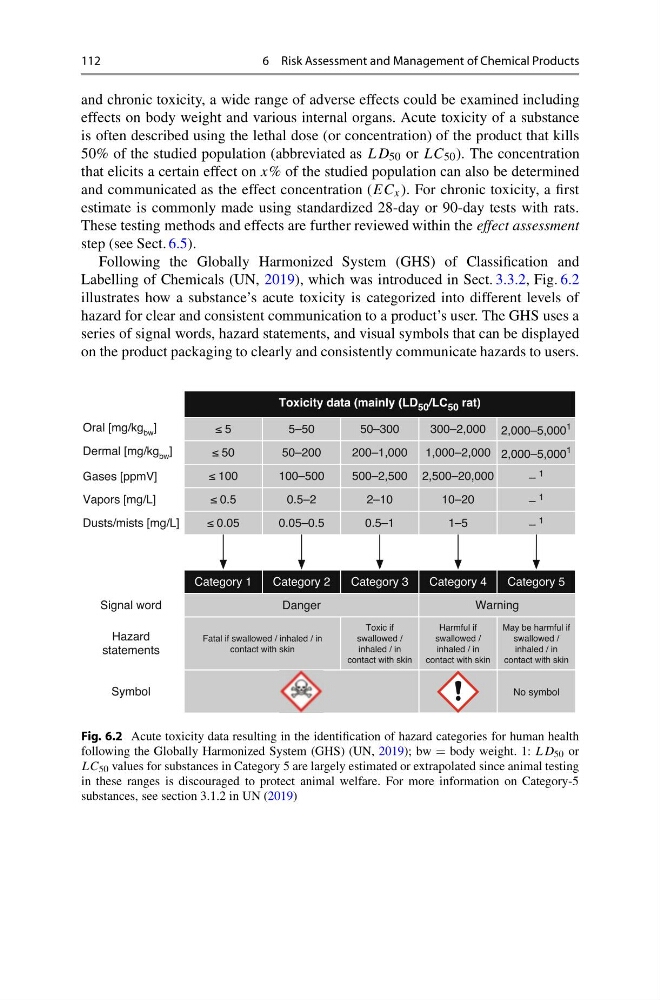
Following the Globally Harmonized System (GHS) of Classification and
Labelling of Chemicals (UN, 2019), which was introduced in Sect. 3.3.2, Fig. 6.2
illustrates how a substance’s acute toxicity is categorized into different levels of
hazard for clear and consistent communication to a product’s user. The GHS uses a
series of signal words, hazard statements, and visual symbols that can be displayed
on the product packaging to clearly and consistently communicate hazards to users.
Fig. 6.2 Acute toxicity data resulting in the identification of hazard categories for human health
following the Globally Harmonized System (GHS) (UN, 2019); bw = body weight. 1: LD 50 or
LC 50 values for substances in Category 5 are largely estimated or extrapolated since animal testing
in these ranges is discouraged to protect animal welfare. For more information on Category-5
substances, see section 3.1.2 in UN (2019)
6 Risk Assessment and Management of Chemical Products
and chronic toxicity, a wide range of adverse effects could be examined including
effects on body weight and various internal organs. Acute toxicity of a substance
is often described using the lethal dose (or concentration) of the product that kills
50% of the studied population (abbreviated as LD 50 or LC 50 ). The concentration
that elicits a certain effect on x% of the studied population can also be determined
and communicated as the effect concentration (EC x ). For chronic toxicity, a first
estimate is commonly made using standardized 28-day or 90-day tests with rats.
These testing methods and effects are further reviewed within the effect assessment
step (see Sect. 6.5).
Following the Globally Harmonized System (GHS) of Classification and
Labelling of Chemicals (UN, 2019), which was introduced in Sect. 3.3.2, Fig. 6.2
illustrates how a substance’s acute toxicity is categorized into different levels of
hazard for clear and consistent communication to a product’s user. The GHS uses a
series of signal words, hazard statements, and visual symbols that can be displayed
on the product packaging to clearly and consistently communicate hazards to users.
Fig. 6.2 Acute toxicity data resulting in the identification of hazard categories for human health
following the Globally Harmonized System (GHS) (UN, 2019); bw = body weight. 1: LD 50 or
LC 50 values for substances in Category 5 are largely estimated or extrapolated since animal testing
in these ranges is discouraged to protect animal welfare. For more information on Category-5
substances, see section 3.1.2 in UN (2019)