

where d is the diameter, l is the length, E is the Young’s modulus, and r is the
density of the material. To analyze the influence of reduced dimensions, a constant
aspect ratio a ¼ l/d is assumed. For this demonstration, iron (E ¼ 2:11 GPa,
r ¼ 7.8 Â 10
3 kg m
À3 ) as material and an aspect ratio a ¼ 10 are assumed. For a
rough estimation, one may use Eq. (2.5) also to estimate the basic vibration mode of
a carbon nanotube (E % 1000 GPa, r $ 2 Â 10
3 kg m
À3 ); the exact values depend on
the number of walls and the chirality (see Chapter 5). Results of the estimations
based on Eq. (2.5) are summarized in Table 2.2.
Analyzing Table 2.2, one realizes that a 10-nm nanorod vibrates in a frequency
range that is far off from those in technical use. More precise results of calculations
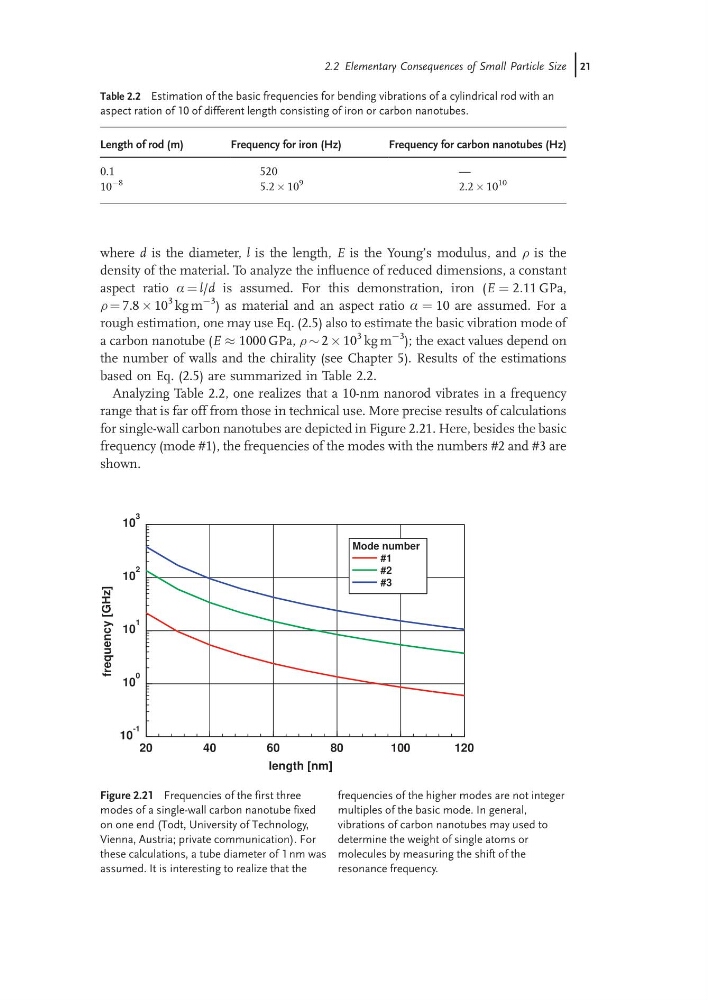
for single-wall carbon nanotubes are depicted in Figure 2.21. Here, besides the basic
frequency (mode #1), the frequencies of the modes with the numbers #2 and #3 are
shown.
20
40
60
80
100
120
length [nm]
10
-1
10
0
10
1
10
2
10
3
frequency
[GHz]
Mode number
#1
#2
#3
Figure 2.21 Frequencies of the first three
modes of a single-wall carbon nanotube fixed
on one end (Todt, University of Technology,
Vienna, Austria; private communication). For
these calculations, a tube diameter of 1 nm was
assumed. It is interesting to realize that the
frequencies of the higher modes are not integer
multiples of the basic mode. In general,
vibrations of carbon nanotubes may used to
determine the weight of single atoms or
molecules by measuring the shift of the
resonance frequency.
Table 2.2 Estimation of the basic frequencies for bending vibrations of a cylindrical rod with an
aspect ration of 10 of different length consisting of iron or carbon nanotubes.
Length of rod (m)
Frequency for iron (Hz)
Frequency for carbon nanotubes (Hz)
0.1
520
—
10
À8
5.2 Â 10
9
2.2 Â 10
10
2.2 Elementary Consequences of Small Particle Size j21
density of the material. To analyze the influence of reduced dimensions, a constant
aspect ratio a ¼ l/d is assumed. For this demonstration, iron (E ¼ 2:11 GPa,
r ¼ 7.8 Â 10
3 kg m
À3 ) as material and an aspect ratio a ¼ 10 are assumed. For a
rough estimation, one may use Eq. (2.5) also to estimate the basic vibration mode of
a carbon nanotube (E % 1000 GPa, r $ 2 Â 10
3 kg m
À3 ); the exact values depend on
the number of walls and the chirality (see Chapter 5). Results of the estimations
based on Eq. (2.5) are summarized in Table 2.2.
Analyzing Table 2.2, one realizes that a 10-nm nanorod vibrates in a frequency
range that is far off from those in technical use. More precise results of calculations
for single-wall carbon nanotubes are depicted in Figure 2.21. Here, besides the basic
frequency (mode #1), the frequencies of the modes with the numbers #2 and #3 are
shown.
20
40
60
80
100
120
length [nm]
10
-1
10
0
10
1
10
2
10
3
frequency
[GHz]
Mode number
#1
#2
#3
Figure 2.21 Frequencies of the first three
modes of a single-wall carbon nanotube fixed
on one end (Todt, University of Technology,
Vienna, Austria; private communication). For
these calculations, a tube diameter of 1 nm was
assumed. It is interesting to realize that the
frequencies of the higher modes are not integer
multiples of the basic mode. In general,
vibrations of carbon nanotubes may used to
determine the weight of single atoms or
molecules by measuring the shift of the
resonance frequency.
Table 2.2 Estimation of the basic frequencies for bending vibrations of a cylindrical rod with an
aspect ration of 10 of different length consisting of iron or carbon nanotubes.
Length of rod (m)
Frequency for iron (Hz)
Frequency for carbon nanotubes (Hz)
0.1
520
—
10
À8
5.2 Â 10
9
2.2 Â 10
10
2.2 Elementary Consequences of Small Particle Size j21