

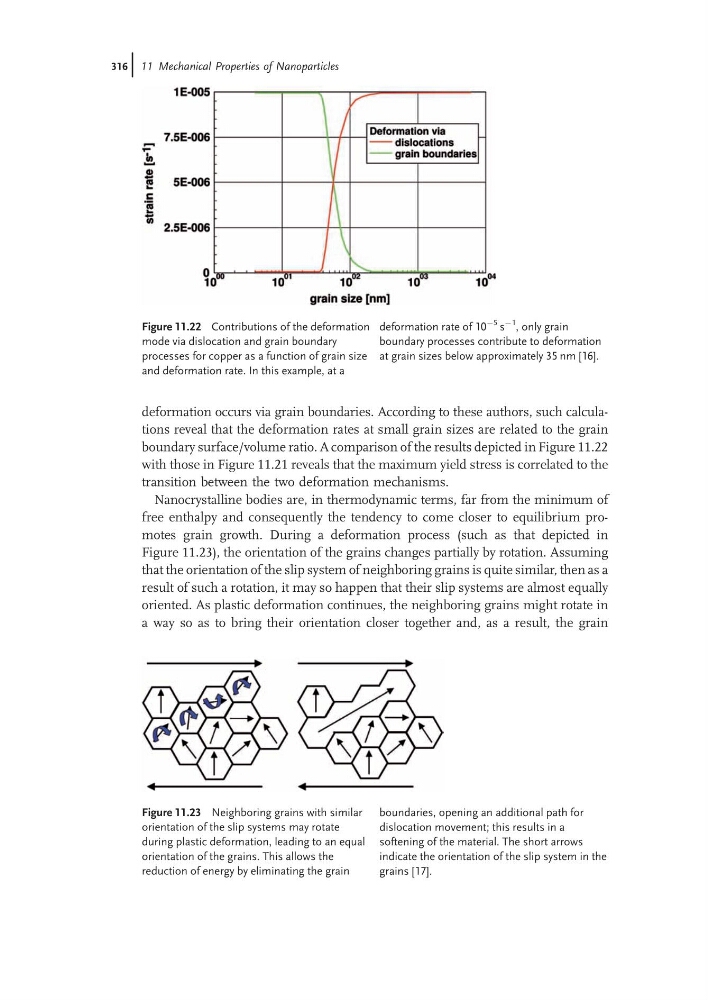
deformation occurs via grain boundaries. According to these authors, such calculations reveal that the deformation rates at small grain sizes are related to the grain
boundary surface/volume ratio. A comparison of the results depicted in Figure 11.22
with those in Figure 11.21 reveals that the maximum yield stress is correlated to the
transition between the two deformation mechanisms.
Nanocrystalline bodies are, in thermodynamic terms, far from the minimum of
free enthalpy and consequently the tendency to come closer to equilibrium promotes grain growth. During a deformation process (such as that depicted in
Figure 11.23), the orientation of the grains changes partially by rotation. Assuming
that the orientation of the slip system of neighboring grains is quite similar, then as a
result of such a rotation, it may so happen that their slip systems are almost equally
oriented. As plastic deformation continues, the neighboring grains might rotate in
a way so as to bring their orientation closer together and, as a result, the grain
Figure 11.22 Contributions of the deformation
mode via dislocation and grain boundary
processes for copper as a function of grain size
and deformation rate. In this example, at a
deformation rate of 10
À5 s
À1 , only grain
boundary processes contribute to deformation
at grain sizes below approximately 35 nm [16].
Figure 11.23 Neighboring grains with similar
orientation of the slip systems may rotate
during plastic deformation, leading to an equal
orientation of the grains. This allows the
reduction of energy by eliminating the grain
boundaries, opening an additional path for
dislocation movement; this results in a
softening of the material. The short arrows
indicate the orientation of the slip system in the
grains [17].
316j 11 Mechanical Properties of Nanoparticles
boundary surface/volume ratio. A comparison of the results depicted in Figure 11.22
with those in Figure 11.21 reveals that the maximum yield stress is correlated to the
transition between the two deformation mechanisms.
Nanocrystalline bodies are, in thermodynamic terms, far from the minimum of
free enthalpy and consequently the tendency to come closer to equilibrium promotes grain growth. During a deformation process (such as that depicted in
Figure 11.23), the orientation of the grains changes partially by rotation. Assuming
that the orientation of the slip system of neighboring grains is quite similar, then as a
result of such a rotation, it may so happen that their slip systems are almost equally
oriented. As plastic deformation continues, the neighboring grains might rotate in
a way so as to bring their orientation closer together and, as a result, the grain
Figure 11.22 Contributions of the deformation
mode via dislocation and grain boundary
processes for copper as a function of grain size
and deformation rate. In this example, at a
deformation rate of 10
À5 s
À1 , only grain
boundary processes contribute to deformation
at grain sizes below approximately 35 nm [16].
Figure 11.23 Neighboring grains with similar
orientation of the slip systems may rotate
during plastic deformation, leading to an equal
orientation of the grains. This allows the
reduction of energy by eliminating the grain
boundaries, opening an additional path for
dislocation movement; this results in a
softening of the material. The short arrows
indicate the orientation of the slip system in the
grains [17].
316j 11 Mechanical Properties of Nanoparticles