

single crystals of conventional size were occasionally observed for nanomaterials [7].
Diffusion coefficients of such magnitude do not allow the synthesis and storage of
nonequilibrium nanoparticles under any conditions. It should be noted that the
above discussion is valid only in cases where transformation from the nonequilibrium to the stable state is not related to the release of free energy.
The possibility of near-instant diffusion through nanoparticles has been exploited
technically, the most important example being the gas sensor. This is based on the
principle that changes in electric conductivity are caused by changes in the
stoichiometry of oxides, variations of which are often observed for transition metals.
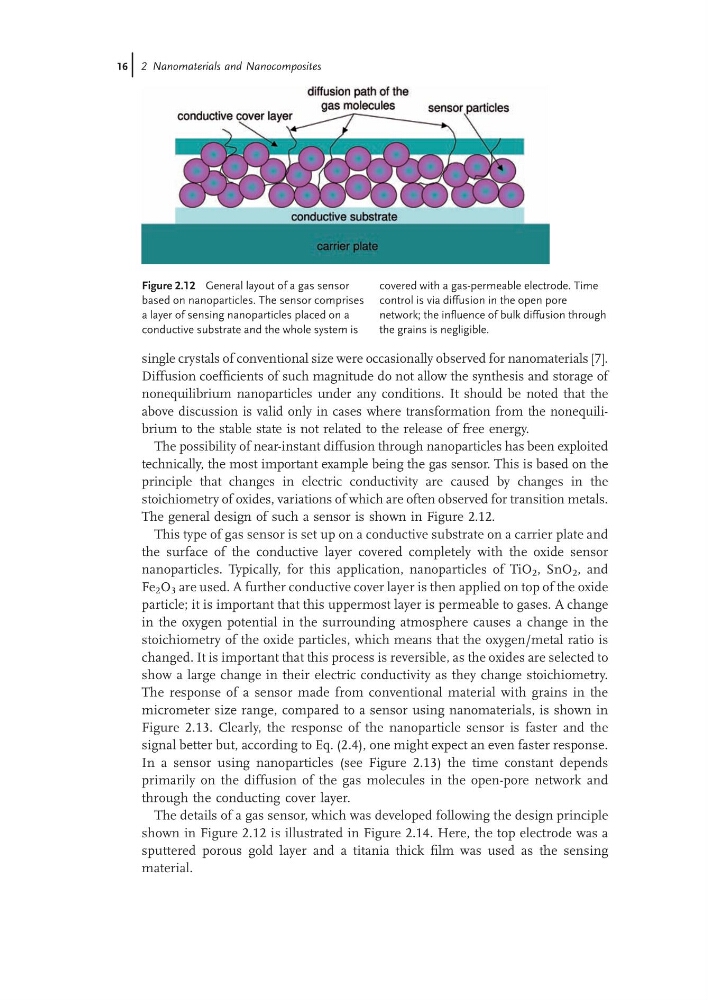
The general design of such a sensor is shown in Figure 2.12.
This type of gas sensor is set up on a conductive substrate on a carrier plate and
the surface of the conductive layer covered completely with the oxide sensor
nanoparticles. Typically, for this application, nanoparticles of TiO 2 , SnO 2 , and
Fe 2 O 3 are used. A further conductive cover layer is then applied on top of the oxide
particle; it is important that this uppermost layer is permeable to gases. A change
in the oxygen potential in the surrounding atmosphere causes a change in the
stoichiometry of the oxide particles, which means that the oxygen/metal ratio is
changed. It is important that this process is reversible, as the oxides are selected to
show a large change in their electric conductivity as they change stoichiometry.
The response of a sensor made from conventional material with grains in the
micrometer size range, compared to a sensor using nanomaterials, is shown in
Figure 2.13. Clearly, the response of the nanoparticle sensor is faster and the
signal better but, according to Eq. (2.4), one might expect an even faster response.
In a sensor using nanoparticles (see Figure 2.13) the time constant depends
primarily on the diffusion of the gas molecules in the open-pore network and
through the conducting cover layer.
The details of a gas sensor, which was developed following the design principle
shown in Figure 2.12 is illustrated in Figure 2.14. Here, the top electrode was a
sputtered porous gold layer and a titania thick film was used as the sensing
material.
Figure 2.12 General layout of a gas sensor
based on nanoparticles. The sensor comprises
a layer of sensing nanoparticles placed on a
conductive substrate and the whole system is
covered with a gas-permeable electrode. Time
control is via diffusion in the open pore
network; the influence of bulk diffusion through
the grains is negligible.
16j 2 Nanomaterials and Nanocomposites
Diffusion coefficients of such magnitude do not allow the synthesis and storage of
nonequilibrium nanoparticles under any conditions. It should be noted that the
above discussion is valid only in cases where transformation from the nonequilibrium to the stable state is not related to the release of free energy.
The possibility of near-instant diffusion through nanoparticles has been exploited
technically, the most important example being the gas sensor. This is based on the
principle that changes in electric conductivity are caused by changes in the
stoichiometry of oxides, variations of which are often observed for transition metals.
The general design of such a sensor is shown in Figure 2.12.
This type of gas sensor is set up on a conductive substrate on a carrier plate and
the surface of the conductive layer covered completely with the oxide sensor
nanoparticles. Typically, for this application, nanoparticles of TiO 2 , SnO 2 , and
Fe 2 O 3 are used. A further conductive cover layer is then applied on top of the oxide
particle; it is important that this uppermost layer is permeable to gases. A change
in the oxygen potential in the surrounding atmosphere causes a change in the
stoichiometry of the oxide particles, which means that the oxygen/metal ratio is
changed. It is important that this process is reversible, as the oxides are selected to
show a large change in their electric conductivity as they change stoichiometry.
The response of a sensor made from conventional material with grains in the
micrometer size range, compared to a sensor using nanomaterials, is shown in
Figure 2.13. Clearly, the response of the nanoparticle sensor is faster and the
signal better but, according to Eq. (2.4), one might expect an even faster response.
In a sensor using nanoparticles (see Figure 2.13) the time constant depends
primarily on the diffusion of the gas molecules in the open-pore network and
through the conducting cover layer.
The details of a gas sensor, which was developed following the design principle
shown in Figure 2.12 is illustrated in Figure 2.14. Here, the top electrode was a
sputtered porous gold layer and a titania thick film was used as the sensing
material.
Figure 2.12 General layout of a gas sensor
based on nanoparticles. The sensor comprises
a layer of sensing nanoparticles placed on a
conductive substrate and the whole system is
covered with a gas-permeable electrode. Time
control is via diffusion in the open pore
network; the influence of bulk diffusion through
the grains is negligible.
16j 2 Nanomaterials and Nanocomposites