

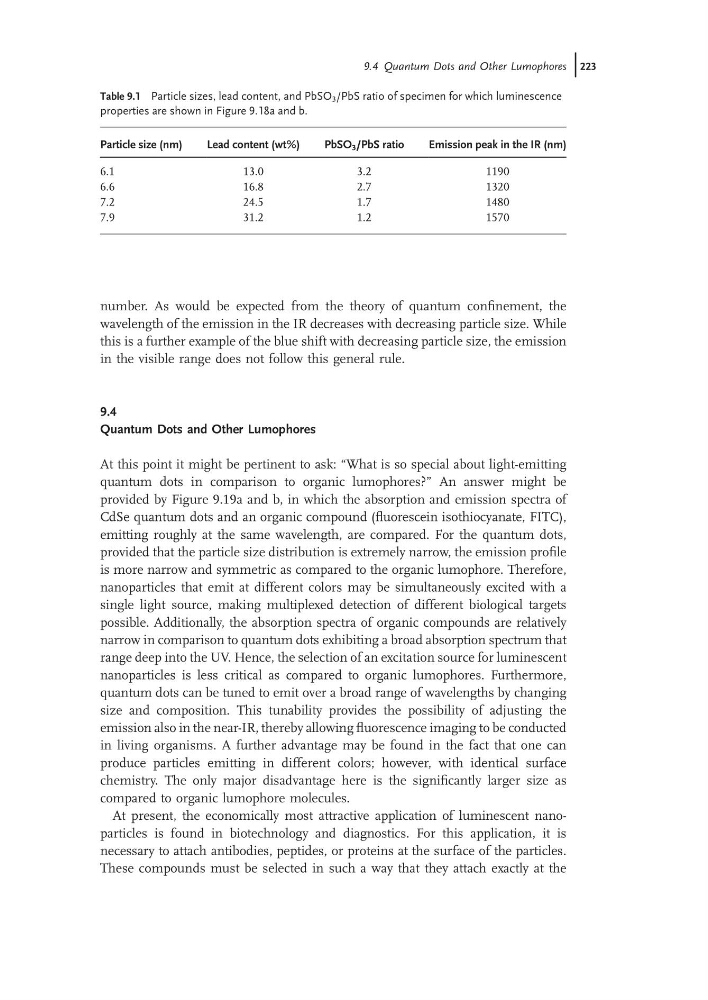
number. As would be expected from the theory of quantum confinement, the
wavelength of the emission in the IR decreases with decreasing particle size. While
this is a further example of the blue shift with decreasing particle size, the emission
in the visible range does not follow this general rule.
9.4
Quantum Dots and Other Lumophores
At this point it might be pertinent to ask: “What is so special about light-emitting
quantum dots in comparison to organic lumophores?” An answer might be
provided by Figure 9.19a and b, in which the absorption and emission spectra of
CdSe quantum dots and an organic compound (fluorescein isothiocyanate, FITC),
emitting roughly at the same wavelength, are compared. For the quantum dots,
provided that the particle size distribution is extremely narrow, the emission profile
is more narrow and symmetric as compared to the organic lumophore. Therefore,
nanoparticles that emit at different colors may be simultaneously excited with a
single light source, making multiplexed detection of different biological targets
possible. Additionally, the absorption spectra of organic compounds are relatively
narrow in comparison to quantum dots exhibiting a broad absorption spectrum that
range deep into the UV. Hence, the selection of an excitation source for luminescent
nanoparticles is less critical as compared to organic lumophores. Furthermore,
quantum dots can be tuned to emit over a broad range of wavelengths by changing
size and composition. This tunability provides the possibility of adjusting the
emission also in the near-IR, thereby allowing fluorescence imaging to be conducted
in living organisms. A further advantage may be found in the fact that one can
produce particles emitting in different colors; however, with identical surface
chemistry. The only major disadvantage here is the significantly larger size as
compared to organic lumophore molecules.
At present, the economically most attractive application of luminescent nanoparticles is found in biotechnology and diagnostics. For this application, it is
necessary to attach antibodies, peptides, or proteins at the surface of the particles.
These compounds must be selected in such a way that they attach exactly at the
Table 9.1 Particle sizes, lead content, and PbSO 3 /PbS ratio of specimen for which luminescence
properties are shown in Figure 9.18a and b.
Particle size (nm)
Lead content (wt%)
PbSO 3 /PbS ratio
Emission peak in the IR (nm)
6.1
13.0
3.2
1190
6.6
16.8
2.7
1320
7.2
24.5
1.7
1480
7.9
31.2
1.2
1570
9.4 Quantum Dots and Other Lumophores j223
wavelength of the emission in the IR decreases with decreasing particle size. While
this is a further example of the blue shift with decreasing particle size, the emission
in the visible range does not follow this general rule.
9.4
Quantum Dots and Other Lumophores
At this point it might be pertinent to ask: “What is so special about light-emitting
quantum dots in comparison to organic lumophores?” An answer might be
provided by Figure 9.19a and b, in which the absorption and emission spectra of
CdSe quantum dots and an organic compound (fluorescein isothiocyanate, FITC),
emitting roughly at the same wavelength, are compared. For the quantum dots,
provided that the particle size distribution is extremely narrow, the emission profile
is more narrow and symmetric as compared to the organic lumophore. Therefore,
nanoparticles that emit at different colors may be simultaneously excited with a
single light source, making multiplexed detection of different biological targets
possible. Additionally, the absorption spectra of organic compounds are relatively
narrow in comparison to quantum dots exhibiting a broad absorption spectrum that
range deep into the UV. Hence, the selection of an excitation source for luminescent
nanoparticles is less critical as compared to organic lumophores. Furthermore,
quantum dots can be tuned to emit over a broad range of wavelengths by changing
size and composition. This tunability provides the possibility of adjusting the
emission also in the near-IR, thereby allowing fluorescence imaging to be conducted
in living organisms. A further advantage may be found in the fact that one can
produce particles emitting in different colors; however, with identical surface
chemistry. The only major disadvantage here is the significantly larger size as
compared to organic lumophore molecules.
At present, the economically most attractive application of luminescent nanoparticles is found in biotechnology and diagnostics. For this application, it is
necessary to attach antibodies, peptides, or proteins at the surface of the particles.
These compounds must be selected in such a way that they attach exactly at the
Table 9.1 Particle sizes, lead content, and PbSO 3 /PbS ratio of specimen for which luminescence
properties are shown in Figure 9.18a and b.
Particle size (nm)
Lead content (wt%)
PbSO 3 /PbS ratio
Emission peak in the IR (nm)
6.1
13.0
3.2
1190
6.6
16.8
2.7
1320
7.2
24.5
1.7
1480
7.9
31.2
1.2
1570
9.4 Quantum Dots and Other Lumophores j223