

element, iron is extremely useful for M€ ossbauer studies since as an emitter it is
possible to use
57 Fe that originates from the decay of
57 Co, which was produced by
neutron irradiation of natural cobalt. The decay of
57 Co leads to
57 Fe in an exited
state that emits, besides others, a c-photon with energy of 14.4 keV. The natural
linewidth of this emission is 10
À8 eV.
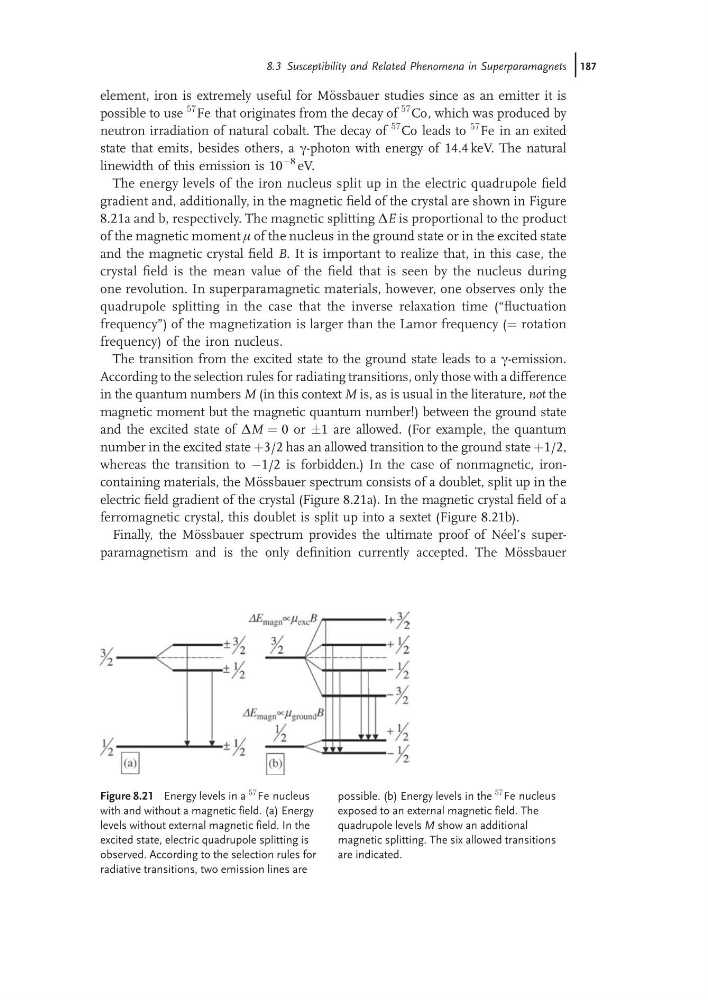
The energy levels of the iron nucleus split up in the electric quadrupole field
gradient and, additionally, in the magnetic field of the crystal are shown in Figure
8.21a and b, respectively. The magnetic splitting DE is proportional to the product
of the magnetic moment m of the nucleus in the ground state or in the excited state
and the magnetic crystal field B. It is important to realize that, in this case, the
crystal field is the mean value of the field that is seen by the nucleus during
one revolution. In superparamagnetic materials, however, one observes only the
quadrupole splitting in the case that the inverse relaxation time (“fluctuation
frequency”) of the magnetization is larger than the Lamor frequency (¼ rotation
frequency) of the iron nucleus.
The transition from the excited state to the ground state leads to a c-emission.
According to the selection rules for radiating transitions, only those with a difference
in the quantum numbers M (in this context M is, as is usual in the literature, not the
magnetic moment but the magnetic quantum number!) between the ground state
and the excited state of DM ¼ 0 or Æ1 are allowed. (For example, the quantum
number in the excited state þ3/2 has an allowed transition to the ground state þ1/2,
whereas the transition to À1/2 is forbidden.) In the case of nonmagnetic, ironcontaining materials, the M€ ossbauer spectrum consists of a doublet, split up in the
electric field gradient of the crystal (Figure 8.21a). In the magnetic crystal field of a
ferromagnetic crystal, this doublet is split up into a sextet (Figure 8.21b).
Finally, the M€ ossbauer spectrum provides the ultimate proof of N eel’s superparamagnetism and is the only definition currently accepted. The M€ ossbauer
Figure 8.21 Energy levels in a
57 Fe nucleus
with and without a magnetic field. (a) Energy
levels without external magnetic field. In the
excited state, electric quadrupole splitting is
observed. According to the selection rules for
radiative transitions, two emission lines are
possible. (b) Energy levels in the
57 Fe nucleus
exposed to an external magnetic field. The
quadrupole levels M show an additional
magnetic splitting. The six allowed transitions
are indicated.
8.3 Susceptibility and Related Phenomena in Superparamagnets j187
possible to use
57 Fe that originates from the decay of
57 Co, which was produced by
neutron irradiation of natural cobalt. The decay of
57 Co leads to
57 Fe in an exited
state that emits, besides others, a c-photon with energy of 14.4 keV. The natural
linewidth of this emission is 10
À8 eV.
The energy levels of the iron nucleus split up in the electric quadrupole field
gradient and, additionally, in the magnetic field of the crystal are shown in Figure
8.21a and b, respectively. The magnetic splitting DE is proportional to the product
of the magnetic moment m of the nucleus in the ground state or in the excited state
and the magnetic crystal field B. It is important to realize that, in this case, the
crystal field is the mean value of the field that is seen by the nucleus during
one revolution. In superparamagnetic materials, however, one observes only the
quadrupole splitting in the case that the inverse relaxation time (“fluctuation
frequency”) of the magnetization is larger than the Lamor frequency (¼ rotation
frequency) of the iron nucleus.
The transition from the excited state to the ground state leads to a c-emission.
According to the selection rules for radiating transitions, only those with a difference
in the quantum numbers M (in this context M is, as is usual in the literature, not the
magnetic moment but the magnetic quantum number!) between the ground state
and the excited state of DM ¼ 0 or Æ1 are allowed. (For example, the quantum
number in the excited state þ3/2 has an allowed transition to the ground state þ1/2,
whereas the transition to À1/2 is forbidden.) In the case of nonmagnetic, ironcontaining materials, the M€ ossbauer spectrum consists of a doublet, split up in the
electric field gradient of the crystal (Figure 8.21a). In the magnetic crystal field of a
ferromagnetic crystal, this doublet is split up into a sextet (Figure 8.21b).
Finally, the M€ ossbauer spectrum provides the ultimate proof of N eel’s superparamagnetism and is the only definition currently accepted. The M€ ossbauer
Figure 8.21 Energy levels in a
57 Fe nucleus
with and without a magnetic field. (a) Energy
levels without external magnetic field. In the
excited state, electric quadrupole splitting is
observed. According to the selection rules for
radiative transitions, two emission lines are
possible. (b) Energy levels in the
57 Fe nucleus
exposed to an external magnetic field. The
quadrupole levels M show an additional
magnetic splitting. The six allowed transitions
are indicated.
8.3 Susceptibility and Related Phenomena in Superparamagnets j187