

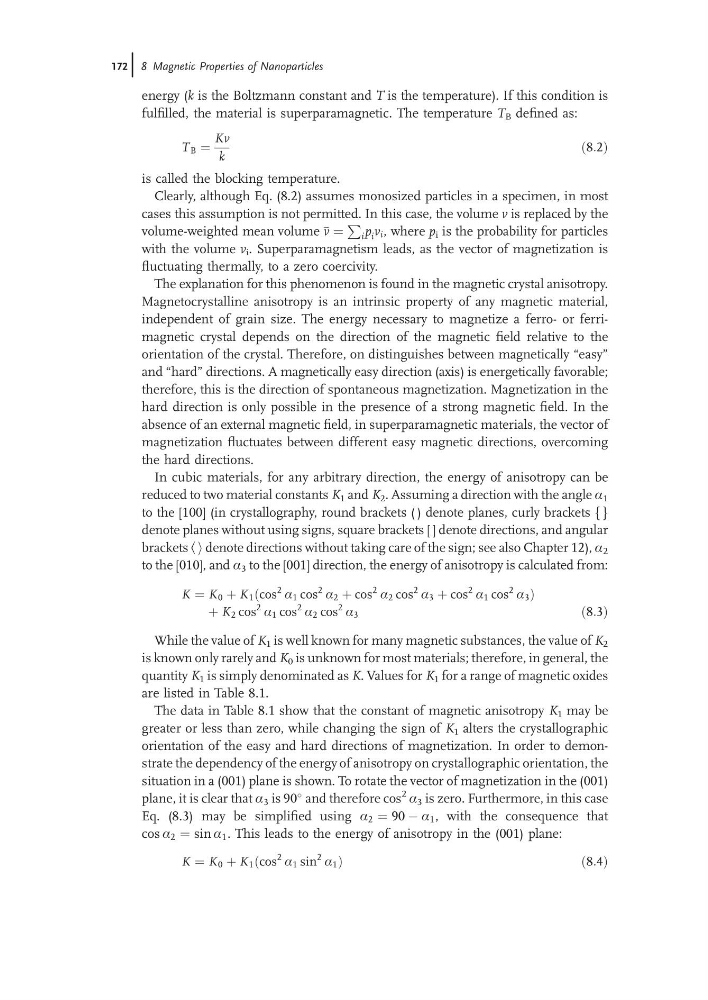
energy (k is the Boltzmann constant and T is the temperature). If this condition is
fulfilled, the material is superparamagnetic. The temperature T B defined as:
T B ¼
Kv
k
ð8:2Þ
is called the blocking temperature.
Clearly, although Eq. (8.2) assumes monosized particles in a specimen, in most
cases this assumption is not permitted. In this case, the volume v is replaced by the
volume-weighted mean volume v ¼
P
i p i v i , where p i is the probability for particles
with the volume v i . Superparamagnetism leads, as the vector of magnetization is
fluctuating thermally, to a zero coercivity.
The explanation for this phenomenon is found in the magnetic crystal anisotropy.
Magnetocrystalline anisotropy is an intrinsic property of any magnetic material,
independent of grain size. The energy necessary to magnetize a ferro- or ferrimagnetic crystal depends on the direction of the magnetic field relative to the
orientation of the crystal. Therefore, on distinguishes between magnetically “easy”
and “hard” directions. A magnetically easy direction (axis) is energetically favorable;
therefore, this is the direction of spontaneous magnetization. Magnetization in the
hard direction is only possible in the presence of a strong magnetic field. In the
absence of an external magnetic field, in superparamagnetic materials, the vector of
magnetization fluctuates between different easy magnetic directions, overcoming
the hard directions.
In cubic materials, for any arbitrary direction, the energy of anisotropy can be
reduced to two material constants K 1 and K 2 . Assuming a direction with the angle a 1
to the [100] (in crystallography, round brackets ( ) denote planes, curly brackets { }
denote planes without using signs, square brackets [ ] denote directions, and angular
brackets k i denote directions without taking care of the sign; see also Chapter 12), a 2
to the [010], and a 3 to the [001] direction, the energy of anisotropy is calculated from:
K ¼ K 0 þ K 1 ðcos
2 a 1 cos
2 a 2 þ cos
2 a 2 cos
2 a 3 þ cos
2 a 1 cos
2 a 3 Þ
þ K 2 cos
2 a 1 cos
2 a 2 cos
2 a 3
ð8:3Þ
While the value of K 1 is well known for many magnetic substances, the value of K 2
is known only rarely and K 0 is unknown for most materials; therefore, in general, the
quantity K 1 is simply denominated as K. Values for K 1 for a range of magnetic oxides
are listed in Table 8.1.
The data in Table 8.1 show that the constant of magnetic anisotropy K 1 may be
greater or less than zero, while changing the sign of K 1 alters the crystallographic
orientation of the easy and hard directions of magnetization. In order to demonstrate the dependency of the energy of anisotropy on crystallographic orientation, the
situation in a (001) plane is shown. To rotate the vector of magnetization in the (001)
plane, it is clear that a 3 is 90
and therefore cos
2 a 3 is zero. Furthermore, in this case
Eq. (8.3) may be simplified using a 2 ¼ 90 À a 1 , with the consequence that
cos a 2 ¼ sin a 1 . This leads to the energy of anisotropy in the (001) plane:
K ¼ K 0 þ K 1 ðcos
2 a 1 sin
2 a 1 Þ
ð 8:4Þ
172j 8 Magnetic Properties of Nanoparticles
fulfilled, the material is superparamagnetic. The temperature T B defined as:
T B ¼
Kv
k
ð8:2Þ
is called the blocking temperature.
Clearly, although Eq. (8.2) assumes monosized particles in a specimen, in most
cases this assumption is not permitted. In this case, the volume v is replaced by the
volume-weighted mean volume v ¼
P
i p i v i , where p i is the probability for particles
with the volume v i . Superparamagnetism leads, as the vector of magnetization is
fluctuating thermally, to a zero coercivity.
The explanation for this phenomenon is found in the magnetic crystal anisotropy.
Magnetocrystalline anisotropy is an intrinsic property of any magnetic material,
independent of grain size. The energy necessary to magnetize a ferro- or ferrimagnetic crystal depends on the direction of the magnetic field relative to the
orientation of the crystal. Therefore, on distinguishes between magnetically “easy”
and “hard” directions. A magnetically easy direction (axis) is energetically favorable;
therefore, this is the direction of spontaneous magnetization. Magnetization in the
hard direction is only possible in the presence of a strong magnetic field. In the
absence of an external magnetic field, in superparamagnetic materials, the vector of
magnetization fluctuates between different easy magnetic directions, overcoming
the hard directions.
In cubic materials, for any arbitrary direction, the energy of anisotropy can be
reduced to two material constants K 1 and K 2 . Assuming a direction with the angle a 1
to the [100] (in crystallography, round brackets ( ) denote planes, curly brackets { }
denote planes without using signs, square brackets [ ] denote directions, and angular
brackets k i denote directions without taking care of the sign; see also Chapter 12), a 2
to the [010], and a 3 to the [001] direction, the energy of anisotropy is calculated from:
K ¼ K 0 þ K 1 ðcos
2 a 1 cos
2 a 2 þ cos
2 a 2 cos
2 a 3 þ cos
2 a 1 cos
2 a 3 Þ
þ K 2 cos
2 a 1 cos
2 a 2 cos
2 a 3
ð8:3Þ
While the value of K 1 is well known for many magnetic substances, the value of K 2
is known only rarely and K 0 is unknown for most materials; therefore, in general, the
quantity K 1 is simply denominated as K. Values for K 1 for a range of magnetic oxides
are listed in Table 8.1.
The data in Table 8.1 show that the constant of magnetic anisotropy K 1 may be
greater or less than zero, while changing the sign of K 1 alters the crystallographic
orientation of the easy and hard directions of magnetization. In order to demonstrate the dependency of the energy of anisotropy on crystallographic orientation, the
situation in a (001) plane is shown. To rotate the vector of magnetization in the (001)
plane, it is clear that a 3 is 90
and therefore cos
2 a 3 is zero. Furthermore, in this case
Eq. (8.3) may be simplified using a 2 ¼ 90 À a 1 , with the consequence that
cos a 2 ¼ sin a 1 . This leads to the energy of anisotropy in the (001) plane:
K ¼ K 0 þ K 1 ðcos
2 a 1 sin
2 a 1 Þ
ð 8:4Þ
172j 8 Magnetic Properties of Nanoparticles