

7.2
Heat Capacity of Nanoparticles
The heat capacity C V per mole at constant volume is defined as
C V ¼ @U=@T
ð
Þ V ¼ T @S=@T
ð
Þ V . Although, heat capacity is one of the properties
where a significant influence of particle size is expected and, in theory, is well
understood, the experimental data obtained lead to different conclusions. The first
approach to the heat capacity is to assume a “linear crystal,” as this simplified model
shows all the necessary features. Such a “linear crystal” – just a chain of atoms – is
characterized by the number of atoms N and the distance of two points in the chain,
the lattice constant a, is shown in Figure 7.2.
The vibrations of such a chain have nodes at the ends. Additionally, as the
vibrations are quantized, vibration nodes are possible only at the position of an atom.
Two parameters give the size of the crystal as L ¼ Na. At temperatures above 0 K, the
atoms begin to vibrate; as they are connected within a crystal only a limited, welldefined, number of vibrations is possible. The finite number of lattice points defines
the limited number of lattice vibrations. Clearly, the longest half-wave that fits into
the lattice has length L and this leads to a wavelength of l max ¼ 2L ¼ 2Na. The
shortest wavelength possible in such a lattice is l min ¼ 2a. This is valid independently if one considers longitudinal or transversal vibrations, with the
1
10
100
particle diameter [nm]
10
2
10
3
10
4
10
5
enthalpy
[Jmol
-1 ]
surface
energy
[Jmol
-1 ]
surface energy liquid
surface energy solid
difference of the surface energies
enthalpy of melting
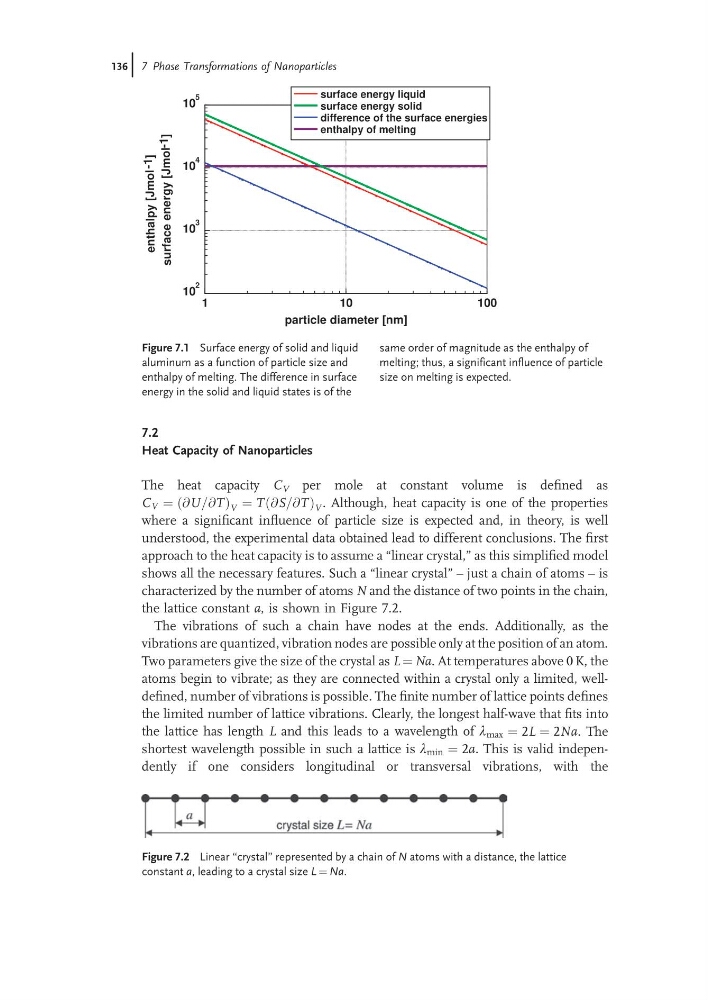
Figure 7.1 Surface energy of solid and liquid
aluminum as a function of particle size and
enthalpy of melting. The difference in surface
energy in the solid and liquid states is of the
same order of magnitude as the enthalpy of
melting; thus, a significant influence of particle
size on melting is expected.
Figure 7.2 Linear “crystal” represented by a chain of N atoms with a distance, the lattice
constant a, leading to a crystal size L ¼ Na.
136j 7 Phase Transformations of Nanoparticles
Heat Capacity of Nanoparticles
The heat capacity C V per mole at constant volume is defined as
C V ¼ @U=@T
ð
Þ V ¼ T @S=@T
ð
Þ V . Although, heat capacity is one of the properties
where a significant influence of particle size is expected and, in theory, is well
understood, the experimental data obtained lead to different conclusions. The first
approach to the heat capacity is to assume a “linear crystal,” as this simplified model
shows all the necessary features. Such a “linear crystal” – just a chain of atoms – is
characterized by the number of atoms N and the distance of two points in the chain,
the lattice constant a, is shown in Figure 7.2.
The vibrations of such a chain have nodes at the ends. Additionally, as the
vibrations are quantized, vibration nodes are possible only at the position of an atom.
Two parameters give the size of the crystal as L ¼ Na. At temperatures above 0 K, the
atoms begin to vibrate; as they are connected within a crystal only a limited, welldefined, number of vibrations is possible. The finite number of lattice points defines
the limited number of lattice vibrations. Clearly, the longest half-wave that fits into
the lattice has length L and this leads to a wavelength of l max ¼ 2L ¼ 2Na. The
shortest wavelength possible in such a lattice is l min ¼ 2a. This is valid independently if one considers longitudinal or transversal vibrations, with the
1
10
100
particle diameter [nm]
10
2
10
3
10
4
10
5
enthalpy
[Jmol
-1 ]
surface
energy
[Jmol
-1 ]
surface energy liquid
surface energy solid
difference of the surface energies
enthalpy of melting
Figure 7.1 Surface energy of solid and liquid
aluminum as a function of particle size and
enthalpy of melting. The difference in surface
energy in the solid and liquid states is of the
same order of magnitude as the enthalpy of
melting; thus, a significant influence of particle
size on melting is expected.
Figure 7.2 Linear “crystal” represented by a chain of N atoms with a distance, the lattice
constant a, leading to a crystal size L ¼ Na.
136j 7 Phase Transformations of Nanoparticles