

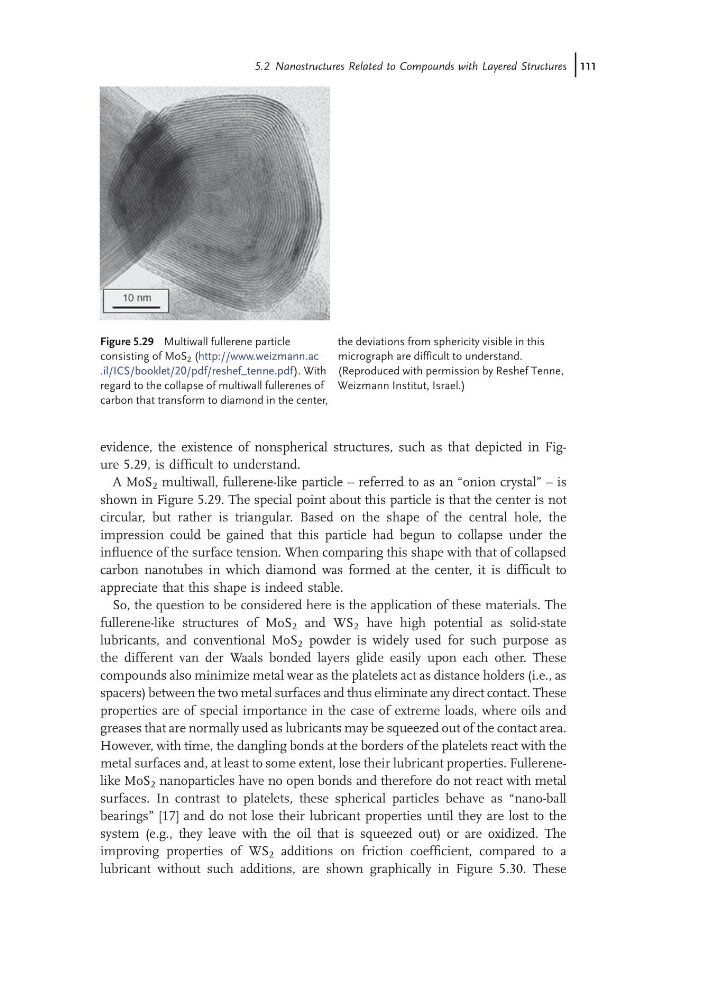
evidence, the existence of nonspherical structures, such as that depicted in Figure 5.29, is difficult to understand.
A MoS 2 multiwall, fullerene-like particle – referred to as an “onion crystal” – is
shown in Figure 5.29. The special point about this particle is that the center is not
circular, but rather is triangular. Based on the shape of the central hole, the
impression could be gained that this particle had begun to collapse under the
in fluence of the surface tension. When comparing this shape with that of collapsed
carbon nanotubes in which diamond was formed at the center, it is difficult to
appreciate that this shape is indeed stable.
So, the question to be considered here is the application of these materials. The
fullerene-like structures of MoS 2 and WS 2 have high potential as solid-state
lubricants, and conventional MoS 2 powder is widely used for such purpose as
the different van der Waals bonded layers glide easily upon each other. These
compounds also minimize metal wear as the platelets act as distance holders (i.e., as
spacers) between the two metal surfaces and thus eliminate any direct contact. These
properties are of special importance in the case of extreme loads, where oils and
greases that are normally used as lubricants may be squeezed out of the contact area.
However, with time, the dangling bonds at the borders of the platelets react with the
metal surfaces and, at least to some extent, lose their lubricant properties. Fullerenelike MoS 2 nanoparticles have no open bonds and therefore do not react with metal
surfaces. In contrast to platelets, these spherical particles behave as “nano-ball
bearings ” [17] and do not lose their lubricant properties until they are lost to the
system (e.g., they leave with the oil that is squeezed out) or are oxidized. The
improving properties of WS 2 additions on friction coefficient, compared to a
lubricant without such additions, are shown graphically in Figure 5.30. These
Figure 5.29 Multiwall fullerene particle
consisting of MoS 2 (http://www.weizmann.ac
.il/ICS/booklet/20/pdf/reshef_tenne.pdf ). With
regard to the collapse of multiwall fullerenes of
carbon that transform to diamond in the center,
the deviations from sphericity visible in this
micrograph are difficult to understand.
(Reproduced with permission by Reshef Tenne,
Weizmann Institut, Israel.)
5.2 Nanostructures Related to Compounds with Layered Structures j111
A MoS 2 multiwall, fullerene-like particle – referred to as an “onion crystal” – is
shown in Figure 5.29. The special point about this particle is that the center is not
circular, but rather is triangular. Based on the shape of the central hole, the
impression could be gained that this particle had begun to collapse under the
in fluence of the surface tension. When comparing this shape with that of collapsed
carbon nanotubes in which diamond was formed at the center, it is difficult to
appreciate that this shape is indeed stable.
So, the question to be considered here is the application of these materials. The
fullerene-like structures of MoS 2 and WS 2 have high potential as solid-state
lubricants, and conventional MoS 2 powder is widely used for such purpose as
the different van der Waals bonded layers glide easily upon each other. These
compounds also minimize metal wear as the platelets act as distance holders (i.e., as
spacers) between the two metal surfaces and thus eliminate any direct contact. These
properties are of special importance in the case of extreme loads, where oils and
greases that are normally used as lubricants may be squeezed out of the contact area.
However, with time, the dangling bonds at the borders of the platelets react with the
metal surfaces and, at least to some extent, lose their lubricant properties. Fullerenelike MoS 2 nanoparticles have no open bonds and therefore do not react with metal
surfaces. In contrast to platelets, these spherical particles behave as “nano-ball
bearings ” [17] and do not lose their lubricant properties until they are lost to the
system (e.g., they leave with the oil that is squeezed out) or are oxidized. The
improving properties of WS 2 additions on friction coefficient, compared to a
lubricant without such additions, are shown graphically in Figure 5.30. These
Figure 5.29 Multiwall fullerene particle
consisting of MoS 2 (http://www.weizmann.ac
.il/ICS/booklet/20/pdf/reshef_tenne.pdf ). With
regard to the collapse of multiwall fullerenes of
carbon that transform to diamond in the center,
the deviations from sphericity visible in this
micrograph are difficult to understand.
(Reproduced with permission by Reshef Tenne,
Weizmann Institut, Israel.)
5.2 Nanostructures Related to Compounds with Layered Structures j111