

analysis, the reason for the misjudgment to fall data is that the tester’s action is too
intense, making the action close to falling, thereby alarming. However, the false alarm
with a small proportion can be ignored because it will not cause harmful consequences.
For the case of falling but no alarm, we analyze: Some falls belong to “pseudo-fall”;
that is, all the required features have occurred, but the data has not reached the
threshold, and although it will not cause harmful consequences theoretically, the
accuracy of this aspect needs to be improved.
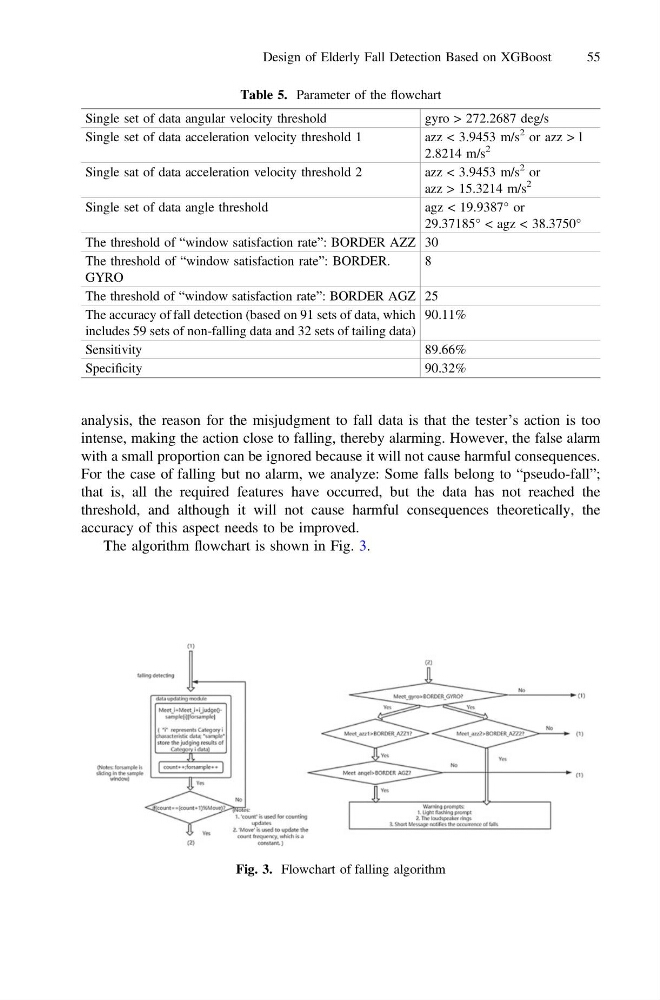
The algorithm flowchart is shown in Fig. 3.
Table 5. Parameter of the flowchart
Single set of data angular velocity threshold
gyro > 272.2687 deg/s
Single set of data acceleration velocity threshold 1
azz < 3.9453 m/s
2 or azz > l
2.8214 m/s
2
Single sat of data acceleration velocity threshold 2
azz < 3.9453 m/s
2 or
azz > 15.3214 m/s
2
Single set of data angle threshold
agz < 19.9387° or
29.37185° < agz < 38.3750°
The threshold of “window satisfaction rate”: BORDER AZZ 30
The threshold of “window satisfaction rate”: BORDER.
GYRO
8
The threshold of “window satisfaction rate”: BORDER AGZ 25
The accuracy of fall detection (based on 91 sets of data, which
includes 59 sets of non-falling data and 32 sets of tailing data)
90.11%
Sensitivity
89.66%
Specificity
90.32%
Fig. 3. Flowchart of falling algorithm
Design of Elderly Fall Detection Based on XGBoost
55
intense, making the action close to falling, thereby alarming. However, the false alarm
with a small proportion can be ignored because it will not cause harmful consequences.
For the case of falling but no alarm, we analyze: Some falls belong to “pseudo-fall”;
that is, all the required features have occurred, but the data has not reached the
threshold, and although it will not cause harmful consequences theoretically, the
accuracy of this aspect needs to be improved.
The algorithm flowchart is shown in Fig. 3.
Table 5. Parameter of the flowchart
Single set of data angular velocity threshold
gyro > 272.2687 deg/s
Single set of data acceleration velocity threshold 1
azz < 3.9453 m/s
2 or azz > l
2.8214 m/s
2
Single sat of data acceleration velocity threshold 2
azz < 3.9453 m/s
2 or
azz > 15.3214 m/s
2
Single set of data angle threshold
agz < 19.9387° or
29.37185° < agz < 38.3750°
The threshold of “window satisfaction rate”: BORDER AZZ 30
The threshold of “window satisfaction rate”: BORDER.
GYRO
8
The threshold of “window satisfaction rate”: BORDER AGZ 25
The accuracy of fall detection (based on 91 sets of data, which
includes 59 sets of non-falling data and 32 sets of tailing data)
90.11%
Sensitivity
89.66%
Specificity
90.32%
Fig. 3. Flowchart of falling algorithm
Design of Elderly Fall Detection Based on XGBoost
55