

neighbor query. Neighbor queries play a pivotal role in location-based services.
A neighbor query is a data object that returns the closest distance from the query point
q in a given data set D. For example, a taxi on a traffic road looks for a gas station
closest to your own k. The nearest neighbor query has been developed to date,
including nearest neighbor (NN) [4, 5], reverse nearest neighbor (RNN) [6], continuous
nearest neighbor (CNN) [7] and aggregate nearest neighbor (ANN) [8].
The environmental characteristics and object characteristics of the mobile network
object query determine the two main issues in the query process: (1) road network
environment representation; (2) mobile object processing. Road network environment,
the existing research, mainly adopts data structure in figure [9] to simulate the actual
road network G = (V, E), where V is the point set in the figure to represent the
connection between the road segments, and E is the edge set in the figure to represent
the road segment. In the section, store some additional information (segment cost,
waiting time, etc. [10]).
3 Existing Solutions and Existing Problems
At present, many universities and research institutes have conducted in-depth research
on NN queries in the road network environment, the research on NN query technology
in the road network environment has obtained many valuable research results, literature
in [11], and the nearest neighbor query technology in the road network environment is
analyzed and compared. There are some typical nearest neighbor query methods: INE
[12], incremental Euclidean restriction (IER) [12], algorithms for processing, as well as
Voronoi-based network nearest Neighbor (VN
3 ) [13] were proposed by Kolahdouzan
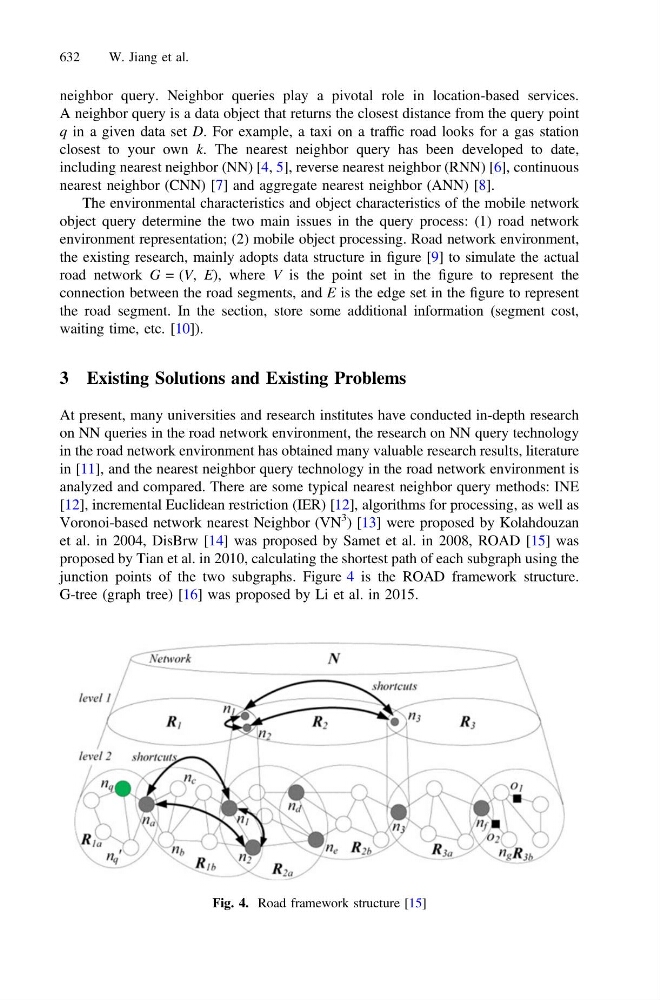
et al. in 2004, DisBrw [14] was proposed by Samet et al. in 2008, ROAD [15] was
proposed by Tian et al. in 2010, calculating the shortest path of each subgraph using the
junction points of the two subgraphs. Figure 4 is the ROAD framework structure.
G-tree (graph tree) [16] was proposed by Li et al. in 2015.
Fig. 4. Road framework structure [15]
632
W. Jiang et al.