

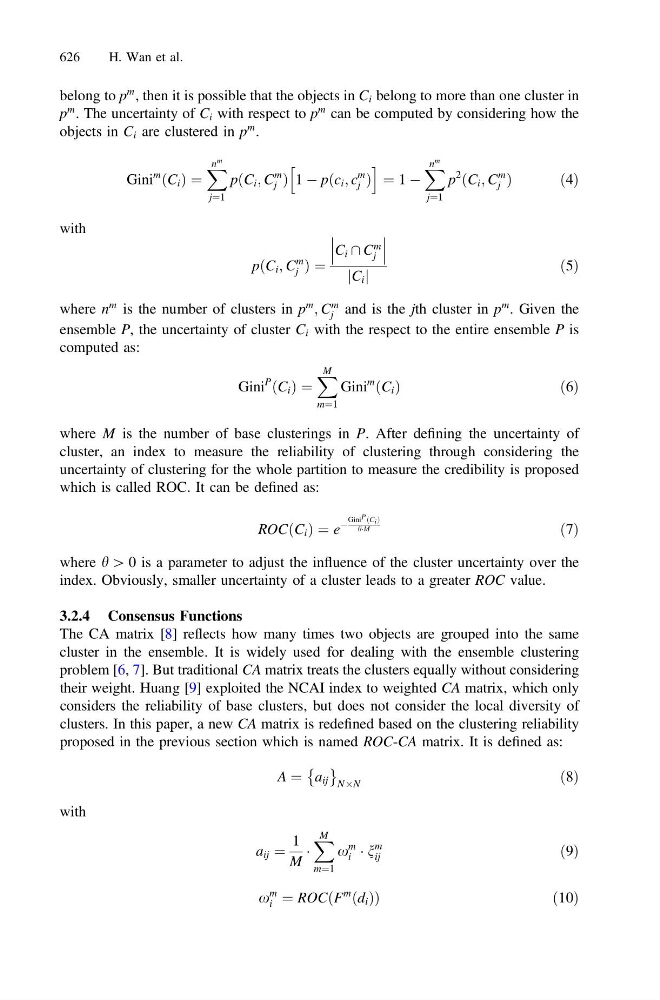
belong to p
m , then it is possible that the objects in C i belong to more than one cluster in
p
m . The uncertainty of C i with respect to p
m can be computed by considering how the
objects in C i are clustered in p
m .
Gini
m
ðC i Þ ¼
X n
m
j¼1
pðC i ; C
m
j Þ 1 À pðc i ; c
m
j Þ
h
i
¼ 1 À
X n
m
j¼1
p
2
ðC i ; C
m
j Þ
ð 4Þ
with
pðC i ; C
m
j Þ ¼
C i \ C
m
j
C i
j j
ð5Þ
where n
m is the number of clusters in p
m
; C
m
j and is the jth cluster in p
m . Given the
ensemble P, the uncertainty of cluster C i with the respect to the entire ensemble P is
computed as:
Gini
P
ðC i Þ ¼
X M
m¼1
Gini
m
ðC i Þ
ð 6Þ
where M is the number of base clusterings in P. After defining the uncertainty of
cluster, an index to measure the reliability of clustering through considering the
uncertainty of clustering for the whole partition to measure the credibility is proposed
which is called ROC. It can be defined as:
ROCðC i Þ ¼ e
À
Gini P ðC i Þ
hÁM
ð7Þ
where h [ 0 is a parameter to adjust the influence of the cluster uncertainty over the
index. Obviously, smaller uncertainty of a cluster leads to a greater ROC value.
3.2.4 Consensus Functions
The CA matrix [8] reflects how many times two objects are grouped into the same
cluster in the ensemble. It is widely used for dealing with the ensemble clustering
problem [6, 7]. But traditional CA matrix treats the clusters equally without considering
their weight. Huang [9] exploited the NCAI index to weighted CA matrix, which only
considers the reliability of base clusters, but does not consider the local diversity of
clusters. In this paper, a new CA matrix is redefined based on the clustering reliability
proposed in the previous section which is named ROC-CA matrix. It is defined as:
A ¼ a ij
È É
NÂN
ð8Þ
with
a ij ¼
1
M
Á
X M
m¼1
x
m
i Á n
m
ij
ð9Þ
x
m
i ¼ ROCðF
m
ðd i ÞÞ
ð10Þ
626
H. Wan et al.