

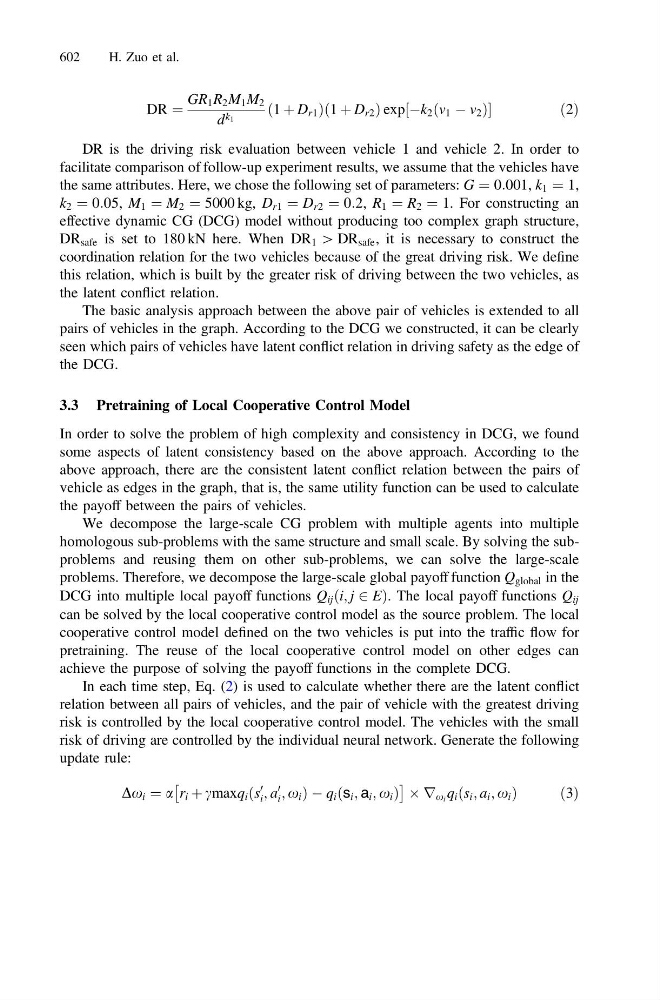
DR ¼
GR 1 R 2 M 1 M 2
d k 1
ð1 þ D r1 Þð1 þ D r2 Þ exp½Àk 2 ðv 1 À v 2 Þ
ð2Þ
DR is the driving risk evaluation between vehicle 1 and vehicle 2. In order to
facilitate comparison of follow-up experiment results, we assume that the vehicles have
the same attributes. Here, we chose the following set of parameters: G ¼ 0:001, k 1 ¼ 1,
k 2 ¼ 0:05, M 1 ¼ M 2 ¼ 5000 kg, D r1 ¼ D r2 ¼ 0:2, R 1 ¼ R 2 ¼ 1. For constructing an
effective dynamic CG (DCG) model without producing too complex graph structure,
DR safe is set to 180 kN here. When DR 1 [ DR safe , it is necessary to construct the
coordination relation for the two vehicles because of the great driving risk. We define
this relation, which is built by the greater risk of driving between the two vehicles, as
the latent conflict relation.
The basic analysis approach between the above pair of vehicles is extended to all
pairs of vehicles in the graph. According to the DCG we constructed, it can be clearly
seen which pairs of vehicles have latent conflict relation in driving safety as the edge of
the DCG.
3.3 Pretraining of Local Cooperative Control Model
In order to solve the problem of high complexity and consistency in DCG, we found
some aspects of latent consistency based on the above approach. According to the
above approach, there are the consistent latent conflict relation between the pairs of
vehicle as edges in the graph, that is, the same utility function can be used to calculate
the payoff between the pairs of vehicles.
We decompose the large-scale CG problem with multiple agents into multiple
homologous sub-problems with the same structure and small scale. By solving the subproblems and reusing them on other sub-problems, we can solve the large-scale
problems. Therefore, we decompose the large-scale global payoff function Q global in the
DCG into multiple local payoff functions Q ij i; j 2 E
ð
Þ. The local payoff functions Q ij
can be solved by the local cooperative control model as the source problem. The local
cooperative control model defined on the two vehicles is put into the traffic flow for
pretraining. The reuse of the local cooperative control model on other edges can
achieve the purpose of solving the payoff functions in the complete DCG.
In each time step, Eq. (2) is used to calculate whether there are the latent conflict
relation between all pairs of vehicles, and the pair of vehicle with the greatest driving
risk is controlled by the local cooperative control model. The vehicles with the small
risk of driving are controlled by the individual neural network. Generate the following
update rule:
Dx i ¼ a r i þ cmaxq i ðs
0
i ; a
0
i ; x i Þ À q i ðs i ; a i ; x i Þ
Â
à  r x i q i ðs i ; a i ; x i Þ
ð3Þ
602
H. Zuo et al.