

is the purpose of detecting the fall. The data we collected using gyroscopes and
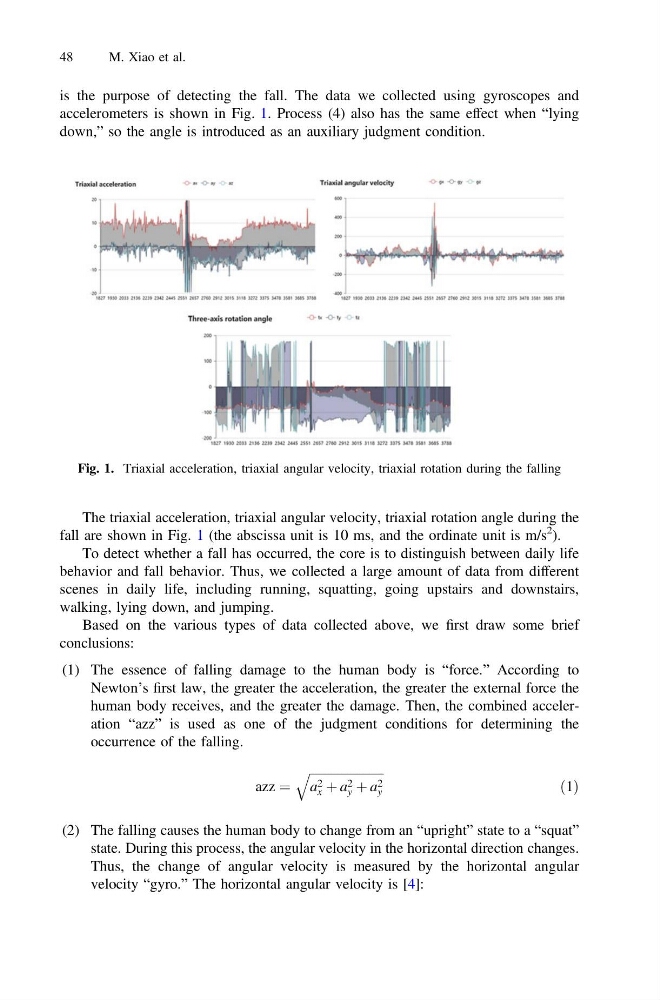
accelerometers is shown in Fig. 1. Process (4) also has the same effect when “lying
down,” so the angle is introduced as an auxiliary judgment condition.
The triaxial acceleration, triaxial angular velocity, triaxial rotation angle during the
fall are shown in Fig. 1 (the abscissa unit is 10 ms, and the ordinate unit is m/s
2 ).
To detect whether a fall has occurred, the core is to distinguish between daily life
behavior and fall behavior. Thus, we collected a large amount of data from different
scenes in daily life, including running, squatting, going upstairs and downstairs,
walking, lying down, and jumping.
Based on the various types of data collected above, we first draw some brief
conclusions:
(1) The essence of falling damage to the human body is “force.” According to
Newton’s first law, the greater the acceleration, the greater the external force the
human body receives, and the greater the damage. Then, the combined acceleration “azz” is used as one of the judgment conditions for determining the
occurrence of the falling.
azz ¼
ffiffiffiffiffiffiffiffiffiffiffiffiffiffiffiffiffiffiffiffiffiffiffiffi
a 2
x þ a 2
y þ a 2
y
q
ð1Þ
(2) The falling causes the human body to change from an “upright” state to a “squat”
state. During this process, the angular velocity in the horizontal direction changes.
Thus, the change of angular velocity is measured by the horizontal angular
velocity “gyro.” The horizontal angular velocity is [4]:
Fig. 1. Triaxial acceleration, triaxial angular velocity, triaxial rotation during the falling
48
M. Xiao et al.
accelerometers is shown in Fig. 1. Process (4) also has the same effect when “lying
down,” so the angle is introduced as an auxiliary judgment condition.
The triaxial acceleration, triaxial angular velocity, triaxial rotation angle during the
fall are shown in Fig. 1 (the abscissa unit is 10 ms, and the ordinate unit is m/s
2 ).
To detect whether a fall has occurred, the core is to distinguish between daily life
behavior and fall behavior. Thus, we collected a large amount of data from different
scenes in daily life, including running, squatting, going upstairs and downstairs,
walking, lying down, and jumping.
Based on the various types of data collected above, we first draw some brief
conclusions:
(1) The essence of falling damage to the human body is “force.” According to
Newton’s first law, the greater the acceleration, the greater the external force the
human body receives, and the greater the damage. Then, the combined acceleration “azz” is used as one of the judgment conditions for determining the
occurrence of the falling.
azz ¼
ffiffiffiffiffiffiffiffiffiffiffiffiffiffiffiffiffiffiffiffiffiffiffiffi
a 2
x þ a 2
y þ a 2
y
q
ð1Þ
(2) The falling causes the human body to change from an “upright” state to a “squat”
state. During this process, the angular velocity in the horizontal direction changes.
Thus, the change of angular velocity is measured by the horizontal angular
velocity “gyro.” The horizontal angular velocity is [4]:
Fig. 1. Triaxial acceleration, triaxial angular velocity, triaxial rotation during the falling
48
M. Xiao et al.