

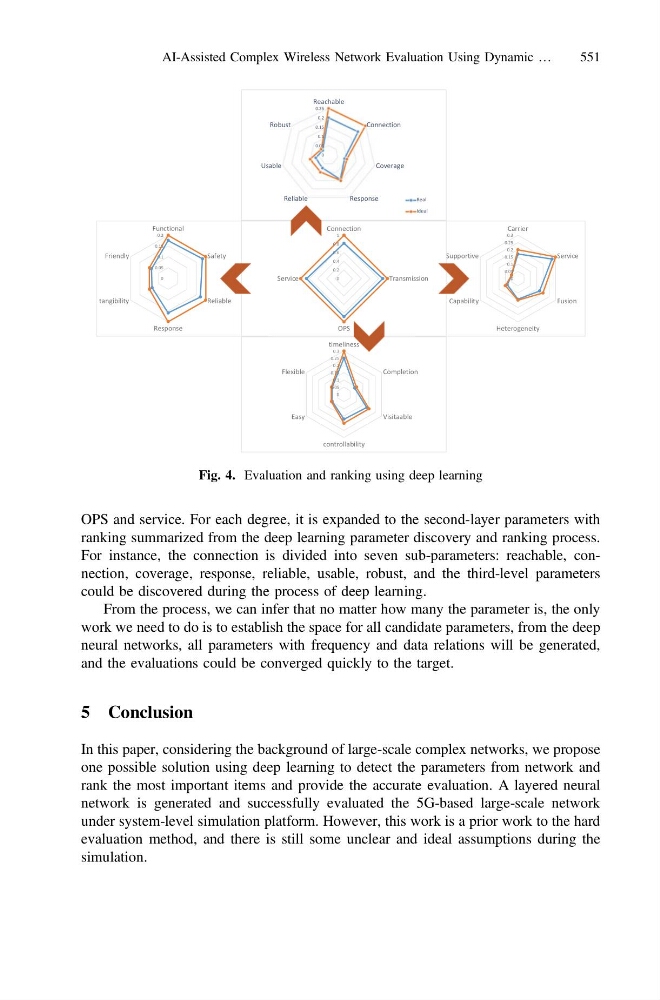
OPS and service. For each degree, it is expanded to the second-layer parameters with
ranking summarized from the deep learning parameter discovery and ranking process.
For instance, the connection is divided into seven sub-parameters: reachable, connection, coverage, response, reliable, usable, robust, and the third-level parameters
could be discovered during the process of deep learning.
From the process, we can infer that no matter how many the parameter is, the only
work we need to do is to establish the space for all candidate parameters, from the deep
neural networks, all parameters with frequency and data relations will be generated,
and the evaluations could be converged quickly to the target.
5 Conclusion
In this paper, considering the background of large-scale complex networks, we propose
one possible solution using deep learning to detect the parameters from network and
rank the most important items and provide the accurate evaluation. A layered neural
network is generated and successfully evaluated the 5G-based large-scale network
under system-level simulation platform. However, this work is a prior work to the hard
evaluation method, and there is still some unclear and ideal assumptions during the
simulation.
0
0.05
0.1
0.15
0.2
0.25
0.3
Carrier
Service
Fusion
Heterogeneity
Capability
Supportive
0
0.05
0.1
0.15
0.2
0.25
Reachable
Connection
Coverage
Response
Reliable
Usable
Robust
Real
Ideal
0
0.05
0.1
0.15
0.2
0.25
0.3
timeliness
Completion
Visitaable
controllability
Easy
Flexible
0
0.05
0.1
0.15
0.2
Functional
Safety
Reliable
Response
tangibility
Friendly
0
0.2
0.4
0.6
0.8
1
Connection
Transmission
OPS
Service
Fig. 4. Evaluation and ranking using deep learning
AI-Assisted Complex Wireless Network Evaluation Using Dynamic …
551