

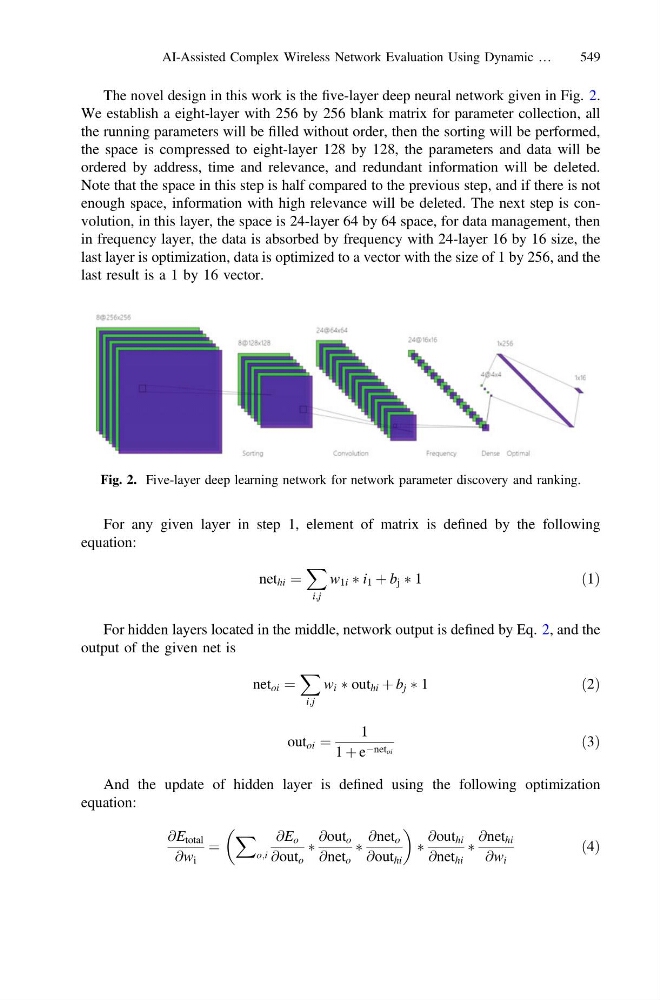
The novel design in this work is the five-layer deep neural network given in Fig. 2.
We establish a eight-layer with 256 by 256 blank matrix for parameter collection, all
the running parameters will be filled without order, then the sorting will be performed,
the space is compressed to eight-layer 128 by 128, the parameters and data will be
ordered by address, time and relevance, and redundant information will be deleted.
Note that the space in this step is half compared to the previous step, and if there is not
enough space, information with high relevance will be deleted. The next step is convolution, in this layer, the space is 24-layer 64 by 64 space, for data management, then
in frequency layer, the data is absorbed by frequency with 24-layer 16 by 16 size, the
last layer is optimization, data is optimized to a vector with the size of 1 by 256, and the
last result is a 1 by 16 vector.
For any given layer in step 1, element of matrix is defined by the following
equation:
net hi ¼
X
i;j
w 1i à i 1 þ b j à 1
ð1Þ
For hidden layers located in the middle, network output is defined by Eq. 2, and the
output of the given net is
net oi ¼
X
i;j
w i à out hi þ b j à 1
ð2Þ
out oi ¼
1
1 þ e Ànet oi
ð3Þ
And the update of hidden layer is defined using the following optimization
equation:
@E total
@w i
¼
X
o;i
@E o
@out o
Ã
@out o
@net o
Ã
@net o
@out hi
Ã
@out hi
@net hi
Ã
@net hi
@w i
ð4Þ
Fig. 2. Five-layer deep learning network for network parameter discovery and ranking.
AI-Assisted Complex Wireless Network Evaluation Using Dynamic …
549