

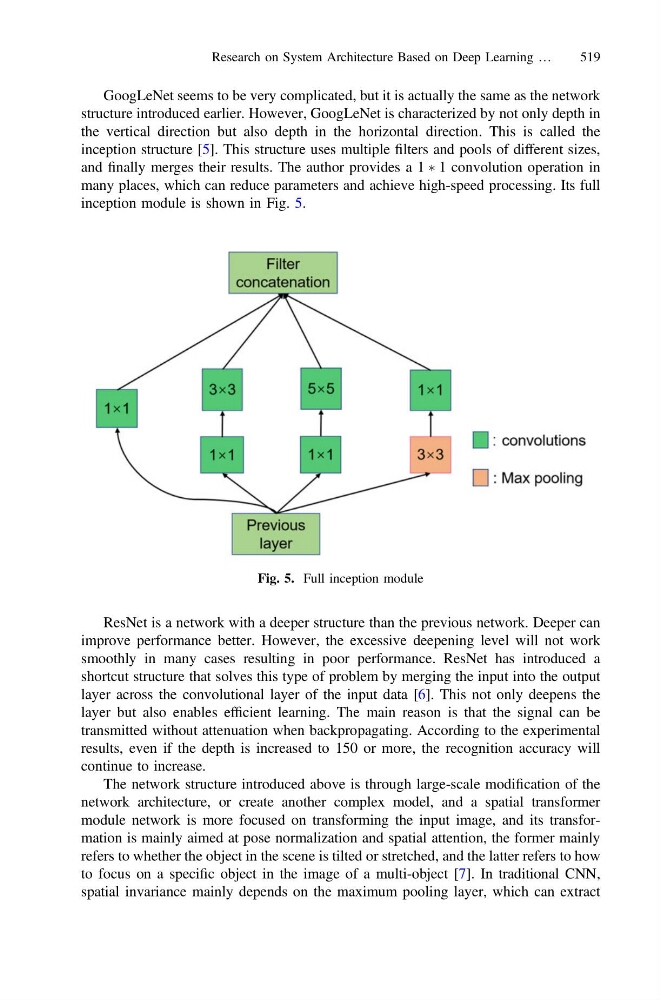
GoogLeNet seems to be very complicated, but it is actually the same as the network
structure introduced earlier. However, GoogLeNet is characterized by not only depth in
the vertical direction but also depth in the horizontal direction. This is called the
inception structure [5]. This structure uses multiple filters and pools of different sizes,
and finally merges their results. The author provides a 1 Ã 1 convolution operation in
many places, which can reduce parameters and achieve high-speed processing. Its full
inception module is shown in Fig. 5.
ResNet is a network with a deeper structure than the previous network. Deeper can
improve performance better. However, the excessive deepening level will not work
smoothly in many cases resulting in poor performance. ResNet has introduced a
shortcut structure that solves this type of problem by merging the input into the output
layer across the convolutional layer of the input data [6]. This not only deepens the
layer but also enables efficient learning. The main reason is that the signal can be
transmitted without attenuation when backpropagating. According to the experimental
results, even if the depth is increased to 150 or more, the recognition accuracy will
continue to increase.
The network structure introduced above is through large-scale modification of the
network architecture, or create another complex model, and a spatial transformer
module network is more focused on transforming the input image, and its transformation is mainly aimed at pose normalization and spatial attention, the former mainly
refers to whether the object in the scene is tilted or stretched, and the latter refers to how
to focus on a specific object in the image of a multi-object [7]. In traditional CNN,
spatial invariance mainly depends on the maximum pooling layer, which can extract
Fig. 5. Full inception module
Research on System Architecture Based on Deep Learning …
519