

where HistðiÞ is the derivative of the cumulative distribution function of the sliding
window local histogram, and H max is the maximum height of the histogram. We cut off
the histogram from the threshold T and then evenly distribute the truncated portion over
the entire grayscale range to ensure that the total histogram area is constant, so that the
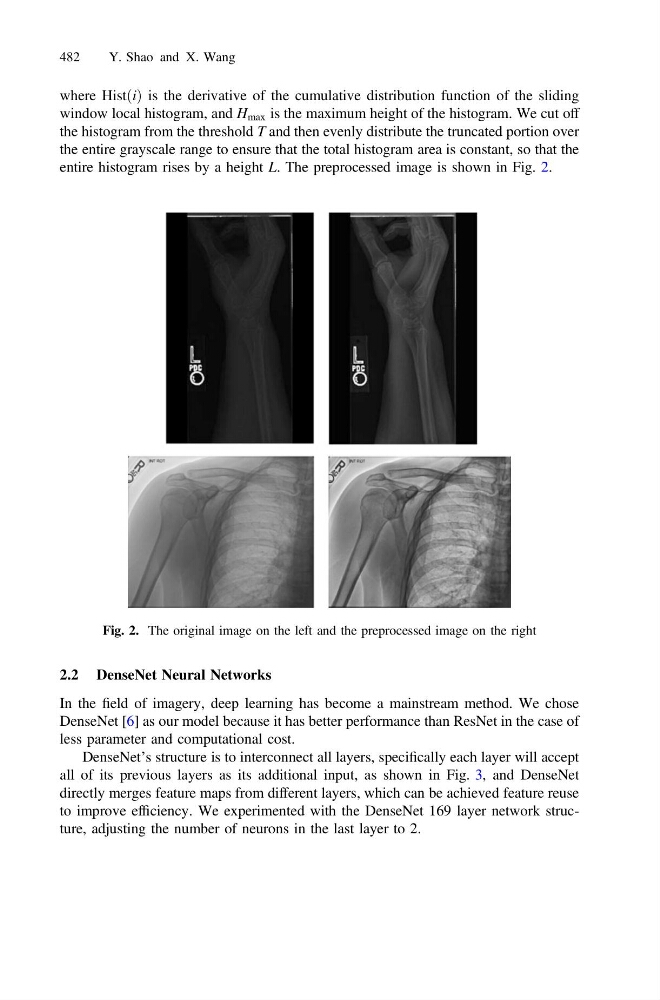
entire histogram rises by a height L. The preprocessed image is shown in Fig. 2.
2.2 DenseNet Neural Networks
In the field of imagery, deep learning has become a mainstream method. We chose
DenseNet [6] as our model because it has better performance than ResNet in the case of
less parameter and computational cost.
DenseNet’s structure is to interconnect all layers, specifically each layer will accept
all of its previous layers as its additional input, as shown in Fig. 3, and DenseNet
directly merges feature maps from different layers, which can be achieved feature reuse
to improve efficiency. We experimented with the DenseNet 169 layer network structure, adjusting the number of neurons in the last layer to 2.
Fig. 2. The original image on the left and the preprocessed image on the right
482
Y. Shao and X. Wang