

sparse rate, the time requirements of the MPPR and Dijkstra algorithms are not much
different. However, when the sparse rate is high, the MPPR algorithm is better, and the
search time required is significantly less than the time required by the Dijkstra.
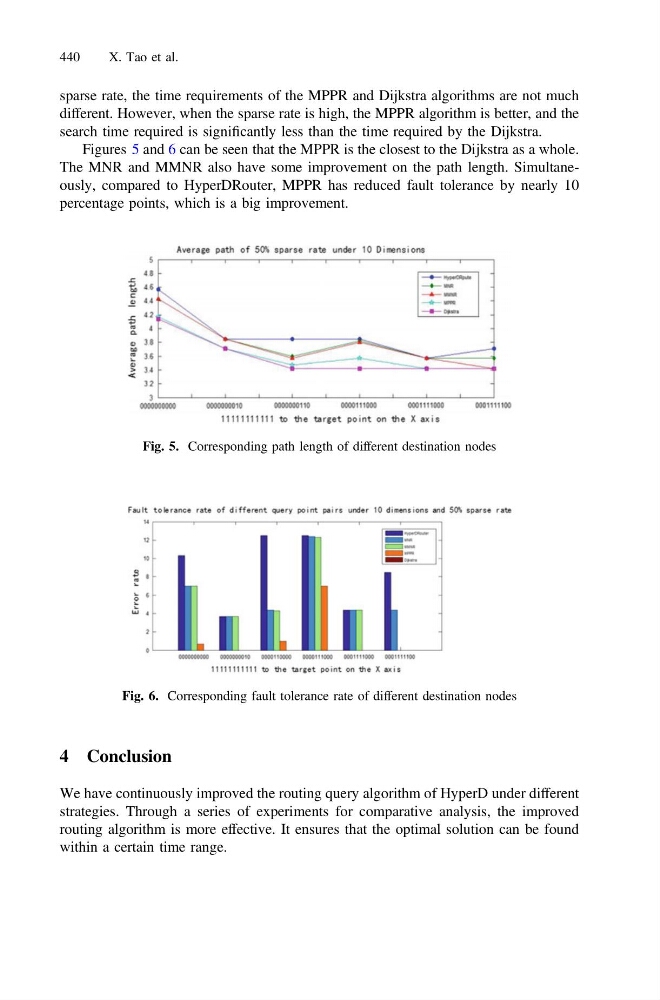
Figures 5 and 6 can be seen that the MPPR is the closest to the Dijkstra as a whole.
The MNR and MMNR also have some improvement on the path length. Simultaneously, compared to HyperDRouter, MPPR has reduced fault tolerance by nearly 10
percentage points, which is a big improvement.
4 Conclusion
We have continuously improved the routing query algorithm of HyperD under different
strategies. Through a series of experiments for comparative analysis, the improved
routing algorithm is more effective. It ensures that the optimal solution can be found
within a certain time range.
Fig. 5. Corresponding path length of different destination nodes
Fig. 6. Corresponding fault tolerance rate of different destination nodes
440
X. Tao et al.