

time series, data can solve the characteristics of long-distance context-dependent feature learning and store information of different time periods and construct deep learning
model for rumor detection.
3.2 CNN with Attention Mechanism Combined with LSTM
In recent years, neural networks based on the attention mechanism [6] have made
important progress in the tasks of natural language processing. We integrate the
attention mechanism into the convolutional neural network, mainly by multiplying the
output features of the CNN module and the salient features output by the corresponding
attention mechanism module. The feasibility and effectiveness of the fusion method
have been verified in the literature written by Wang et al. [7].
e ji ¼ aðquery i ; key j Þ
ð 1Þ
Compared with the traditional rumor detection method, the combined model
learning method based on user-content relationship proposed by us, Which comprehensively considers the relationship between users and content, extracts the relevant
features between them, and achieves better rumor identification effect through model
training. Inspired by the CNN-based neural multitask model, we use the CNN model
with attention mechanism to extract significant fine-grained features and extract coarsegrain features based on text and emotion features. At the same time, each dimension is
refined and processed, and the output is carried out through the last hidden layer in
LSTM network, which can prevent the memory loss and gradient exploding problems
caused by excessive step length. Finally, Softmax classifier is used for feature
classification.
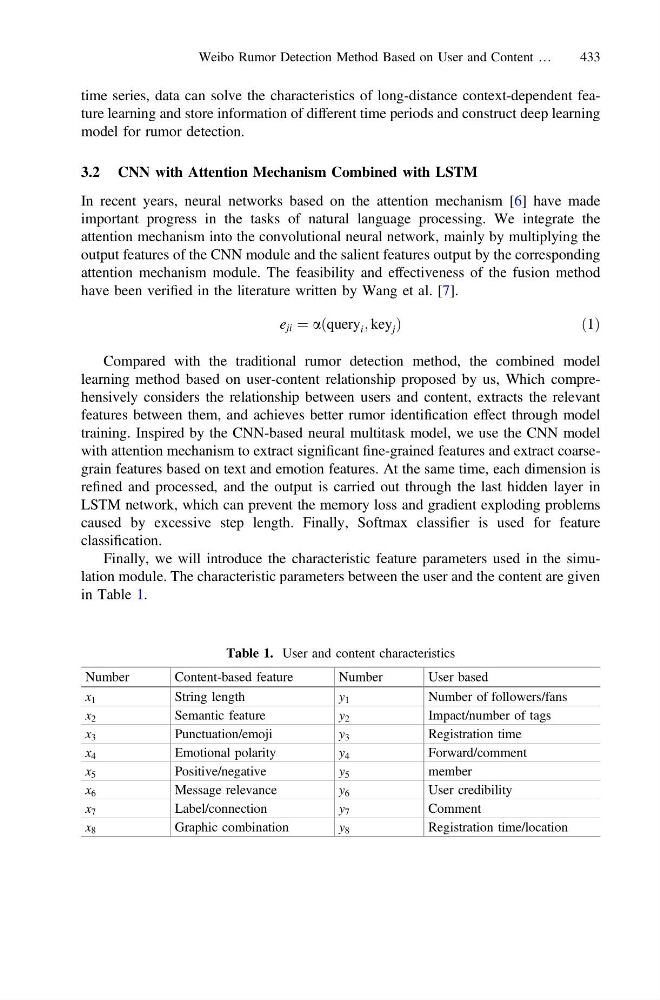
Finally, we will introduce the characteristic feature parameters used in the simulation module. The characteristic parameters between the user and the content are given
in Table 1.
Table 1. User and content characteristics
Number
Content-based feature
Number
User based
x 1
String length
y 1
Number of followers/fans
x 2
Semantic feature
y 2
Impact/number of tags
x 3
Punctuation/emoji
y 3
Registration time
x 4
Emotional polarity
y 4
Forward/comment
x 5
Positive/negative
y 5
member
x 6
Message relevance
y 6
User credibility
x 7
Label/connection
y 7
Comment
x 8
Graphic combination
y 8
Registration time/location
Weibo Rumor Detection Method Based on User and Content …
433