

5.1 A Comparison by Feature Extraction Method of Different Low Level
In this paper, the method of visual word generation is CSIFT feature, and the SIFT
feature is mainly aimed at gray images. So convert the color image into grayscale
image first when extracting the feature. When the feature is extracted, the sampling
interval of dense grid is 8 * 8, and the number of visual words is 600, and the number
of latent semantic topics is 20. The experiment results obtained from description
methods of different low-level feature is shown in Table 1. Using CSIFT features as a
low-level feature is better than the conventional SIFT feature based on gray level. Only
for the “depot oil-fuel” scene, the performance of SIFT feature based on gray level is a
little better. This is mainly because the target of the main position in this kind of scene
is some cylindrical oil storage tank, Its shape feature is the most effective distinguishing
feature. And the tone difference of oil depot in different regions is large, therefore, for
this type of scene, the advantages of CSIFT are not obvious. As far as average
recognition rate of 10 targets, CSIFI is 90.2%, SIFT is 79.67%.
5.2 The Improvement of Recognition Result by PLSA
The algorithm in this paper is realized by introducing the KNN model which is trained
by PLSA model and based on the BOF expression of the remote sensing image, mark
PLSA+BOF-KNN. In fact, the BOF expression of remote sensing image is obtained. We
can also train the KNN classifier for scene recognition directly, denoted as BOF-KNN.
Still set sampling interval of dense grid is 8 * 8, and the number of visual words is 600.
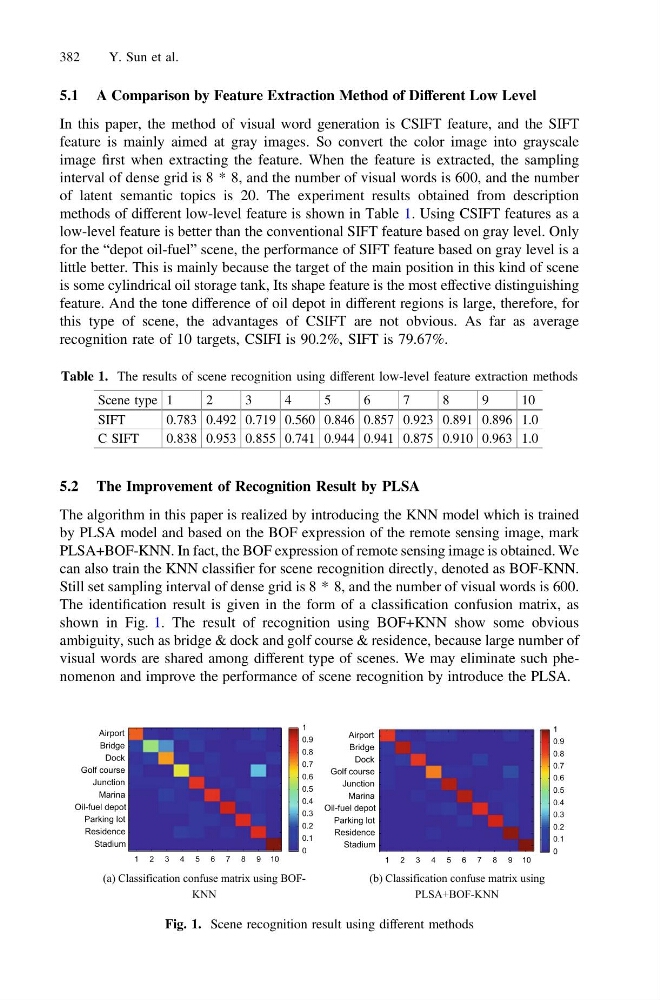
The identification result is given in the form of a classification confusion matrix, as
shown in Fig. 1. The result of recognition using BOF+KNN show some obvious
ambiguity, such as bridge & dock and golf course & residence, because large number of
visual words are shared among different type of scenes. We may eliminate such phenomenon and improve the performance of scene recognition by introduce the PLSA.
Table 1. The results of scene recognition using different low-level feature extraction methods
Scene type 1
2
3
4
5
6
7
8
9
10
SIFT
0.783 0.492 0.719 0.560 0.846 0.857 0.923 0.891 0.896 1.0
C SIFT
0.838 0.953 0.855 0.741 0.944 0.941 0.875 0.910 0.963 1.0
1 2 3 4 5 6 7 8 9 10
Airport
Bridge
Dock
Golf course
Junction
Marina
Oil-fuel depot
Parking lot
Residence
Stadium
0
0.1
0.2
0.3
0.4
0.5
0.6
0.7
0.8
0.9
1
1 2 3 4 5 6 7 8 9 10
Airport
Bridge
Dock
Golf course
Junction
Marina
Oil-fuel depot
Parking lot
Residence
Stadium
0
0.1
0.2
0.3
0.4
0.5
0.6
0.7
0.8
0.9
1
(a) Classification confuse matrix using BOFKNN
(b) Classification confuse matrix using
PLSA+BOF-KNN
Fig. 1. Scene recognition result using different methods
382
Y. Sun et al.
In this paper, the method of visual word generation is CSIFT feature, and the SIFT
feature is mainly aimed at gray images. So convert the color image into grayscale
image first when extracting the feature. When the feature is extracted, the sampling
interval of dense grid is 8 * 8, and the number of visual words is 600, and the number
of latent semantic topics is 20. The experiment results obtained from description
methods of different low-level feature is shown in Table 1. Using CSIFT features as a
low-level feature is better than the conventional SIFT feature based on gray level. Only
for the “depot oil-fuel” scene, the performance of SIFT feature based on gray level is a
little better. This is mainly because the target of the main position in this kind of scene
is some cylindrical oil storage tank, Its shape feature is the most effective distinguishing
feature. And the tone difference of oil depot in different regions is large, therefore, for
this type of scene, the advantages of CSIFT are not obvious. As far as average
recognition rate of 10 targets, CSIFI is 90.2%, SIFT is 79.67%.
5.2 The Improvement of Recognition Result by PLSA
The algorithm in this paper is realized by introducing the KNN model which is trained
by PLSA model and based on the BOF expression of the remote sensing image, mark
PLSA+BOF-KNN. In fact, the BOF expression of remote sensing image is obtained. We
can also train the KNN classifier for scene recognition directly, denoted as BOF-KNN.
Still set sampling interval of dense grid is 8 * 8, and the number of visual words is 600.
The identification result is given in the form of a classification confusion matrix, as
shown in Fig. 1. The result of recognition using BOF+KNN show some obvious
ambiguity, such as bridge & dock and golf course & residence, because large number of
visual words are shared among different type of scenes. We may eliminate such phenomenon and improve the performance of scene recognition by introduce the PLSA.
Table 1. The results of scene recognition using different low-level feature extraction methods
Scene type 1
2
3
4
5
6
7
8
9
10
SIFT
0.783 0.492 0.719 0.560 0.846 0.857 0.923 0.891 0.896 1.0
C SIFT
0.838 0.953 0.855 0.741 0.944 0.941 0.875 0.910 0.963 1.0
1 2 3 4 5 6 7 8 9 10
Airport
Bridge
Dock
Golf course
Junction
Marina
Oil-fuel depot
Parking lot
Residence
Stadium
0
0.1
0.2
0.3
0.4
0.5
0.6
0.7
0.8
0.9
1
1 2 3 4 5 6 7 8 9 10
Airport
Bridge
Dock
Golf course
Junction
Marina
Oil-fuel depot
Parking lot
Residence
Stadium
0
0.1
0.2
0.3
0.4
0.5
0.6
0.7
0.8
0.9
1
(a) Classification confuse matrix using BOFKNN
(b) Classification confuse matrix using
PLSA+BOF-KNN
Fig. 1. Scene recognition result using different methods
382
Y. Sun et al.