

difficult to achieve global consensus, often reach local consistency. Collaborative
decision-making should achieve by local consistency.
Incentive layer. This layer is mainly used for value rewards, which gives the
blockchain-based Swarm robots Economic attribute, make the swarm robots network a value network.
Contract layer. The application of smart contracts is still in its infancy, and it is
also the hardest-hit area for blockchain security. Swarm robots mainly use
blockchain-based smart contracts to realize data transmission and complete task
coordination. Different smart contracts can accomplish different missions. A node
can deploy multiple smart contracts depending on the task.
Application layer. Distributed Application (DApps) is used to customize different
types of activities. The DApps provide different services to users by calling smart
contracts and adapting various application scenarios of the blockchain.
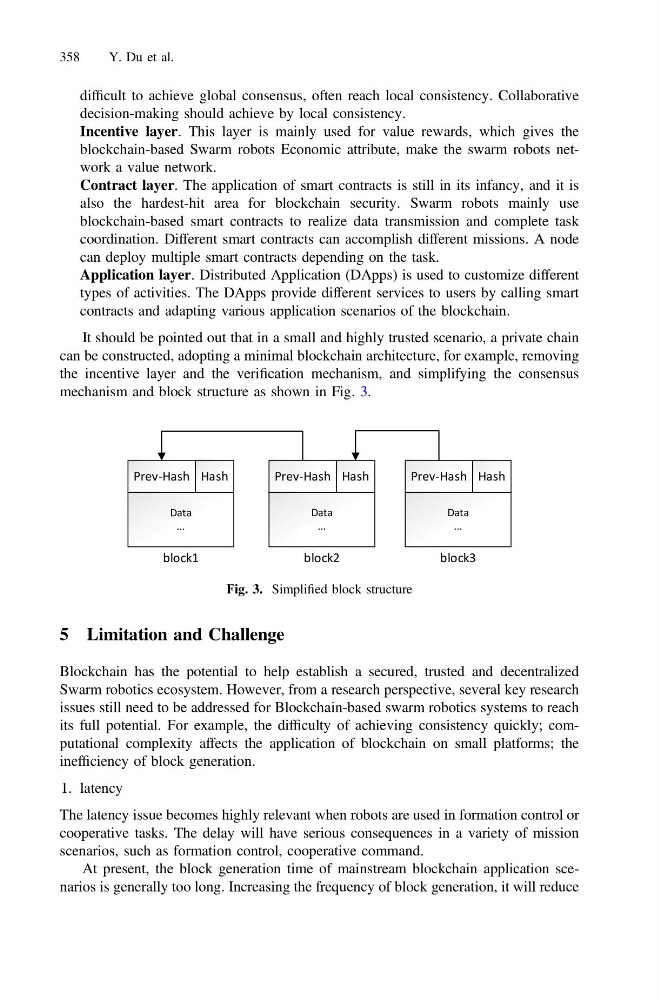
It should be pointed out that in a small and highly trusted scenario, a private chain
can be constructed, adopting a minimal blockchain architecture, for example, removing
the incentive layer and the verification mechanism, and simplifying the consensus
mechanism and block structure as shown in Fig. 3.
5 Limitation and Challenge
Blockchain has the potential to help establish a secured, trusted and decentralized
Swarm robotics ecosystem. However, from a research perspective, several key research
issues still need to be addressed for Blockchain-based swarm robotics systems to reach
its full potential. For example, the difficulty of achieving consistency quickly; computational complexity affects the application of blockchain on small platforms; the
inefficiency of block generation.
1. latency
The latency issue becomes highly relevant when robots are used in formation control or
cooperative tasks. The delay will have serious consequences in a variety of mission
scenarios, such as formation control, cooperative command.
At present, the block generation time of mainstream blockchain application scenarios is generally too long. Increasing the frequency of block generation, it will reduce
Prev-Hash Hash
Data
...
block1
block2
block3
Prev-Hash Hash
Data
...
Prev-Hash Hash
Data
...
Fig. 3. Simplified block structure
358
Y. Du et al.
decision-making should achieve by local consistency.
Incentive layer. This layer is mainly used for value rewards, which gives the
blockchain-based Swarm robots Economic attribute, make the swarm robots network a value network.
Contract layer. The application of smart contracts is still in its infancy, and it is
also the hardest-hit area for blockchain security. Swarm robots mainly use
blockchain-based smart contracts to realize data transmission and complete task
coordination. Different smart contracts can accomplish different missions. A node
can deploy multiple smart contracts depending on the task.
Application layer. Distributed Application (DApps) is used to customize different
types of activities. The DApps provide different services to users by calling smart
contracts and adapting various application scenarios of the blockchain.
It should be pointed out that in a small and highly trusted scenario, a private chain
can be constructed, adopting a minimal blockchain architecture, for example, removing
the incentive layer and the verification mechanism, and simplifying the consensus
mechanism and block structure as shown in Fig. 3.
5 Limitation and Challenge
Blockchain has the potential to help establish a secured, trusted and decentralized
Swarm robotics ecosystem. However, from a research perspective, several key research
issues still need to be addressed for Blockchain-based swarm robotics systems to reach
its full potential. For example, the difficulty of achieving consistency quickly; computational complexity affects the application of blockchain on small platforms; the
inefficiency of block generation.
1. latency
The latency issue becomes highly relevant when robots are used in formation control or
cooperative tasks. The delay will have serious consequences in a variety of mission
scenarios, such as formation control, cooperative command.
At present, the block generation time of mainstream blockchain application scenarios is generally too long. Increasing the frequency of block generation, it will reduce
Prev-Hash Hash
Data
...
block1
block2
block3
Prev-Hash Hash
Data
...
Prev-Hash Hash
Data
...
Fig. 3. Simplified block structure
358
Y. Du et al.