

environment, give the robots global information which makes it be a basic credible
information environment of swarm robots, expands the application of swarm robots.
2 Blockchain: Concept and Properties
Blockchain idea originates from the foundational article entitled “Bitcoin: a peer-topeer electronic cash system” in 2008 written by “Satoshi Nakamoto” [3]. Blockchain
can be narrowly defined as a kind of decentralized shared ledger that uses chronological, encrypted and chained blocks to store verifiable and synchronized data across
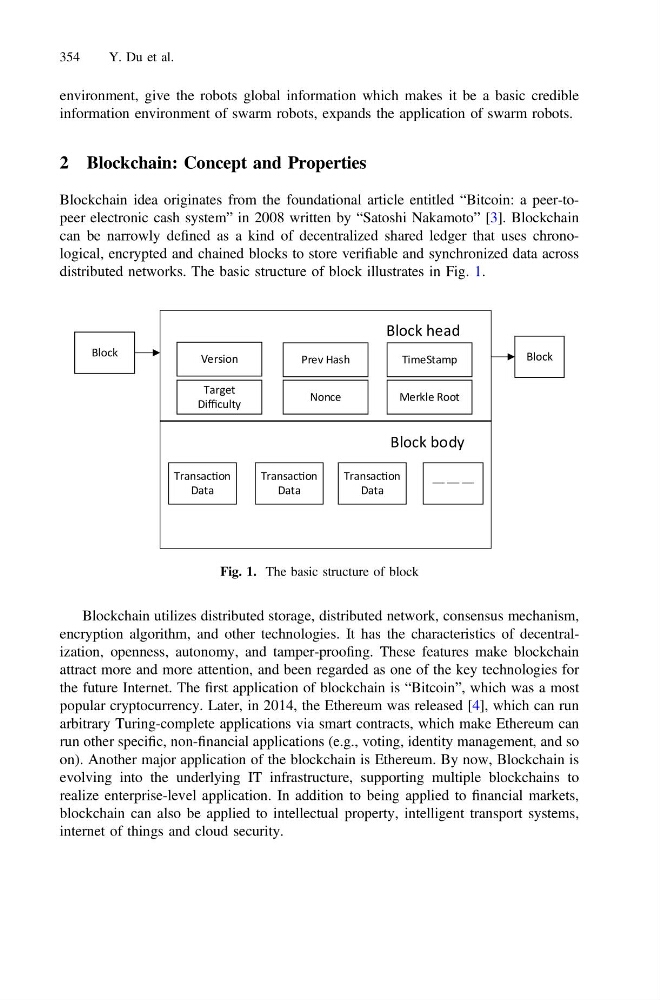
distributed networks. The basic structure of block illustrates in Fig. 1.
Blockchain utilizes distributed storage, distributed network, consensus mechanism,
encryption algorithm, and other technologies. It has the characteristics of decentralization, openness, autonomy, and tamper-proofing. These features make blockchain
attract more and more attention, and been regarded as one of the key technologies for
the future Internet. The first application of blockchain is “Bitcoin”, which was a most
popular cryptocurrency. Later, in 2014, the Ethereum was released [4], which can run
arbitrary Turing-complete applications via smart contracts, which make Ethereum can
run other specific, non-financial applications (e.g., voting, identity management, and so
on). Another major application of the blockchain is Ethereum. By now, Blockchain is
evolving into the underlying IT infrastructure, supporting multiple blockchains to
realize enterprise-level application. In addition to being applied to financial markets,
blockchain can also be applied to intellectual property, intelligent transport systems,
internet of things and cloud security.
Merkle Root
Transacon
Data
Prev Hash
TimeStamp
Block head
Version
Nonce
Target
Difficulty
Transacon
Data
Transacon
Data
— — —
Block body
Block
Block
Fig. 1. The basic structure of block
354
Y. Du et al.
information environment of swarm robots, expands the application of swarm robots.
2 Blockchain: Concept and Properties
Blockchain idea originates from the foundational article entitled “Bitcoin: a peer-topeer electronic cash system” in 2008 written by “Satoshi Nakamoto” [3]. Blockchain
can be narrowly defined as a kind of decentralized shared ledger that uses chronological, encrypted and chained blocks to store verifiable and synchronized data across
distributed networks. The basic structure of block illustrates in Fig. 1.
Blockchain utilizes distributed storage, distributed network, consensus mechanism,
encryption algorithm, and other technologies. It has the characteristics of decentralization, openness, autonomy, and tamper-proofing. These features make blockchain
attract more and more attention, and been regarded as one of the key technologies for
the future Internet. The first application of blockchain is “Bitcoin”, which was a most
popular cryptocurrency. Later, in 2014, the Ethereum was released [4], which can run
arbitrary Turing-complete applications via smart contracts, which make Ethereum can
run other specific, non-financial applications (e.g., voting, identity management, and so
on). Another major application of the blockchain is Ethereum. By now, Blockchain is
evolving into the underlying IT infrastructure, supporting multiple blockchains to
realize enterprise-level application. In addition to being applied to financial markets,
blockchain can also be applied to intellectual property, intelligent transport systems,
internet of things and cloud security.
Merkle Root
Transacon
Data
Prev Hash
TimeStamp
Block head
Version
Nonce
Target
Difficulty
Transacon
Data
Transacon
Data
— — —
Block body
Block
Block
Fig. 1. The basic structure of block
354
Y. Du et al.