

L
ðtÞ
¼ f ðo
ðtÞ
; y
ðtÞ
Þ
ð 2:3Þ
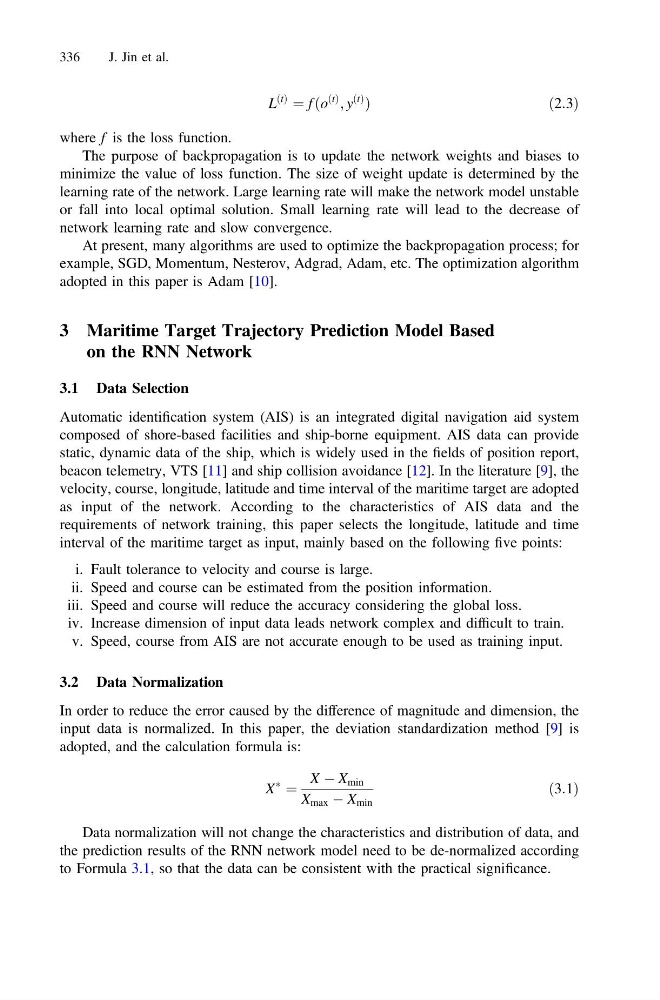
where f is the loss function.
The purpose of backpropagation is to update the network weights and biases to
minimize the value of loss function. The size of weight update is determined by the
learning rate of the network. Large learning rate will make the network model unstable
or fall into local optimal solution. Small learning rate will lead to the decrease of
network learning rate and slow convergence.
At present, many algorithms are used to optimize the backpropagation process; for
example, SGD, Momentum, Nesterov, Adgrad, Adam, etc. The optimization algorithm
adopted in this paper is Adam [10].
3 Maritime Target Trajectory Prediction Model Based
on the RNN Network
3.1 Data Selection
Automatic identification system (AIS) is an integrated digital navigation aid system
composed of shore-based facilities and ship-borne equipment. AIS data can provide
static, dynamic data of the ship, which is widely used in the fields of position report,
beacon telemetry, VTS [11] and ship collision avoidance [12]. In the literature [9], the
velocity, course, longitude, latitude and time interval of the maritime target are adopted
as input of the network. According to the characteristics of AIS data and the
requirements of network training, this paper selects the longitude, latitude and time
interval of the maritime target as input, mainly based on the following five points:
i. Fault tolerance to velocity and course is large.
ii. Speed and course can be estimated from the position information.
iii. Speed and course will reduce the accuracy considering the global loss.
iv. Increase dimension of input data leads network complex and difficult to train.
v. Speed, course from AIS are not accurate enough to be used as training input.
3.2 Data Normalization
In order to reduce the error caused by the difference of magnitude and dimension, the
input data is normalized. In this paper, the deviation standardization method [9] is
adopted, and the calculation formula is:
X
Ã
¼
X À X min
X max À X min
ð3:1Þ
Data normalization will not change the characteristics and distribution of data, and
the prediction results of the RNN network model need to be de-normalized according
to Formula 3.1, so that the data can be consistent with the practical significance.
336
J. Jin et al.
ðtÞ
¼ f ðo
ðtÞ
; y
ðtÞ
Þ
ð 2:3Þ
where f is the loss function.
The purpose of backpropagation is to update the network weights and biases to
minimize the value of loss function. The size of weight update is determined by the
learning rate of the network. Large learning rate will make the network model unstable
or fall into local optimal solution. Small learning rate will lead to the decrease of
network learning rate and slow convergence.
At present, many algorithms are used to optimize the backpropagation process; for
example, SGD, Momentum, Nesterov, Adgrad, Adam, etc. The optimization algorithm
adopted in this paper is Adam [10].
3 Maritime Target Trajectory Prediction Model Based
on the RNN Network
3.1 Data Selection
Automatic identification system (AIS) is an integrated digital navigation aid system
composed of shore-based facilities and ship-borne equipment. AIS data can provide
static, dynamic data of the ship, which is widely used in the fields of position report,
beacon telemetry, VTS [11] and ship collision avoidance [12]. In the literature [9], the
velocity, course, longitude, latitude and time interval of the maritime target are adopted
as input of the network. According to the characteristics of AIS data and the
requirements of network training, this paper selects the longitude, latitude and time
interval of the maritime target as input, mainly based on the following five points:
i. Fault tolerance to velocity and course is large.
ii. Speed and course can be estimated from the position information.
iii. Speed and course will reduce the accuracy considering the global loss.
iv. Increase dimension of input data leads network complex and difficult to train.
v. Speed, course from AIS are not accurate enough to be used as training input.
3.2 Data Normalization
In order to reduce the error caused by the difference of magnitude and dimension, the
input data is normalized. In this paper, the deviation standardization method [9] is
adopted, and the calculation formula is:
X
Ã
¼
X À X min
X max À X min
ð3:1Þ
Data normalization will not change the characteristics and distribution of data, and
the prediction results of the RNN network model need to be de-normalized according
to Formula 3.1, so that the data can be consistent with the practical significance.
336
J. Jin et al.