

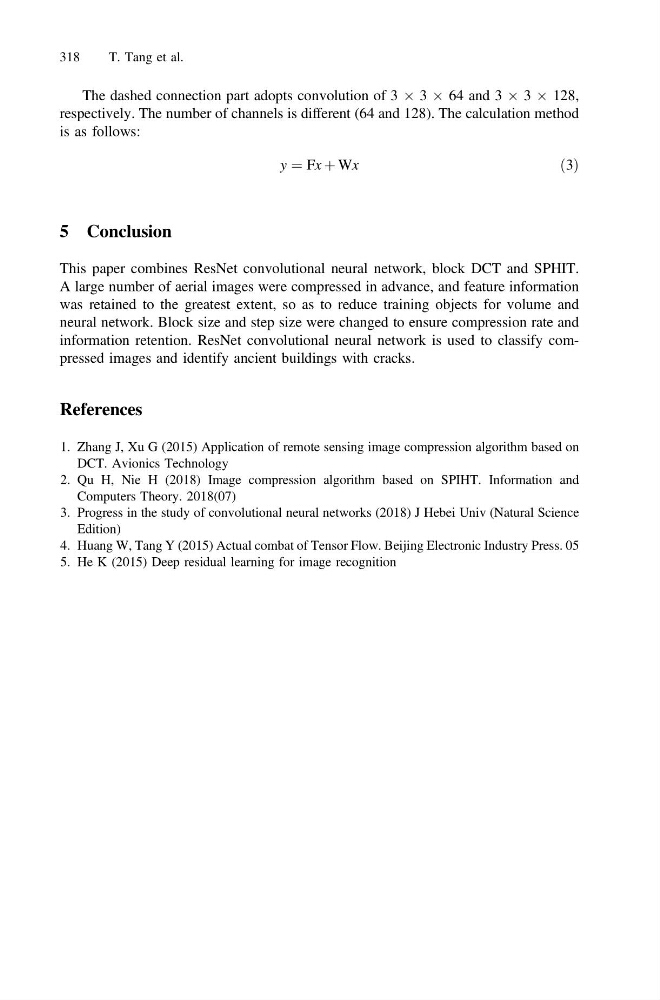
The dashed connection part adopts convolution of 3 Â 3 Â 64 and 3 Â 3 Â 128,
respectively. The number of channels is different (64 and 128). The calculation method
is as follows:
y ¼ Fx þ Wx
ð3Þ
5 Conclusion
This paper combines ResNet convolutional neural network, block DCT and SPHIT.
A large number of aerial images were compressed in advance, and feature information
was retained to the greatest extent, so as to reduce training objects for volume and
neural network. Block size and step size were changed to ensure compression rate and
information retention. ResNet convolutional neural network is used to classify compressed images and identify ancient buildings with cracks.
References
1. Zhang J, Xu G (2015) Application of remote sensing image compression algorithm based on
DCT. Avionics Technology
2. Qu H, Nie H (2018) Image compression algorithm based on SPIHT. Information and
Computers Theory. 2018(07)
3. Progress in the study of convolutional neural networks (2018) J Hebei Univ (Natural Science
Edition)
4. Huang W, Tang Y (2015) Actual combat of Tensor Flow. Beijing Electronic Industry Press. 05
5. He K (2015) Deep residual learning for image recognition
318
T. Tang et al.
respectively. The number of channels is different (64 and 128). The calculation method
is as follows:
y ¼ Fx þ Wx
ð3Þ
5 Conclusion
This paper combines ResNet convolutional neural network, block DCT and SPHIT.
A large number of aerial images were compressed in advance, and feature information
was retained to the greatest extent, so as to reduce training objects for volume and
neural network. Block size and step size were changed to ensure compression rate and
information retention. ResNet convolutional neural network is used to classify compressed images and identify ancient buildings with cracks.
References
1. Zhang J, Xu G (2015) Application of remote sensing image compression algorithm based on
DCT. Avionics Technology
2. Qu H, Nie H (2018) Image compression algorithm based on SPIHT. Information and
Computers Theory. 2018(07)
3. Progress in the study of convolutional neural networks (2018) J Hebei Univ (Natural Science
Edition)
4. Huang W, Tang Y (2015) Actual combat of Tensor Flow. Beijing Electronic Industry Press. 05
5. He K (2015) Deep residual learning for image recognition
318
T. Tang et al.