

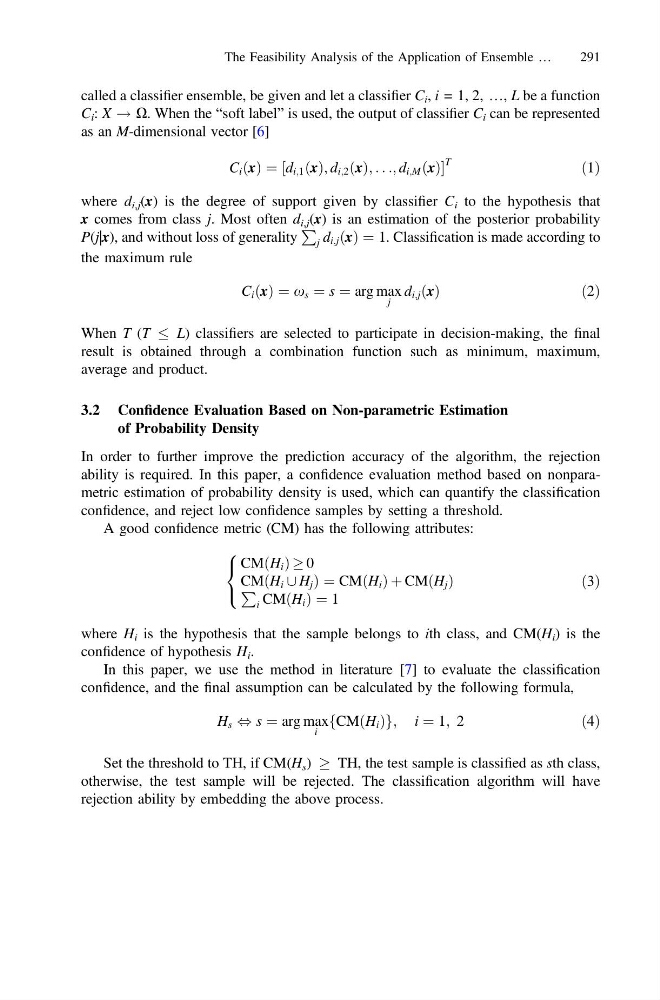
called a classifier ensemble, be given and let a classifier C i , i = 1, 2, …, L be a function
C i : X ! X. When the “soft label” is used, the output of classifier C i can be represented
as an M-dimensional vector [6]
C i ðxÞ ¼ ½d i;1 ðxÞ; d i;2 ðxÞ; . . .; d i;M ðxÞ
T
ð1Þ
where d i,j (x) is the degree of support given by classifier C i to the hypothesis that
x comes from class j. Most often d i,j (x) is an estimation of the posterior probability
P(j|x), and without loss of generality
P
j d i;j ðxÞ ¼ 1. Classification is made according to
the maximum rule
C i ðxÞ ¼ x s ¼ s ¼ arg max
j
d i;j ðxÞ
ð 2Þ
When T (T
L) classifiers are selected to participate in decision-making, the final
result is obtained through a combination function such as minimum, maximum,
average and product.
3.2 Confidence Evaluation Based on Non-parametric Estimation
of Probability Density
In order to further improve the prediction accuracy of the algorithm, the rejection
ability is required. In this paper, a confidence evaluation method based on nonparametric estimation of probability density is used, which can quantify the classification
confidence, and reject low confidence samples by setting a threshold.
A good confidence metric (CM) has the following attributes:
CMðH i Þ ! 0
CMðH i [ H j Þ ¼ CMðH i Þ þ CMðH j Þ
P
i CMðH i Þ ¼ 1
8
<
:
ð3Þ
where H i is the hypothesis that the sample belongs to ith class, and CM(H i ) is the
confidence of hypothesis H i .
In this paper, we use the method in literature [7] to evaluate the classification
confidence, and the final assumption can be calculated by the following formula,
H s , s ¼ arg max
i
fCMðH i Þg; i ¼ 1; 2
ð4Þ
Set the threshold to TH, if CM(H s ) ! TH, the test sample is classified as sth class,
otherwise, the test sample will be rejected. The classification algorithm will have
rejection ability by embedding the above process.
The Feasibility Analysis of the Application of Ensemble …
291
C i : X ! X. When the “soft label” is used, the output of classifier C i can be represented
as an M-dimensional vector [6]
C i ðxÞ ¼ ½d i;1 ðxÞ; d i;2 ðxÞ; . . .; d i;M ðxÞ
T
ð1Þ
where d i,j (x) is the degree of support given by classifier C i to the hypothesis that
x comes from class j. Most often d i,j (x) is an estimation of the posterior probability
P(j|x), and without loss of generality
P
j d i;j ðxÞ ¼ 1. Classification is made according to
the maximum rule
C i ðxÞ ¼ x s ¼ s ¼ arg max
j
d i;j ðxÞ
ð 2Þ
When T (T
L) classifiers are selected to participate in decision-making, the final
result is obtained through a combination function such as minimum, maximum,
average and product.
3.2 Confidence Evaluation Based on Non-parametric Estimation
of Probability Density
In order to further improve the prediction accuracy of the algorithm, the rejection
ability is required. In this paper, a confidence evaluation method based on nonparametric estimation of probability density is used, which can quantify the classification
confidence, and reject low confidence samples by setting a threshold.
A good confidence metric (CM) has the following attributes:
CMðH i Þ ! 0
CMðH i [ H j Þ ¼ CMðH i Þ þ CMðH j Þ
P
i CMðH i Þ ¼ 1
8
<
:
ð3Þ
where H i is the hypothesis that the sample belongs to ith class, and CM(H i ) is the
confidence of hypothesis H i .
In this paper, we use the method in literature [7] to evaluate the classification
confidence, and the final assumption can be calculated by the following formula,
H s , s ¼ arg max
i
fCMðH i Þg; i ¼ 1; 2
ð4Þ
Set the threshold to TH, if CM(H s ) ! TH, the test sample is classified as sth class,
otherwise, the test sample will be rejected. The classification algorithm will have
rejection ability by embedding the above process.
The Feasibility Analysis of the Application of Ensemble …
291