

4 Conclusions
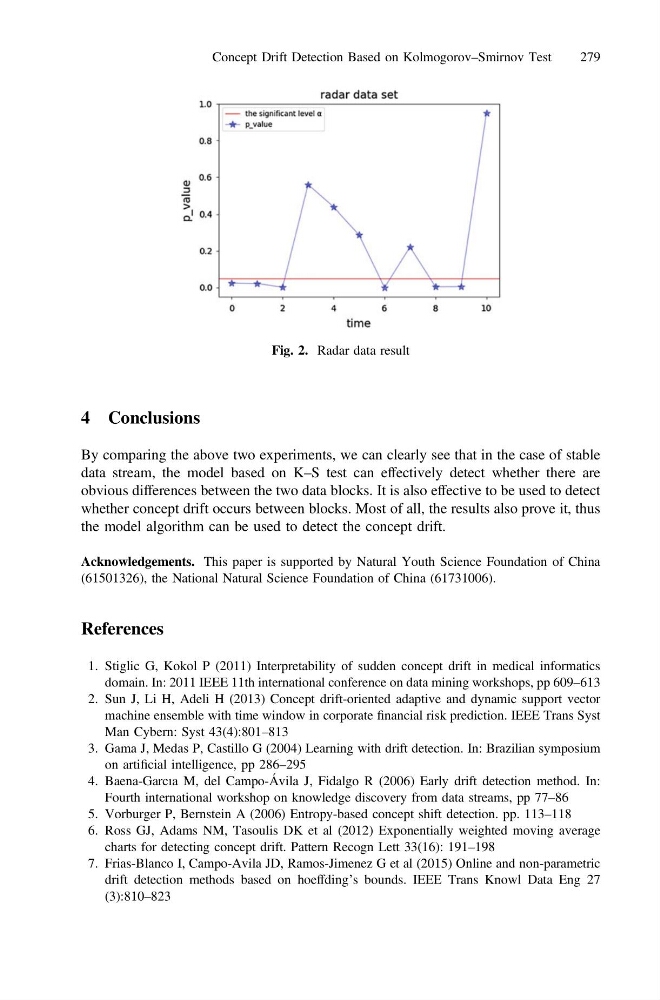
By comparing the above two experiments, we can clearly see that in the case of stable
data stream, the model based on K–S test can effectively detect whether there are
obvious differences between the two data blocks. It is also effective to be used to detect
whether concept drift occurs between blocks. Most of all, the results also prove it, thus
the model algorithm can be used to detect the concept drift.
Acknowledgements. This paper is supported by Natural Youth Science Foundation of China
(61501326), the National Natural Science Foundation of China (61731006).
References
1. Stiglic G, Kokol P (2011) Interpretability of sudden concept drift in medical informatics
domain. In: 2011 IEEE 11th international conference on data mining workshops, pp 609–613
2. Sun J, Li H, Adeli H (2013) Concept drift-oriented adaptive and dynamic support vector
machine ensemble with time window in corporate financial risk prediction. IEEE Trans Syst
Man Cybern: Syst 43(4):801–813
3. Gama J, Medas P, Castillo G (2004) Learning with drift detection. In: Brazilian symposium
on artificial intelligence, pp 286–295
4. Baena-Garcıa M, del Campo-Ávila J, Fidalgo R (2006) Early drift detection method. In:
Fourth international workshop on knowledge discovery from data streams, pp 77–86
5. Vorburger P, Bernstein A (2006) Entropy-based concept shift detection. pp. 113–118
6. Ross GJ, Adams NM, Tasoulis DK et al (2012) Exponentially weighted moving average
charts for detecting concept drift. Pattern Recogn Lett 33(16): 191–198
7. Frias-Blanco I, Campo-Avila JD, Ramos-Jimenez G et al (2015) Online and non-parametric
drift detection methods based on hoeffding’s bounds. IEEE Trans Knowl Data Eng 27
(3):810–823
Fig. 2. Radar data result
Concept Drift Detection Based on Kolmogorov–Smirnov Test
279
By comparing the above two experiments, we can clearly see that in the case of stable
data stream, the model based on K–S test can effectively detect whether there are
obvious differences between the two data blocks. It is also effective to be used to detect
whether concept drift occurs between blocks. Most of all, the results also prove it, thus
the model algorithm can be used to detect the concept drift.
Acknowledgements. This paper is supported by Natural Youth Science Foundation of China
(61501326), the National Natural Science Foundation of China (61731006).
References
1. Stiglic G, Kokol P (2011) Interpretability of sudden concept drift in medical informatics
domain. In: 2011 IEEE 11th international conference on data mining workshops, pp 609–613
2. Sun J, Li H, Adeli H (2013) Concept drift-oriented adaptive and dynamic support vector
machine ensemble with time window in corporate financial risk prediction. IEEE Trans Syst
Man Cybern: Syst 43(4):801–813
3. Gama J, Medas P, Castillo G (2004) Learning with drift detection. In: Brazilian symposium
on artificial intelligence, pp 286–295
4. Baena-Garcıa M, del Campo-Ávila J, Fidalgo R (2006) Early drift detection method. In:
Fourth international workshop on knowledge discovery from data streams, pp 77–86
5. Vorburger P, Bernstein A (2006) Entropy-based concept shift detection. pp. 113–118
6. Ross GJ, Adams NM, Tasoulis DK et al (2012) Exponentially weighted moving average
charts for detecting concept drift. Pattern Recogn Lett 33(16): 191–198
7. Frias-Blanco I, Campo-Avila JD, Ramos-Jimenez G et al (2015) Online and non-parametric
drift detection methods based on hoeffding’s bounds. IEEE Trans Knowl Data Eng 27
(3):810–823
Fig. 2. Radar data result
Concept Drift Detection Based on Kolmogorov–Smirnov Test
279