

Pedestrian Retrieval Using Valuable Absence Augmentation
259
Table 1. Influence of valuable parts of the pedestrian on the network performance,
where C expresses the proportion of removing valuable parts.
C (%)
0 (Baseline) 5
10
15
20
Rank-1 (%) 85.2
78.2 70.1 61.3 52.1
3.4 Evaluation of the Proposed VAA for the Performance
of Pedestrian Retrieval
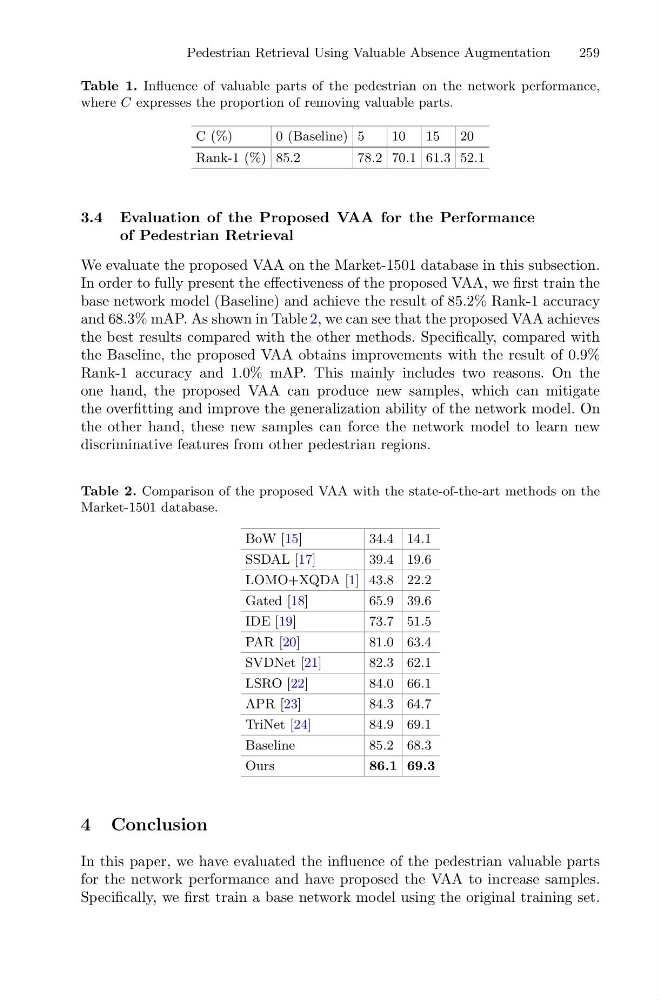
We evaluate the proposed VAA on the Market-1501 database in this subsection.
In order to fully present the effectiveness of the proposed VAA, we first train the
base network model (Baseline) and achieve the result of 85.2% Rank-1 accuracy
and 68.3% mAP. As shown in Table 2, we can see that the proposed VAA achieves
the best results compared with the other methods. Specifically, compared with
the Baseline, the proposed VAA obtains improvements with the result of 0.9%
Rank-1 accuracy and 1.0% mAP. This mainly includes two reasons. On the
one hand, the proposed VAA can produce new samples, which can mitigate
the overfitting and improve the generalization ability of the network model. On
the other hand, these new samples can force the network model to learn new
discriminative features from other pedestrian regions.
Table 2. Comparison of the proposed VAA with the state-of-the-art methods on the
Market-1501 database.
BoW [15]
34.4 14.1
SSDAL [17]
39.4 19.6
LOMO+XQDA [1] 43.8 22.2
Gated [18]
65.9 39.6
IDE [19]
73.7 51.5
PAR [20]
81.0 63.4
SVDNet [21]
82.3 62.1
LSRO [22]
84.0 66.1
APR [23]
84.3 64.7
TriNet [24]
84.9 69.1
Baseline
85.2 68.3
Ours
86.1 69.3
4 Conclusion
In this paper, we have evaluated the influence of the pedestrian valuable parts
for the network performance and have proposed the VAA to increase samples.
Specifically, we first train a base network model using the original training set.
259
Table 1. Influence of valuable parts of the pedestrian on the network performance,
where C expresses the proportion of removing valuable parts.
C (%)
0 (Baseline) 5
10
15
20
Rank-1 (%) 85.2
78.2 70.1 61.3 52.1
3.4 Evaluation of the Proposed VAA for the Performance
of Pedestrian Retrieval
We evaluate the proposed VAA on the Market-1501 database in this subsection.
In order to fully present the effectiveness of the proposed VAA, we first train the
base network model (Baseline) and achieve the result of 85.2% Rank-1 accuracy
and 68.3% mAP. As shown in Table 2, we can see that the proposed VAA achieves
the best results compared with the other methods. Specifically, compared with
the Baseline, the proposed VAA obtains improvements with the result of 0.9%
Rank-1 accuracy and 1.0% mAP. This mainly includes two reasons. On the
one hand, the proposed VAA can produce new samples, which can mitigate
the overfitting and improve the generalization ability of the network model. On
the other hand, these new samples can force the network model to learn new
discriminative features from other pedestrian regions.
Table 2. Comparison of the proposed VAA with the state-of-the-art methods on the
Market-1501 database.
BoW [15]
34.4 14.1
SSDAL [17]
39.4 19.6
LOMO+XQDA [1] 43.8 22.2
Gated [18]
65.9 39.6
IDE [19]
73.7 51.5
PAR [20]
81.0 63.4
SVDNet [21]
82.3 62.1
LSRO [22]
84.0 66.1
APR [23]
84.3 64.7
TriNet [24]
84.9 69.1
Baseline
85.2 68.3
Ours
86.1 69.3
4 Conclusion
In this paper, we have evaluated the influence of the pedestrian valuable parts
for the network performance and have proposed the VAA to increase samples.
Specifically, we first train a base network model using the original training set.