

Pedestrian Retrieval Using Valuable Absence Augmentation
257
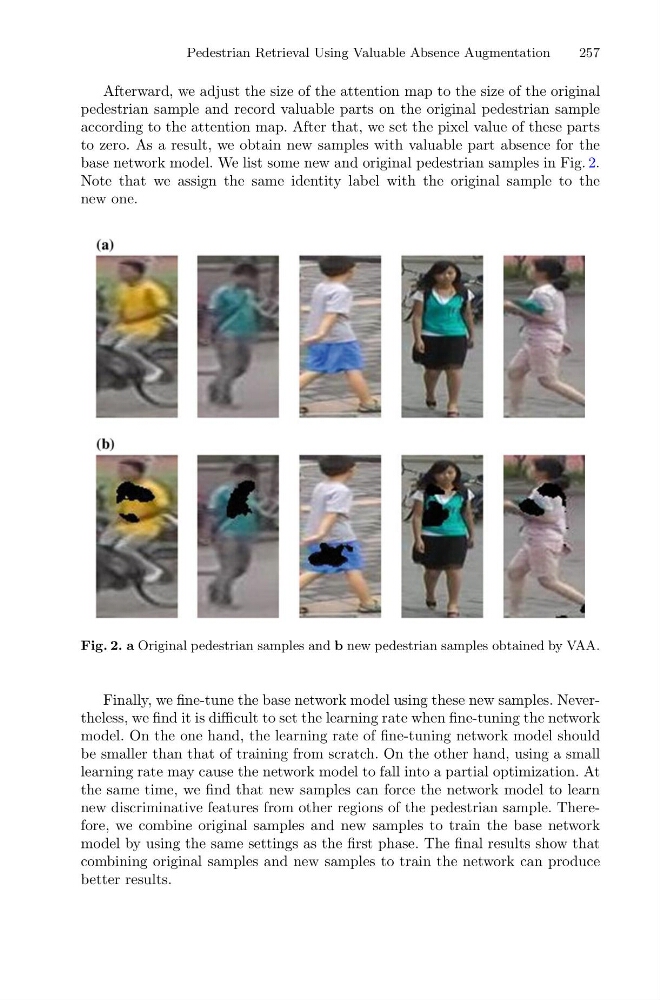
Afterward, we adjust the size of the attention map to the size of the original
pedestrian sample and record valuable parts on the original pedestrian sample
according to the attention map. After that, we set the pixel value of these parts
to zero. As a result, we obtain new samples with valuable part absence for the
base network model. We list some new and original pedestrian samples in Fig. 2.
Note that we assign the same identity label with the original sample to the
new one.
Fig. 2. a Original pedestrian samples and b new pedestrian samples obtained by VAA.
Finally, we fine-tune the base network model using these new samples. Nevertheless, we find it is difficult to set the learning rate when fine-tuning the network
model. On the one hand, the learning rate of fine-tuning network model should
be smaller than that of training from scratch. On the other hand, using a small
learning rate may cause the network model to fall into a partial optimization. At
the same time, we find that new samples can force the network model to learn
new discriminative features from other regions of the pedestrian sample. Therefore, we combine original samples and new samples to train the base network
model by using the same settings as the first phase. The final results show that
combining original samples and new samples to train the network can produce
better results.
257
Afterward, we adjust the size of the attention map to the size of the original
pedestrian sample and record valuable parts on the original pedestrian sample
according to the attention map. After that, we set the pixel value of these parts
to zero. As a result, we obtain new samples with valuable part absence for the
base network model. We list some new and original pedestrian samples in Fig. 2.
Note that we assign the same identity label with the original sample to the
new one.
Fig. 2. a Original pedestrian samples and b new pedestrian samples obtained by VAA.
Finally, we fine-tune the base network model using these new samples. Nevertheless, we find it is difficult to set the learning rate when fine-tuning the network
model. On the one hand, the learning rate of fine-tuning network model should
be smaller than that of training from scratch. On the other hand, using a small
learning rate may cause the network model to fall into a partial optimization. At
the same time, we find that new samples can force the network model to learn
new discriminative features from other regions of the pedestrian sample. Therefore, we combine original samples and new samples to train the base network
model by using the same settings as the first phase. The final results show that
combining original samples and new samples to train the network can produce
better results.