

This structured design can enhance the independence of each functional module,
improve system maintainability and stability, and facilitate software function upgrade,
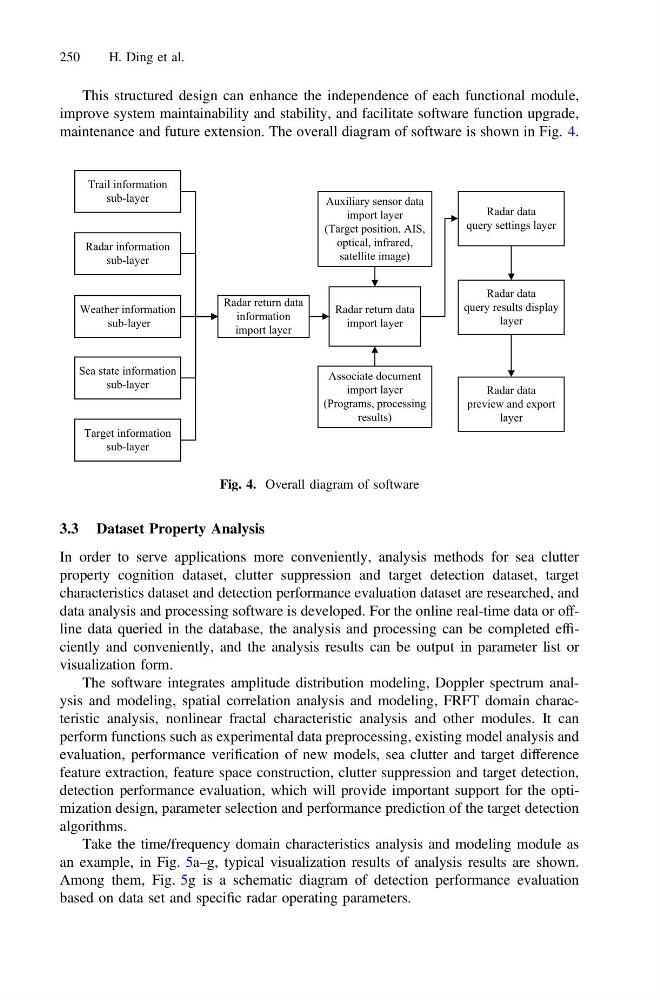
maintenance and future extension. The overall diagram of software is shown in Fig. 4.
3.3 Dataset Property Analysis
In order to serve applications more conveniently, analysis methods for sea clutter
property cognition dataset, clutter suppression and target detection dataset, target
characteristics dataset and detection performance evaluation dataset are researched, and
data analysis and processing software is developed. For the online real-time data or offline data queried in the database, the analysis and processing can be completed efficiently and conveniently, and the analysis results can be output in parameter list or
visualization form.
The software integrates amplitude distribution modeling, Doppler spectrum analysis and modeling, spatial correlation analysis and modeling, FRFT domain characteristic analysis, nonlinear fractal characteristic analysis and other modules. It can
perform functions such as experimental data preprocessing, existing model analysis and
evaluation, performance verification of new models, sea clutter and target difference
feature extraction, feature space construction, clutter suppression and target detection,
detection performance evaluation, which will provide important support for the optimization design, parameter selection and performance prediction of the target detection
algorithms.
Take the time/frequency domain characteristics analysis and modeling module as
an example, in Fig. 5a–g, typical visualization results of analysis results are shown.
Among them, Fig. 5g is a schematic diagram of detection performance evaluation
based on data set and specific radar operating parameters.
Radar return data
import layer
Radar return data
information
import layer
Trail information
sub-layer
Radar information
sub-layer
Weather information
sub-layer
Sea state information
sub-layer
Target information
sub-layer
Radar data
query settings layer
Auxiliary sensor data
import layer
(Target position, AIS,
optical, infrared,
satellite image)
Associate document
import layer
(Programs, processing
results)
Radar data
query results display
layer
Radar data
preview and export
layer
Fig. 4. Overall diagram of software
250
H. Ding et al.
improve system maintainability and stability, and facilitate software function upgrade,
maintenance and future extension. The overall diagram of software is shown in Fig. 4.
3.3 Dataset Property Analysis
In order to serve applications more conveniently, analysis methods for sea clutter
property cognition dataset, clutter suppression and target detection dataset, target
characteristics dataset and detection performance evaluation dataset are researched, and
data analysis and processing software is developed. For the online real-time data or offline data queried in the database, the analysis and processing can be completed efficiently and conveniently, and the analysis results can be output in parameter list or
visualization form.
The software integrates amplitude distribution modeling, Doppler spectrum analysis and modeling, spatial correlation analysis and modeling, FRFT domain characteristic analysis, nonlinear fractal characteristic analysis and other modules. It can
perform functions such as experimental data preprocessing, existing model analysis and
evaluation, performance verification of new models, sea clutter and target difference
feature extraction, feature space construction, clutter suppression and target detection,
detection performance evaluation, which will provide important support for the optimization design, parameter selection and performance prediction of the target detection
algorithms.
Take the time/frequency domain characteristics analysis and modeling module as
an example, in Fig. 5a–g, typical visualization results of analysis results are shown.
Among them, Fig. 5g is a schematic diagram of detection performance evaluation
based on data set and specific radar operating parameters.
Radar return data
import layer
Radar return data
information
import layer
Trail information
sub-layer
Radar information
sub-layer
Weather information
sub-layer
Sea state information
sub-layer
Target information
sub-layer
Radar data
query settings layer
Auxiliary sensor data
import layer
(Target position, AIS,
optical, infrared,
satellite image)
Associate document
import layer
(Programs, processing
results)
Radar data
query results display
layer
Radar data
preview and export
layer
Fig. 4. Overall diagram of software
250
H. Ding et al.