

dataset for SAR image recognition is already available, namely the MASTER datasets,
but for marine target detection, open dataset is insufficient to meet application
requirements [8].
Aiming at this problem, framework of marine target detection dataset for intelligent
radar application is constructed in this paper, on the basis of reviewing existing dataset.
Supported with previous measurement experiments, several datasets such as sea clutter
property cognition dataset, clutter suppression and target detection dataset, target
characteristics dataset and detection performance evaluation dataset are preliminarily
obtained. At present, these datasets are in the stage of accumulation and enrichment
stage, which still need the support of measured data with diverse experimental conditions such as sea areas or sea states. When the datasets are nearly sufficient, they will
be gradually opened up and shared for public use in radar community.
2 Description of Existing Marine Target Detection Dataset
2.1 IPIX Radar Dataset
The dataset was acquired by McMaster University in Canada during experiments with
the IPIX radar and was managed and maintained by a team led by Professor Haykin.
The data were stored in complete netCDF format. It contains 1993 and 1998 dataset,
which are typical X-band low grazing angle data [9]. The 1993 dataset was measured in
Dartmouth, southern Nova Scotia, Canada. The cooperative target is a spherical block
of styrofoam, wrapped with wire mesh. It has a diameter of one meter. The average
SCR varies in the range 0–6 dB. The 1998 dataset was collected at Grimsby, Ontario.
The radar site was located at east of the Place Polonaise at Grimsby, Ontario, looking at
Lake Ontario from a height of 20 m.
2.2 CSIR Radar Dataset
In 2006 and 2007, the Defence, Peace, Safety, and Security Unit of the Council for
Scientific and Industrial Research (CSIR) in Pretoria, South Africa, conducted two sea
clutter measurement trials to address some of the limitations of the IPIX dataset [10].
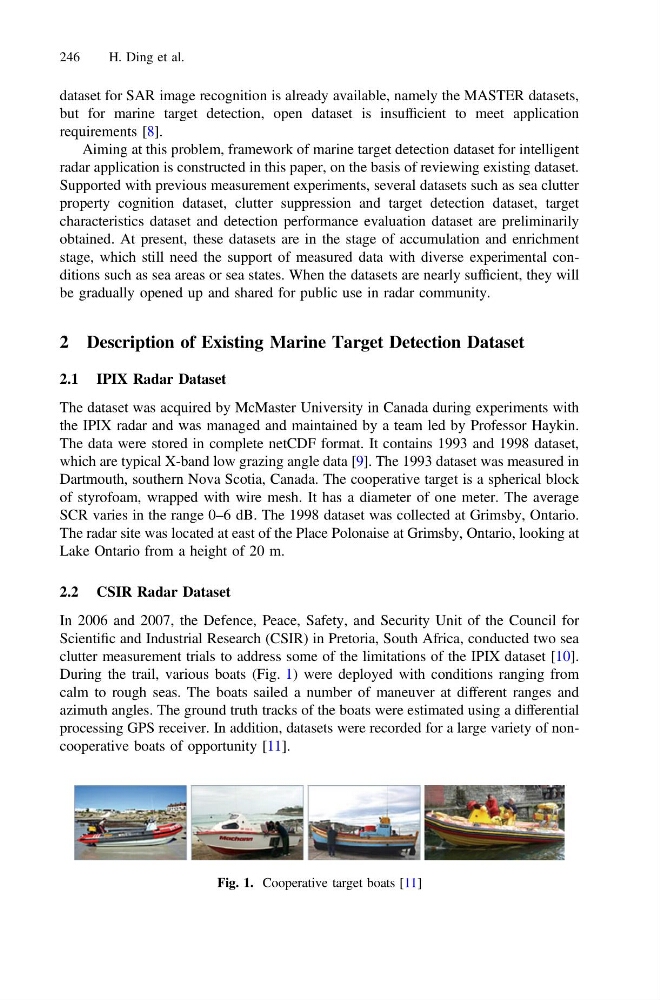
During the trail, various boats (Fig. 1) were deployed with conditions ranging from
calm to rough seas. The boats sailed a number of maneuver at different ranges and
azimuth angles. The ground truth tracks of the boats were estimated using a differential
processing GPS receiver. In addition, datasets were recorded for a large variety of noncooperative boats of opportunity [11].
Fig. 1. Cooperative target boats [11]
246
H. Ding et al.
but for marine target detection, open dataset is insufficient to meet application
requirements [8].
Aiming at this problem, framework of marine target detection dataset for intelligent
radar application is constructed in this paper, on the basis of reviewing existing dataset.
Supported with previous measurement experiments, several datasets such as sea clutter
property cognition dataset, clutter suppression and target detection dataset, target
characteristics dataset and detection performance evaluation dataset are preliminarily
obtained. At present, these datasets are in the stage of accumulation and enrichment
stage, which still need the support of measured data with diverse experimental conditions such as sea areas or sea states. When the datasets are nearly sufficient, they will
be gradually opened up and shared for public use in radar community.
2 Description of Existing Marine Target Detection Dataset
2.1 IPIX Radar Dataset
The dataset was acquired by McMaster University in Canada during experiments with
the IPIX radar and was managed and maintained by a team led by Professor Haykin.
The data were stored in complete netCDF format. It contains 1993 and 1998 dataset,
which are typical X-band low grazing angle data [9]. The 1993 dataset was measured in
Dartmouth, southern Nova Scotia, Canada. The cooperative target is a spherical block
of styrofoam, wrapped with wire mesh. It has a diameter of one meter. The average
SCR varies in the range 0–6 dB. The 1998 dataset was collected at Grimsby, Ontario.
The radar site was located at east of the Place Polonaise at Grimsby, Ontario, looking at
Lake Ontario from a height of 20 m.
2.2 CSIR Radar Dataset
In 2006 and 2007, the Defence, Peace, Safety, and Security Unit of the Council for
Scientific and Industrial Research (CSIR) in Pretoria, South Africa, conducted two sea
clutter measurement trials to address some of the limitations of the IPIX dataset [10].
During the trail, various boats (Fig. 1) were deployed with conditions ranging from
calm to rough seas. The boats sailed a number of maneuver at different ranges and
azimuth angles. The ground truth tracks of the boats were estimated using a differential
processing GPS receiver. In addition, datasets were recorded for a large variety of noncooperative boats of opportunity [11].
Fig. 1. Cooperative target boats [11]
246
H. Ding et al.