

236
Y. Zhou et al.
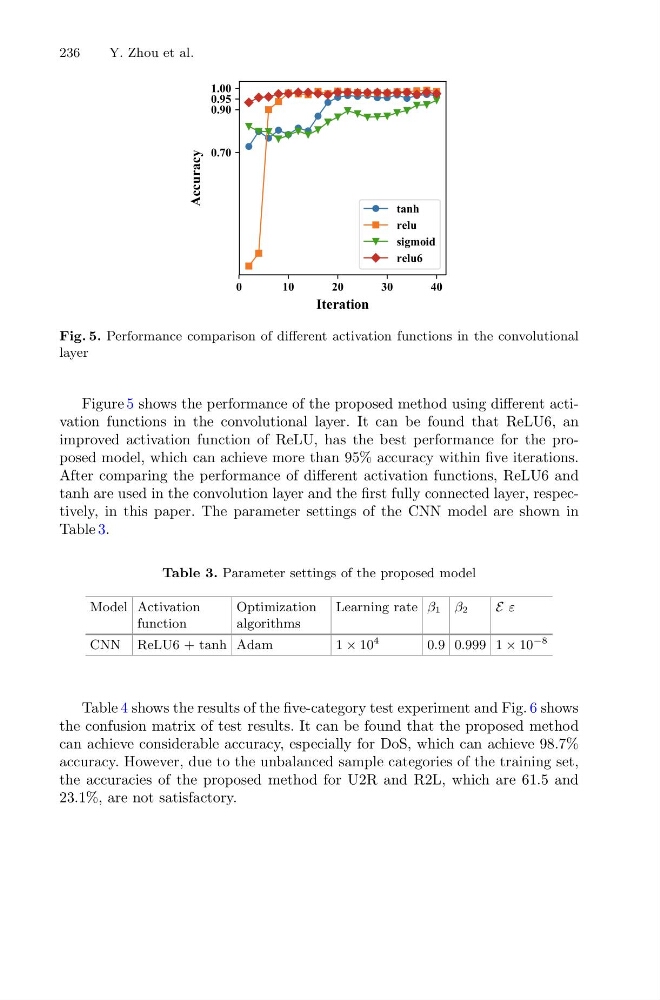
Fig. 5. Performance comparison of different activation functions in the convolutional
layer
Figure 5 shows the performance of the proposed method using different activation functions in the convolutional layer. It can be found that ReLU6, an
improved activation function of ReLU, has the best performance for the proposed model, which can achieve more than 95% accuracy within five iterations.
After comparing the performance of different activation functions, ReLU6 and
tanh are used in the convolution layer and the first fully connected layer, respectively, in this paper. The parameter settings of the CNN model are shown in
Table 3.
Table 3. Parameter settings of the proposed model
Model Activation
function
Optimization
algorithms
Learning rate β1 β2
E ε
CNN ReLU6 + tanh Adam
1 × 10
4
0.9 0.999 1 × 10
−8
Table 4 shows the results of the five-category test experiment and Fig. 6 shows
the confusion matrix of test results. It can be found that the proposed method
can achieve considerable accuracy, especially for DoS, which can achieve 98.7%
accuracy. However, due to the unbalanced sample categories of the training set,
the accuracies of the proposed method for U2R and R2L, which are 61.5 and
23.1%, are not satisfactory.
Y. Zhou et al.
Fig. 5. Performance comparison of different activation functions in the convolutional
layer
Figure 5 shows the performance of the proposed method using different activation functions in the convolutional layer. It can be found that ReLU6, an
improved activation function of ReLU, has the best performance for the proposed model, which can achieve more than 95% accuracy within five iterations.
After comparing the performance of different activation functions, ReLU6 and
tanh are used in the convolution layer and the first fully connected layer, respectively, in this paper. The parameter settings of the CNN model are shown in
Table 3.
Table 3. Parameter settings of the proposed model
Model Activation
function
Optimization
algorithms
Learning rate β1 β2
E ε
CNN ReLU6 + tanh Adam
1 × 10
4
0.9 0.999 1 × 10
−8
Table 4 shows the results of the five-category test experiment and Fig. 6 shows
the confusion matrix of test results. It can be found that the proposed method
can achieve considerable accuracy, especially for DoS, which can achieve 98.7%
accuracy. However, due to the unbalanced sample categories of the training set,
the accuracies of the proposed method for U2R and R2L, which are 61.5 and
23.1%, are not satisfactory.