

202
S. Hu et al.
In summary, the constellation feature does well than others. Either bagged
tree or weighted KNN is better than fine Gaussian SVM, and the accuracy
reaches to 98.5%. As the number of feature inputs increases, the performance
of those three classifiers approaches similar. Also, it proves that the method of
extracting feature values before using classifier is effective.
The above all based on the real laboratory environment does not change
much; otherwise, the accuracy will be influenced. In order to better analyze the
performance of the feature parameter identification method, the channel environment must also be taken into consideration. For the sake of simplicity, only
the difference in SNR is considered. Since SNR in the experimental environment
is difficult to change, we add Gaussian white noise to the signal emitted by the
transmitter in this paper, and SNR of the received signal is the superposition of
Gaussian white noise and channel noise, so that SNR can be changed.
0
5
1 0
1 5
SNR(dB)
55
60
65
70
75
80
85
90
95
100
Accuracy(%)
SVM
KNN
TREE
Fractal dimension
Constellation
Phase noise
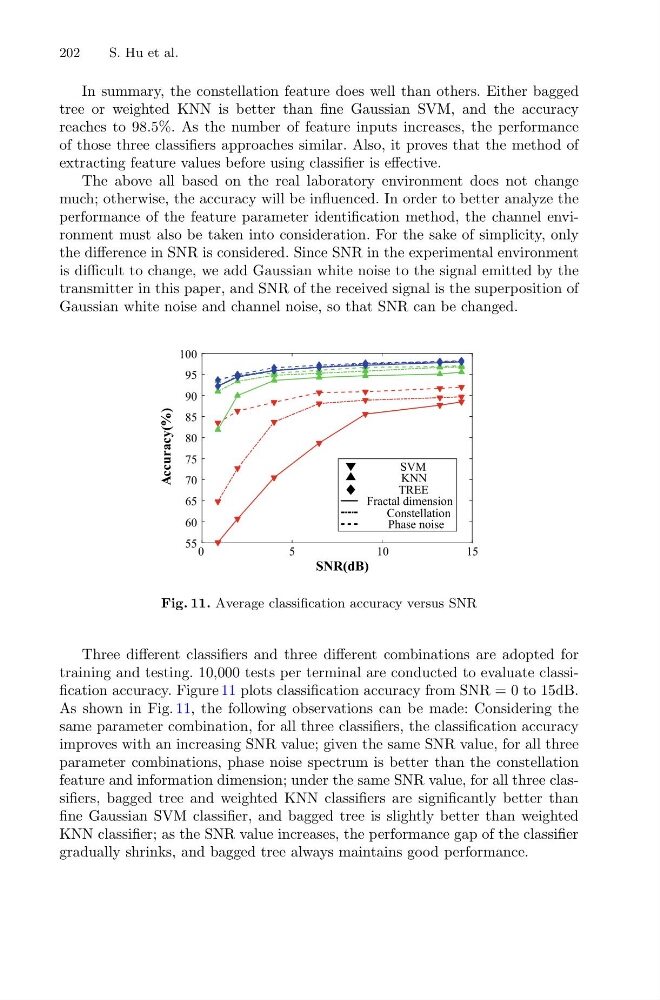
Fig. 11. Average classification accuracy versus SNR
Three different classifiers and three different combinations are adopted for
training and testing. 10,000 tests per terminal are conducted to evaluate classification accuracy. Figure 11 plots classification accuracy from SNR = 0 to 15dB.
As shown in Fig. 11, the following observations can be made: Considering the
same parameter combination, for all three classifiers, the classification accuracy
improves with an increasing SNR value; given the same SNR value, for all three
parameter combinations, phase noise spectrum is better than the constellation
feature and information dimension; under the same SNR value, for all three classifiers, bagged tree and weighted KNN classifiers are significantly better than
fine Gaussian SVM classifier, and bagged tree is slightly better than weighted
KNN classifier; as the SNR value increases, the performance gap of the classifier
gradually shrinks, and bagged tree always maintains good performance.
S. Hu et al.
In summary, the constellation feature does well than others. Either bagged
tree or weighted KNN is better than fine Gaussian SVM, and the accuracy
reaches to 98.5%. As the number of feature inputs increases, the performance
of those three classifiers approaches similar. Also, it proves that the method of
extracting feature values before using classifier is effective.
The above all based on the real laboratory environment does not change
much; otherwise, the accuracy will be influenced. In order to better analyze the
performance of the feature parameter identification method, the channel environment must also be taken into consideration. For the sake of simplicity, only
the difference in SNR is considered. Since SNR in the experimental environment
is difficult to change, we add Gaussian white noise to the signal emitted by the
transmitter in this paper, and SNR of the received signal is the superposition of
Gaussian white noise and channel noise, so that SNR can be changed.
0
5
1 0
1 5
SNR(dB)
55
60
65
70
75
80
85
90
95
100
Accuracy(%)
SVM
KNN
TREE
Fractal dimension
Constellation
Phase noise
Fig. 11. Average classification accuracy versus SNR
Three different classifiers and three different combinations are adopted for
training and testing. 10,000 tests per terminal are conducted to evaluate classification accuracy. Figure 11 plots classification accuracy from SNR = 0 to 15dB.
As shown in Fig. 11, the following observations can be made: Considering the
same parameter combination, for all three classifiers, the classification accuracy
improves with an increasing SNR value; given the same SNR value, for all three
parameter combinations, phase noise spectrum is better than the constellation
feature and information dimension; under the same SNR value, for all three classifiers, bagged tree and weighted KNN classifiers are significantly better than
fine Gaussian SVM classifier, and bagged tree is slightly better than weighted
KNN classifier; as the SNR value increases, the performance gap of the classifier
gradually shrinks, and bagged tree always maintains good performance.