

Machine Learning for RF Fingerprinting Extraction . . .
191
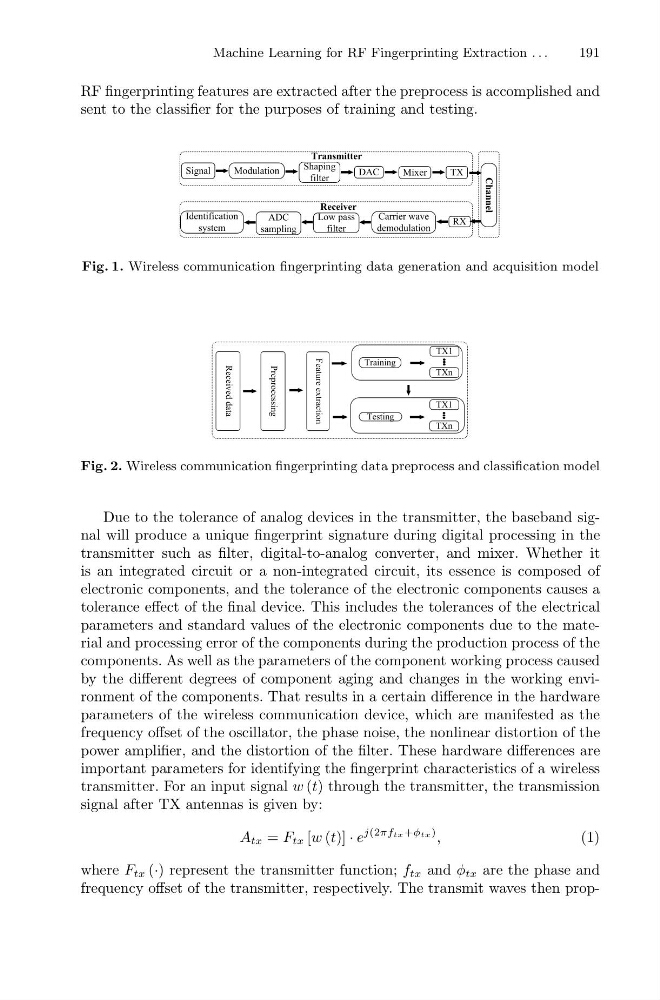
RF fingerprinting features are extracted after the preprocess is accomplished and
sent to the classifier for the purposes of training and testing.
Signal
Modulation
Shaping
filter
DAC
Mixer
TX
Identification
system
ADC
sampling
Low pass
filter
Carrier wave
demodulation
Transmitter
Receiver
Channel
RX
Fig. 1. Wireless communication fingerprinting data generation and acquisition model
Received data
Testing
Training
TX1
Preprocessing
Feature extraction
TXn
TX1
TXn
Fig. 2. Wireless communication fingerprinting data preprocess and classification model
Due to the tolerance of analog devices in the transmitter, the baseband signal will produce a unique fingerprint signature during digital processing in the
transmitter such as filter, digital-to-analog converter, and mixer. Whether it
is an integrated circuit or a non-integrated circuit, its essence is composed of
electronic components, and the tolerance of the electronic components causes a
tolerance effect of the final device. This includes the tolerances of the electrical
parameters and standard values of the electronic components due to the material and processing error of the components during the production process of the
components. As well as the parameters of the component working process caused
by the different degrees of component aging and changes in the working environment of the components. That results in a certain difference in the hardware
parameters of the wireless communication device, which are manifested as the
frequency offset of the oscillator, the phase noise, the nonlinear distortion of the
power amplifier, and the distortion of the filter. These hardware differences are
important parameters for identifying the fingerprint characteristics of a wireless
transmitter. For an input signal w (t) through the transmitter, the transmission
signal after TX antennas is given by:
A tx = F tx [w (t)] · e
j(2πftx+φtx) ,
(1)
where F tx (·) represent the transmitter function; f tx and φ tx are the phase and
frequency offset of the transmitter, respectively. The transmit waves then prop-
191
RF fingerprinting features are extracted after the preprocess is accomplished and
sent to the classifier for the purposes of training and testing.
Signal
Modulation
Shaping
filter
DAC
Mixer
TX
Identification
system
ADC
sampling
Low pass
filter
Carrier wave
demodulation
Transmitter
Receiver
Channel
RX
Fig. 1. Wireless communication fingerprinting data generation and acquisition model
Received data
Testing
Training
TX1
Preprocessing
Feature extraction
TXn
TX1
TXn
Fig. 2. Wireless communication fingerprinting data preprocess and classification model
Due to the tolerance of analog devices in the transmitter, the baseband signal will produce a unique fingerprint signature during digital processing in the
transmitter such as filter, digital-to-analog converter, and mixer. Whether it
is an integrated circuit or a non-integrated circuit, its essence is composed of
electronic components, and the tolerance of the electronic components causes a
tolerance effect of the final device. This includes the tolerances of the electrical
parameters and standard values of the electronic components due to the material and processing error of the components during the production process of the
components. As well as the parameters of the component working process caused
by the different degrees of component aging and changes in the working environment of the components. That results in a certain difference in the hardware
parameters of the wireless communication device, which are manifested as the
frequency offset of the oscillator, the phase noise, the nonlinear distortion of the
power amplifier, and the distortion of the filter. These hardware differences are
important parameters for identifying the fingerprint characteristics of a wireless
transmitter. For an input signal w (t) through the transmitter, the transmission
signal after TX antennas is given by:
A tx = F tx [w (t)] · e
j(2πftx+φtx) ,
(1)
where F tx (·) represent the transmitter function; f tx and φ tx are the phase and
frequency offset of the transmitter, respectively. The transmit waves then prop-