

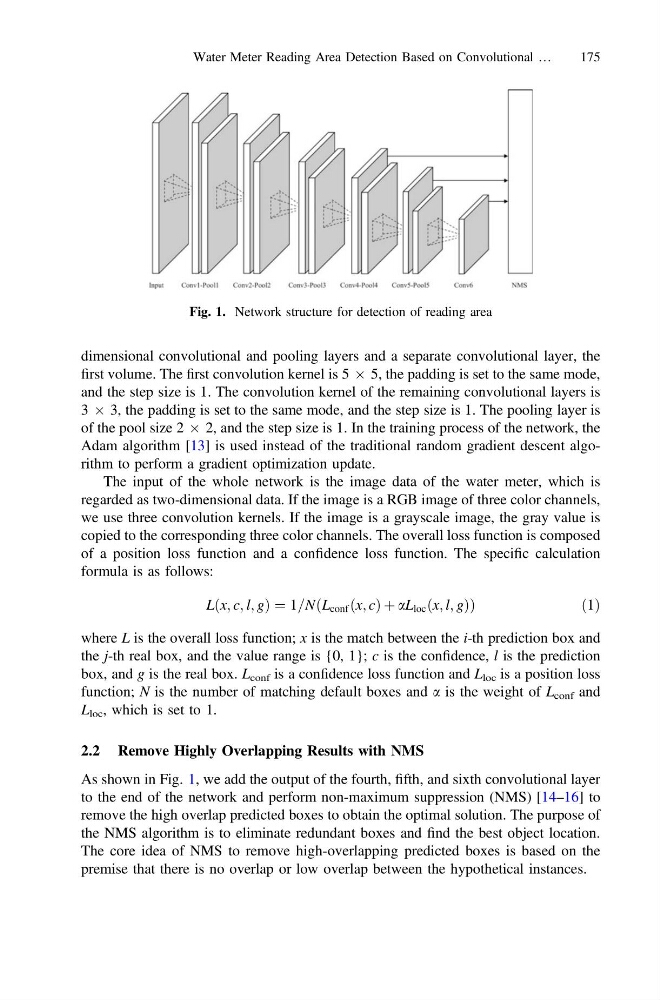
dimensional convolutional and pooling layers and a separate convolutional layer, the
first volume. The first convolution kernel is 5 Â 5, the padding is set to the same mode,
and the step size is 1. The convolution kernel of the remaining convolutional layers is
3 Â 3, the padding is set to the same mode, and the step size is 1. The pooling layer is
of the pool size 2 Â 2, and the step size is 1. In the training process of the network, the
Adam algorithm [13] is used instead of the traditional random gradient descent algorithm to perform a gradient optimization update.
The input of the whole network is the image data of the water meter, which is
regarded as two-dimensional data. If the image is a RGB image of three color channels,
we use three convolution kernels. If the image is a grayscale image, the gray value is
copied to the corresponding three color channels. The overall loss function is composed
of a position loss function and a confidence loss function. The specific calculation
formula is as follows:
L x; c; l; g
ð
Þ¼1=N L conf ðx; cÞ þ aL loc ðx; l; gÞ
ð
Þ
ð 1Þ
where L is the overall loss function; x is the match between the i-th prediction box and
the j-th real box, and the value range is {0, 1}; c is the confidence, l is the prediction
box, and g is the real box. L conf is a confidence loss function and L loc is a position loss
function; N is the number of matching default boxes and a is the weight of L conf and
L loc , which is set to 1.
2.2 Remove Highly Overlapping Results with NMS
As shown in Fig. 1, we add the output of the fourth, fifth, and sixth convolutional layer
to the end of the network and perform non-maximum suppression (NMS) [14–16] to
remove the high overlap predicted boxes to obtain the optimal solution. The purpose of
the NMS algorithm is to eliminate redundant boxes and find the best object location.
The core idea of NMS to remove high-overlapping predicted boxes is based on the
premise that there is no overlap or low overlap between the hypothetical instances.
Fig. 1. Network structure for detection of reading area
Water Meter Reading Area Detection Based on Convolutional …
175
first volume. The first convolution kernel is 5 Â 5, the padding is set to the same mode,
and the step size is 1. The convolution kernel of the remaining convolutional layers is
3 Â 3, the padding is set to the same mode, and the step size is 1. The pooling layer is
of the pool size 2 Â 2, and the step size is 1. In the training process of the network, the
Adam algorithm [13] is used instead of the traditional random gradient descent algorithm to perform a gradient optimization update.
The input of the whole network is the image data of the water meter, which is
regarded as two-dimensional data. If the image is a RGB image of three color channels,
we use three convolution kernels. If the image is a grayscale image, the gray value is
copied to the corresponding three color channels. The overall loss function is composed
of a position loss function and a confidence loss function. The specific calculation
formula is as follows:
L x; c; l; g
ð
Þ¼1=N L conf ðx; cÞ þ aL loc ðx; l; gÞ
ð
Þ
ð 1Þ
where L is the overall loss function; x is the match between the i-th prediction box and
the j-th real box, and the value range is {0, 1}; c is the confidence, l is the prediction
box, and g is the real box. L conf is a confidence loss function and L loc is a position loss
function; N is the number of matching default boxes and a is the weight of L conf and
L loc , which is set to 1.
2.2 Remove Highly Overlapping Results with NMS
As shown in Fig. 1, we add the output of the fourth, fifth, and sixth convolutional layer
to the end of the network and perform non-maximum suppression (NMS) [14–16] to
remove the high overlap predicted boxes to obtain the optimal solution. The purpose of
the NMS algorithm is to eliminate redundant boxes and find the best object location.
The core idea of NMS to remove high-overlapping predicted boxes is based on the
premise that there is no overlap or low overlap between the hypothetical instances.
Fig. 1. Network structure for detection of reading area
Water Meter Reading Area Detection Based on Convolutional …
175