

3.2 Excavating Sentimental Features of Comments
With the liberalization of microblog language, it is suitable to use simple and effective
methods of deep learning to classify, that is, to construct an LSTM-based sentimental
classifier for sentimental analysis of comments.
LSTM sentimental classifier is used to mark the sentimental tendencies of comment
data in rumor microblog and non-rumor microblog in corpus. The final results are
shown in Table 1.
According to the sentimental tendency of the comment, the sentimental intensity of
the whole comment is calculated, and the formula is as follows:
text sentiment ¼
n pos À n neg
N
ð1Þ
Among them, n represents the number of positive (negative) comments, and
N represents the total number of comments. When the sentimental value is between
[−1, 1], when it is greater than 0, it indicates that the overall sentimental of microblog
comments is positive, and vice versa, negative. The greater the absolute value, the
stronger the positive (negative) sentiment of microblog comments.
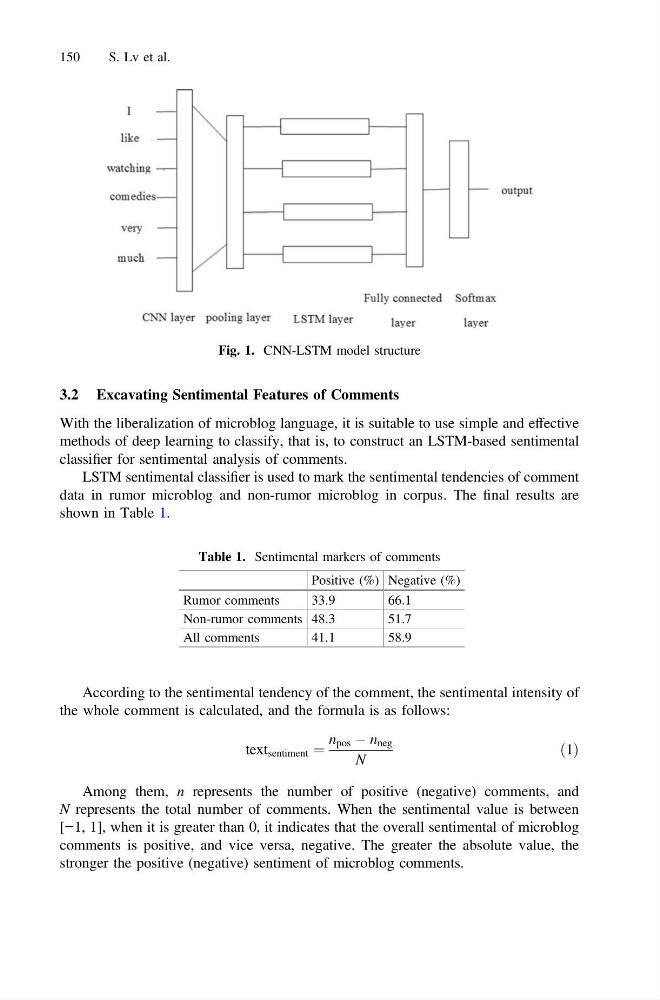
Fig. 1. CNN-LSTM model structure
Table 1. Sentimental markers of comments
Positive (%) Negative (%)
Rumor comments
33.9
66.1
Non-rumor comments 48.3
51.7
All comments
41.1
58.9
150
S. Lv et al.
With the liberalization of microblog language, it is suitable to use simple and effective
methods of deep learning to classify, that is, to construct an LSTM-based sentimental
classifier for sentimental analysis of comments.
LSTM sentimental classifier is used to mark the sentimental tendencies of comment
data in rumor microblog and non-rumor microblog in corpus. The final results are
shown in Table 1.
According to the sentimental tendency of the comment, the sentimental intensity of
the whole comment is calculated, and the formula is as follows:
text sentiment ¼
n pos À n neg
N
ð1Þ
Among them, n represents the number of positive (negative) comments, and
N represents the total number of comments. When the sentimental value is between
[−1, 1], when it is greater than 0, it indicates that the overall sentimental of microblog
comments is positive, and vice versa, negative. The greater the absolute value, the
stronger the positive (negative) sentiment of microblog comments.
Fig. 1. CNN-LSTM model structure
Table 1. Sentimental markers of comments
Positive (%) Negative (%)
Rumor comments
33.9
66.1
Non-rumor comments 48.3
51.7
All comments
41.1
58.9
150
S. Lv et al.