

server through high-speed links and upload tasks to MEC server for processing [6]. The
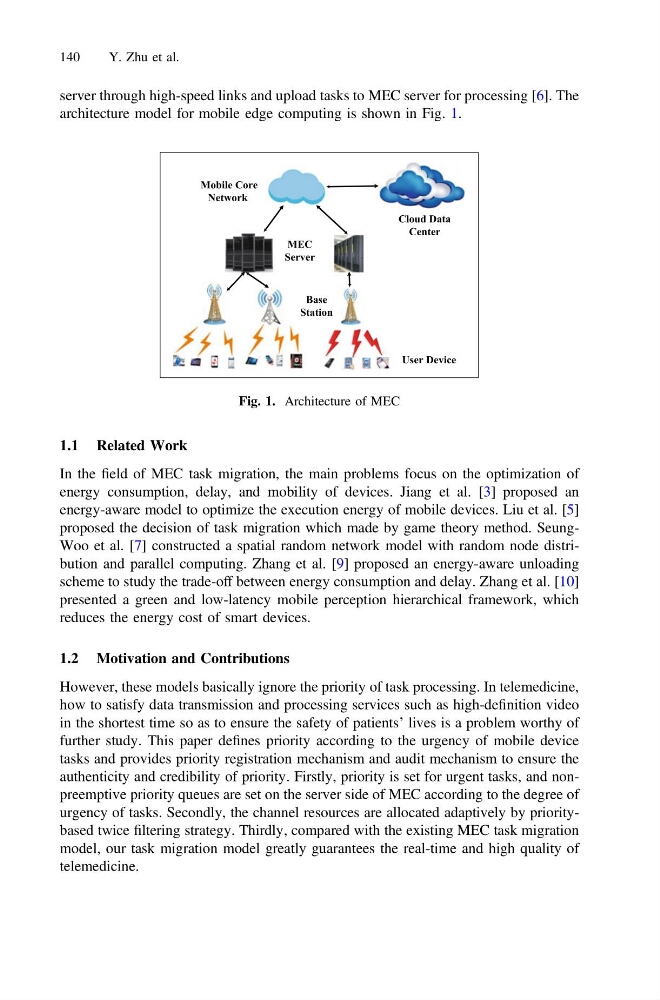
architecture model for mobile edge computing is shown in Fig. 1.
1.1 Related Work
In the field of MEC task migration, the main problems focus on the optimization of
energy consumption, delay, and mobility of devices. Jiang et al. [3] proposed an
energy-aware model to optimize the execution energy of mobile devices. Liu et al. [5]
proposed the decision of task migration which made by game theory method. SeungWoo et al. [7] constructed a spatial random network model with random node distribution and parallel computing. Zhang et al. [9] proposed an energy-aware unloading
scheme to study the trade-off between energy consumption and delay. Zhang et al. [10]
presented a green and low-latency mobile perception hierarchical framework, which
reduces the energy cost of smart devices.
1.2 Motivation and Contributions
However, these models basically ignore the priority of task processing. In telemedicine,
how to satisfy data transmission and processing services such as high-definition video
in the shortest time so as to ensure the safety of patients’ lives is a problem worthy of
further study. This paper defines priority according to the urgency of mobile device
tasks and provides priority registration mechanism and audit mechanism to ensure the
authenticity and credibility of priority. Firstly, priority is set for urgent tasks, and nonpreemptive priority queues are set on the server side of MEC according to the degree of
urgency of tasks. Secondly, the channel resources are allocated adaptively by prioritybased twice filtering strategy. Thirdly, compared with the existing MEC task migration
model, our task migration model greatly guarantees the real-time and high quality of
telemedicine.
Base
Station
MEC
Server
Mobile Core
Network
Cloud Data
Center
User Device
Fig. 1. Architecture of MEC
140
Y. Zhu et al.
architecture model for mobile edge computing is shown in Fig. 1.
1.1 Related Work
In the field of MEC task migration, the main problems focus on the optimization of
energy consumption, delay, and mobility of devices. Jiang et al. [3] proposed an
energy-aware model to optimize the execution energy of mobile devices. Liu et al. [5]
proposed the decision of task migration which made by game theory method. SeungWoo et al. [7] constructed a spatial random network model with random node distribution and parallel computing. Zhang et al. [9] proposed an energy-aware unloading
scheme to study the trade-off between energy consumption and delay. Zhang et al. [10]
presented a green and low-latency mobile perception hierarchical framework, which
reduces the energy cost of smart devices.
1.2 Motivation and Contributions
However, these models basically ignore the priority of task processing. In telemedicine,
how to satisfy data transmission and processing services such as high-definition video
in the shortest time so as to ensure the safety of patients’ lives is a problem worthy of
further study. This paper defines priority according to the urgency of mobile device
tasks and provides priority registration mechanism and audit mechanism to ensure the
authenticity and credibility of priority. Firstly, priority is set for urgent tasks, and nonpreemptive priority queues are set on the server side of MEC according to the degree of
urgency of tasks. Secondly, the channel resources are allocated adaptively by prioritybased twice filtering strategy. Thirdly, compared with the existing MEC task migration
model, our task migration model greatly guarantees the real-time and high quality of
telemedicine.
Base
Station
MEC
Server
Mobile Core
Network
Cloud Data
Center
User Device
Fig. 1. Architecture of MEC
140
Y. Zhu et al.