

Global Descriptors of Convolution Neural Networks . . .
3
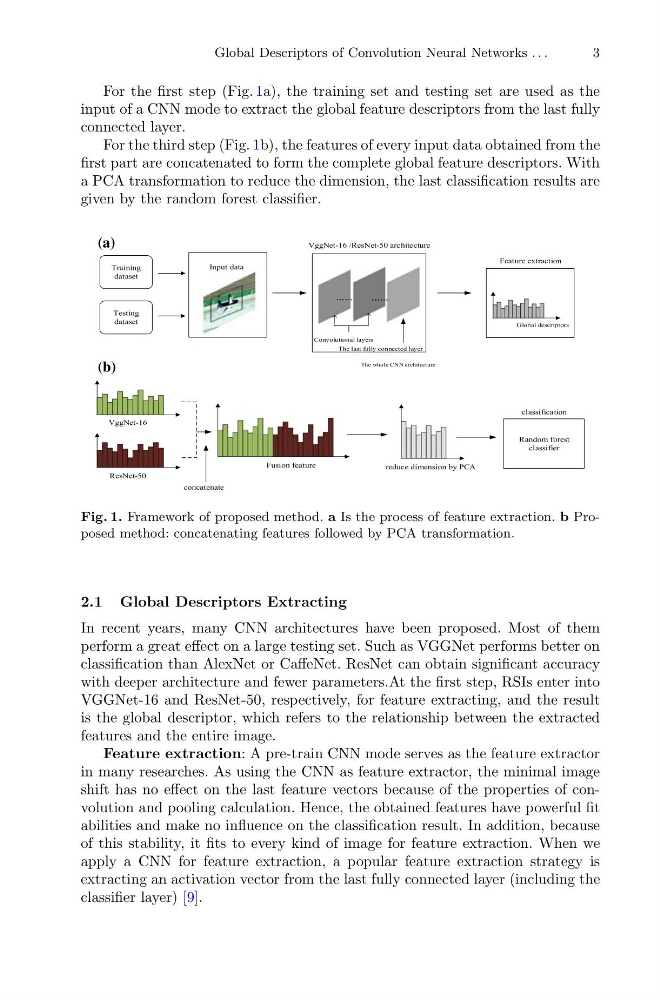
For the first step (Fig. 1a), the training set and testing set are used as the
input of a CNN mode to extract the global feature descriptors from the last fully
connected layer.
For the third step (Fig. 1b), the features of every input data obtained from the
first part are concatenated to form the complete global feature descriptors. With
a PCA transformation to reduce the dimension, the last classification results are
given by the random forest classifier.
(a)
(b)
Fig. 1. Framework of proposed method. a Is the process of feature extraction. b Proposed method: concatenating features followed by PCA transformation.
2.1 Global Descriptors Extracting
In recent years, many CNN architectures have been proposed. Most of them
perform a great effect on a large testing set. Such as VGGNet performs better on
classification than AlexNet or CaffeNet. ResNet can obtain significant accuracy
with deeper architecture and fewer parameters.At the first step, RSIs enter into
VGGNet-16 and ResNet-50, respectively, for feature extracting, and the result
is the global descriptor, which refers to the relationship between the extracted
features and the entire image.
Feature extraction: A pre-train CNN mode serves as the feature extractor
in many researches. As using the CNN as feature extractor, the minimal image
shift has no effect on the last feature vectors because of the properties of convolution and pooling calculation. Hence, the obtained features have powerful fit
abilities and make no influence on the classification result. In addition, because
of this stability, it fits to every kind of image for feature extraction. When we
apply a CNN for feature extraction, a popular feature extraction strategy is
extracting an activation vector from the last fully connected layer (including the
classifier layer) [9].
3
For the first step (Fig. 1a), the training set and testing set are used as the
input of a CNN mode to extract the global feature descriptors from the last fully
connected layer.
For the third step (Fig. 1b), the features of every input data obtained from the
first part are concatenated to form the complete global feature descriptors. With
a PCA transformation to reduce the dimension, the last classification results are
given by the random forest classifier.
(a)
(b)
Fig. 1. Framework of proposed method. a Is the process of feature extraction. b Proposed method: concatenating features followed by PCA transformation.
2.1 Global Descriptors Extracting
In recent years, many CNN architectures have been proposed. Most of them
perform a great effect on a large testing set. Such as VGGNet performs better on
classification than AlexNet or CaffeNet. ResNet can obtain significant accuracy
with deeper architecture and fewer parameters.At the first step, RSIs enter into
VGGNet-16 and ResNet-50, respectively, for feature extracting, and the result
is the global descriptor, which refers to the relationship between the extracted
features and the entire image.
Feature extraction: A pre-train CNN mode serves as the feature extractor
in many researches. As using the CNN as feature extractor, the minimal image
shift has no effect on the last feature vectors because of the properties of convolution and pooling calculation. Hence, the obtained features have powerful fit
abilities and make no influence on the classification result. In addition, because
of this stability, it fits to every kind of image for feature extraction. When we
apply a CNN for feature extraction, a popular feature extraction strategy is
extracting an activation vector from the last fully connected layer (including the
classifier layer) [9].