

2 Related Works
So far, there are two main methods of event recognition, one is the rule-based method
to identify the event and the other is to extract the event through machine learning.
The rule-based identification method is to identify the type of event by manually
defining rules for the text, creating a template and matching the text. Yankova and
Boytcheva [3] and Rainer [4] use their knowledge and logical form representations in
different fields to infer facts and template fills. Yangarber [5] takes advantage of regular
expressions and an association map from syntactic to logical form for event extraction.
However, this method requires a large amount of manpower and related experts to
analyze them, and the accuracy of the extraction is not high.
Research scholars are also concerned about the problems brought by the rules. With
the extensive use of machine learning, more and more people combine event recognition with machine learning [6]. For example, Ahn [7] has used MegaM and TiMBL,
two kinds of machine learning methods have been used for event extraction and have
achieved good results in English corpus; Comparing with independent learning classifiers, Vlachos [8] used structured predictive learning model, which based on
searching. As the core of artificial intelligence, machine learning improves the performance of the algorithm itself through experience learning and solves the shortcomings of requiring a large amount of manpower in the rule-based way.
As a branch of machine learning, deep learning [9] is one of the most popular
machine learnings. In 2014, Kim [10] proposed a convolutional neural network which
achieved good results in text classification; Su et al. [11] combines two trained RNN
models with a dictionary to obtain the best recognition results. In this paper, we will
use the RCNN [12] that combines the CNN with the RNN, which not only contact the
context, but also solve the shortcomings of data bias in the RNN.
3 Improved RCNN Incident Identification Method
3.1 The Principle of Traditional RCNN
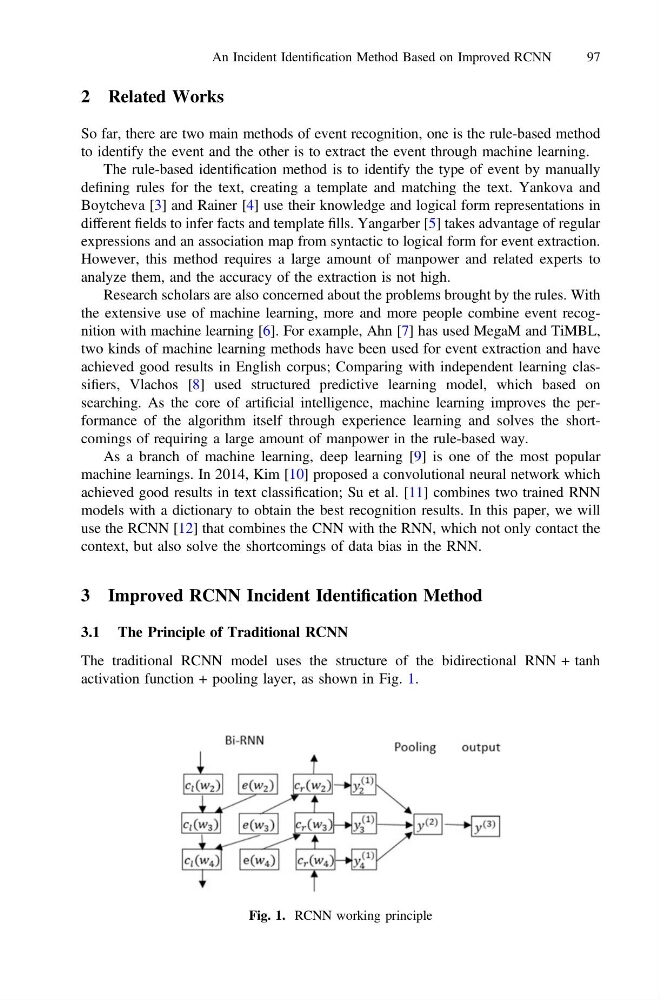
The traditional RCNN model uses the structure of the bidirectional RNN + tanh
activation function + pooling layer, as shown in Fig. 1.
Fig. 1. RCNN working principle
An Incident Identification Method Based on Improved RCNN
97
So far, there are two main methods of event recognition, one is the rule-based method
to identify the event and the other is to extract the event through machine learning.
The rule-based identification method is to identify the type of event by manually
defining rules for the text, creating a template and matching the text. Yankova and
Boytcheva [3] and Rainer [4] use their knowledge and logical form representations in
different fields to infer facts and template fills. Yangarber [5] takes advantage of regular
expressions and an association map from syntactic to logical form for event extraction.
However, this method requires a large amount of manpower and related experts to
analyze them, and the accuracy of the extraction is not high.
Research scholars are also concerned about the problems brought by the rules. With
the extensive use of machine learning, more and more people combine event recognition with machine learning [6]. For example, Ahn [7] has used MegaM and TiMBL,
two kinds of machine learning methods have been used for event extraction and have
achieved good results in English corpus; Comparing with independent learning classifiers, Vlachos [8] used structured predictive learning model, which based on
searching. As the core of artificial intelligence, machine learning improves the performance of the algorithm itself through experience learning and solves the shortcomings of requiring a large amount of manpower in the rule-based way.
As a branch of machine learning, deep learning [9] is one of the most popular
machine learnings. In 2014, Kim [10] proposed a convolutional neural network which
achieved good results in text classification; Su et al. [11] combines two trained RNN
models with a dictionary to obtain the best recognition results. In this paper, we will
use the RCNN [12] that combines the CNN with the RNN, which not only contact the
context, but also solve the shortcomings of data bias in the RNN.
3 Improved RCNN Incident Identification Method
3.1 The Principle of Traditional RCNN
The traditional RCNN model uses the structure of the bidirectional RNN + tanh
activation function + pooling layer, as shown in Fig. 1.
Fig. 1. RCNN working principle
An Incident Identification Method Based on Improved RCNN
97