

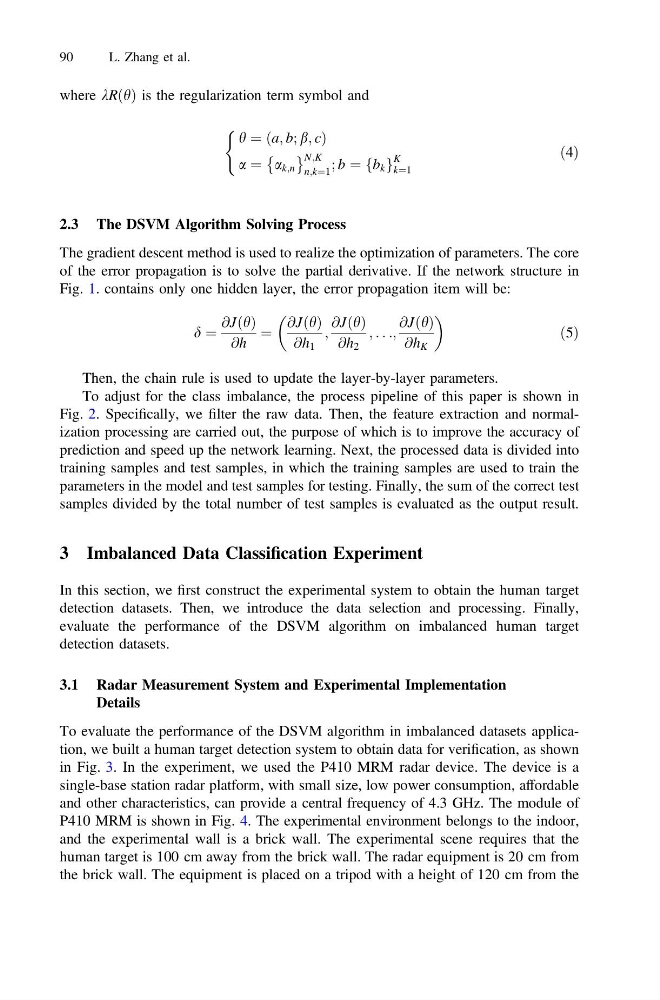
where kRðhÞ is the regularization term symbol and
h ¼ ða; b; b; cÞ
a ¼ a k;n
È É N;K
n;k¼1
; b ¼ fb k g
K
k¼1
(
ð4Þ
2.3 The DSVM Algorithm Solving Process
The gradient descent method is used to realize the optimization of parameters. The core
of the error propagation is to solve the partial derivative. If the network structure in
Fig. 1. contains only one hidden layer, the error propagation item will be:
d ¼
@JðhÞ
@h
¼
@JðhÞ
@h 1
;
@JðhÞ
@h 2
; . . .;
@JðhÞ
@h K
ð5Þ
Then, the chain rule is used to update the layer-by-layer parameters.
To adjust for the class imbalance, the process pipeline of this paper is shown in
Fig. 2. Specifically, we filter the raw data. Then, the feature extraction and normalization processing are carried out, the purpose of which is to improve the accuracy of
prediction and speed up the network learning. Next, the processed data is divided into
training samples and test samples, in which the training samples are used to train the
parameters in the model and test samples for testing. Finally, the sum of the correct test
samples divided by the total number of test samples is evaluated as the output result.
3 Imbalanced Data Classification Experiment
In this section, we first construct the experimental system to obtain the human target
detection datasets. Then, we introduce the data selection and processing. Finally,
evaluate the performance of the DSVM algorithm on imbalanced human target
detection datasets.
3.1 Radar Measurement System and Experimental Implementation
Details
To evaluate the performance of the DSVM algorithm in imbalanced datasets application, we built a human target detection system to obtain data for verification, as shown
in Fig. 3. In the experiment, we used the P410 MRM radar device. The device is a
single-base station radar platform, with small size, low power consumption, affordable
and other characteristics, can provide a central frequency of 4.3 GHz. The module of
P410 MRM is shown in Fig. 4. The experimental environment belongs to the indoor,
and the experimental wall is a brick wall. The experimental scene requires that the
human target is 100 cm away from the brick wall. The radar equipment is 20 cm from
the brick wall. The equipment is placed on a tripod with a height of 120 cm from the
90
L. Zhang et al.
h ¼ ða; b; b; cÞ
a ¼ a k;n
È É N;K
n;k¼1
; b ¼ fb k g
K
k¼1
(
ð4Þ
2.3 The DSVM Algorithm Solving Process
The gradient descent method is used to realize the optimization of parameters. The core
of the error propagation is to solve the partial derivative. If the network structure in
Fig. 1. contains only one hidden layer, the error propagation item will be:
d ¼
@JðhÞ
@h
¼
@JðhÞ
@h 1
;
@JðhÞ
@h 2
; . . .;
@JðhÞ
@h K
ð5Þ
Then, the chain rule is used to update the layer-by-layer parameters.
To adjust for the class imbalance, the process pipeline of this paper is shown in
Fig. 2. Specifically, we filter the raw data. Then, the feature extraction and normalization processing are carried out, the purpose of which is to improve the accuracy of
prediction and speed up the network learning. Next, the processed data is divided into
training samples and test samples, in which the training samples are used to train the
parameters in the model and test samples for testing. Finally, the sum of the correct test
samples divided by the total number of test samples is evaluated as the output result.
3 Imbalanced Data Classification Experiment
In this section, we first construct the experimental system to obtain the human target
detection datasets. Then, we introduce the data selection and processing. Finally,
evaluate the performance of the DSVM algorithm on imbalanced human target
detection datasets.
3.1 Radar Measurement System and Experimental Implementation
Details
To evaluate the performance of the DSVM algorithm in imbalanced datasets application, we built a human target detection system to obtain data for verification, as shown
in Fig. 3. In the experiment, we used the P410 MRM radar device. The device is a
single-base station radar platform, with small size, low power consumption, affordable
and other characteristics, can provide a central frequency of 4.3 GHz. The module of
P410 MRM is shown in Fig. 4. The experimental environment belongs to the indoor,
and the experimental wall is a brick wall. The experimental scene requires that the
human target is 100 cm away from the brick wall. The radar equipment is 20 cm from
the brick wall. The equipment is placed on a tripod with a height of 120 cm from the
90
L. Zhang et al.