

72
4 Bessel and Airy Functions
More recurrence formulas can be found, e.g., in [1, 2]. The first pair is of limited
use for numerically applications, because the first one is only downwards and the
second one upwards stable. We will use the second pair (4.17) to compute the first
derivative of Bessel functions for path integral based computations.
Computational Aspects: Bessel Function J ν (z)
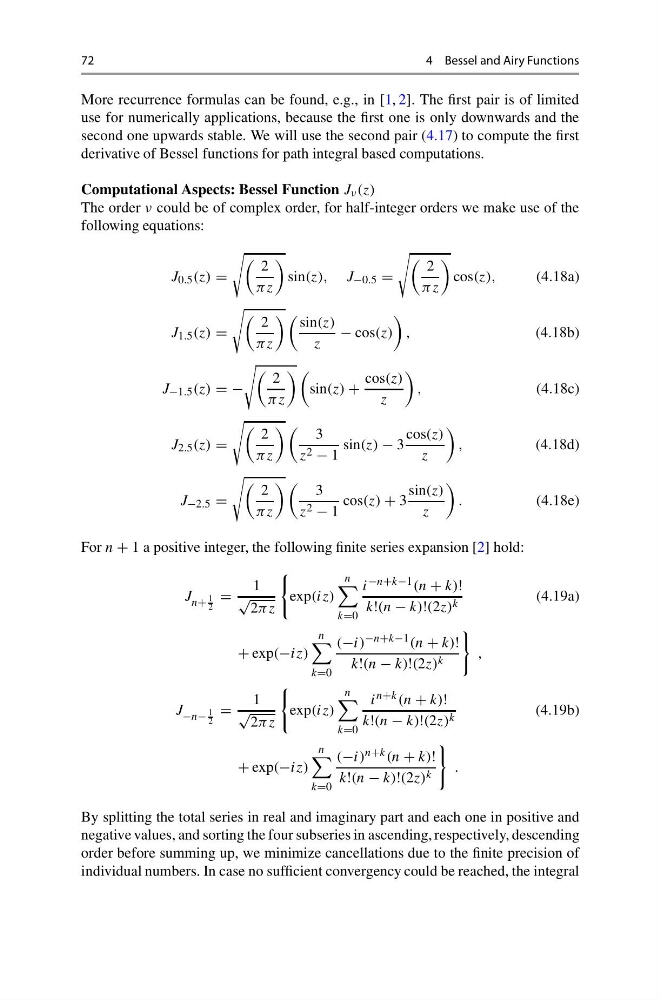
The order ν could be of complex order, for half-integer orders we make use of the
following equations:
J 0.5 (z) =
2
πz
sin(z), J −0.5 =
2
πz
cos(z),
(4.18a)
J 1.5 (z) =
2
πz
sin(z)
z
− cos(z)
,
(4.18b)
J −1.5 (z) = −
2
πz
sin(z) +
cos(z)
z
,
(4.18c)
J 2.5 (z) =
2
πz
3
z 2 − 1
sin(z) − 3
cos(z)
z
,
(4.18d)
J −2.5 =
2
πz
3
z 2 − 1
cos(z) + 3
sin(z)
z
.
(4.18e)
For n + 1 a positive integer, the following finite series expansion [2] hold:
J n+
1
2
=
1
√
2πz
exp(iz)
n
k=0
i −n+k−1 (n + k)!
k!(n − k)!(2z) k
(4.19a)
+ exp(−iz)
n
k=0
(−i) −n+k−1 (n + k)!
k!(n − k)!(2z) k
,
J −n−
1
2
=
1
√
2πz
exp(iz)
n
k=0
i n+k (n + k)!
k!(n − k)!(2z) k
(4.19b)
+ exp(−iz)
n
k=0
(−i) n+k (n + k)!
k!(n − k)!(2z) k
.
By splitting the total series in real and imaginary part and each one in positive and
negative values, and sorting the four subseries in ascending, respectively, descending
order before summing up, we minimize cancellations due to the finite precision of
individual numbers. In case no sufficient convergency could be reached, the integral
4 Bessel and Airy Functions
More recurrence formulas can be found, e.g., in [1, 2]. The first pair is of limited
use for numerically applications, because the first one is only downwards and the
second one upwards stable. We will use the second pair (4.17) to compute the first
derivative of Bessel functions for path integral based computations.
Computational Aspects: Bessel Function J ν (z)
The order ν could be of complex order, for half-integer orders we make use of the
following equations:
J 0.5 (z) =
2
πz
sin(z), J −0.5 =
2
πz
cos(z),
(4.18a)
J 1.5 (z) =
2
πz
sin(z)
z
− cos(z)
,
(4.18b)
J −1.5 (z) = −
2
πz
sin(z) +
cos(z)
z
,
(4.18c)
J 2.5 (z) =
2
πz
3
z 2 − 1
sin(z) − 3
cos(z)
z
,
(4.18d)
J −2.5 =
2
πz
3
z 2 − 1
cos(z) + 3
sin(z)
z
.
(4.18e)
For n + 1 a positive integer, the following finite series expansion [2] hold:
J n+
1
2
=
1
√
2πz
exp(iz)
n
k=0
i −n+k−1 (n + k)!
k!(n − k)!(2z) k
(4.19a)
+ exp(−iz)
n
k=0
(−i) −n+k−1 (n + k)!
k!(n − k)!(2z) k
,
J −n−
1
2
=
1
√
2πz
exp(iz)
n
k=0
i n+k (n + k)!
k!(n − k)!(2z) k
(4.19b)
+ exp(−iz)
n
k=0
(−i) n+k (n + k)!
k!(n − k)!(2z) k
.
By splitting the total series in real and imaginary part and each one in positive and
negative values, and sorting the four subseries in ascending, respectively, descending
order before summing up, we minimize cancellations due to the finite precision of
individual numbers. In case no sufficient convergency could be reached, the integral