

70
4 Bessel and Airy Functions
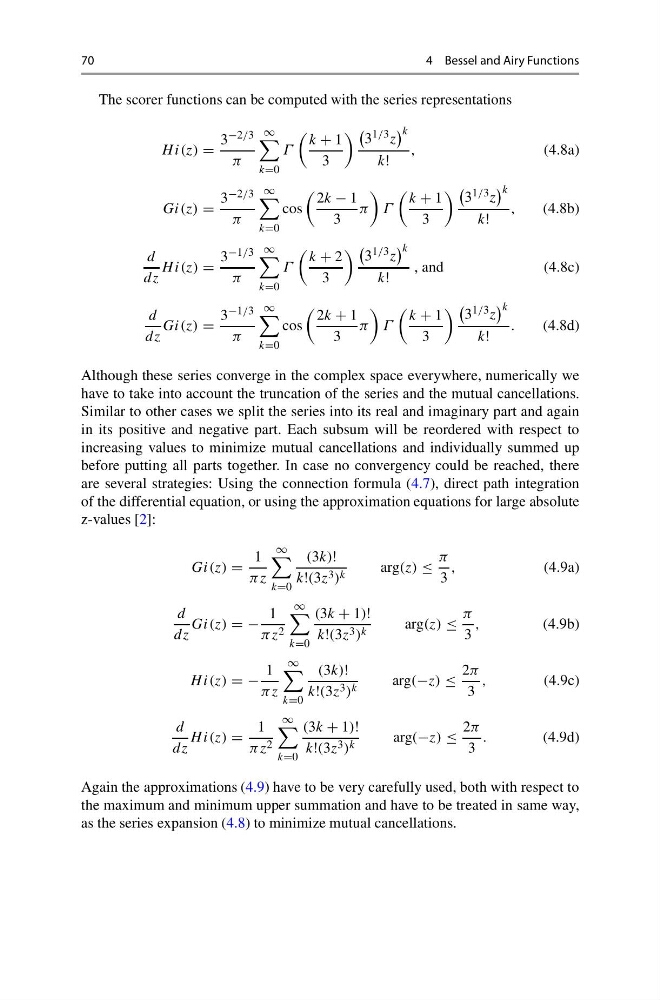
The scorer functions can be computed with the series representations
H i(z) =
3 −2/3
π
∞
k=0
Γ
k + 1
3
3 1/3 z
k
k!
,
(4.8a)
Gi(z) =
3 −2/3
π
∞
k=0
cos
2k − 1
3
π
Γ
k + 1
3
3 1/3 z
k
k!
,
(4.8b)
d
dz
H i(z) =
3 −1/3
π
∞
k=0
Γ
k + 2
3
3 1/3 z
k
k!
, and
(4.8c)
d
dz
Gi(z) =
3 −1/3
π
∞
k=0
cos
2k + 1
3
π
Γ
k + 1
3
3 1/3 z
k
k!
.
(4.8d)
Although these series converge in the complex space everywhere, numerically we
have to take into account the truncation of the series and the mutual cancellations.
Similar to other cases we split the series into its real and imaginary part and again
in its positive and negative part. Each subsum will be reordered with respect to
increasing values to minimize mutual cancellations and individually summed up
before putting all parts together. In case no convergency could be reached, there
are several strategies: Using the connection formula (4.7), direct path integration
of the differential equation, or using the approximation equations for large absolute
z-values [2]:
Gi(z) =
1
πz
∞
k=0
(3k)!
k!(3z 3 ) k
arg(z) ≤
π
3
,
(4.9a)
d
dz
Gi(z) = −
1
πz 2
∞
k=0
(3k + 1)!
k!(3z 3 ) k
arg(z) ≤
π
3
,
(4.9b)
H i(z) = −
1
πz
∞
k=0
(3k)!
k!(3z 3 ) k
arg(−z) ≤
2π
3
,
(4.9c)
d
dz
H i(z) =
1
πz 2
∞
k=0
(3k + 1)!
k!(3z 3 ) k
arg(−z) ≤
2π
3
.
(4.9d)
Again the approximations (4.9) have to be very carefully used, both with respect to
the maximum and minimum upper summation and have to be treated in same way,
as the series expansion (4.8) to minimize mutual cancellations.
4 Bessel and Airy Functions
The scorer functions can be computed with the series representations
H i(z) =
3 −2/3
π
∞
k=0
Γ
k + 1
3
3 1/3 z
k
k!
,
(4.8a)
Gi(z) =
3 −2/3
π
∞
k=0
cos
2k − 1
3
π
Γ
k + 1
3
3 1/3 z
k
k!
,
(4.8b)
d
dz
H i(z) =
3 −1/3
π
∞
k=0
Γ
k + 2
3
3 1/3 z
k
k!
, and
(4.8c)
d
dz
Gi(z) =
3 −1/3
π
∞
k=0
cos
2k + 1
3
π
Γ
k + 1
3
3 1/3 z
k
k!
.
(4.8d)
Although these series converge in the complex space everywhere, numerically we
have to take into account the truncation of the series and the mutual cancellations.
Similar to other cases we split the series into its real and imaginary part and again
in its positive and negative part. Each subsum will be reordered with respect to
increasing values to minimize mutual cancellations and individually summed up
before putting all parts together. In case no convergency could be reached, there
are several strategies: Using the connection formula (4.7), direct path integration
of the differential equation, or using the approximation equations for large absolute
z-values [2]:
Gi(z) =
1
πz
∞
k=0
(3k)!
k!(3z 3 ) k
arg(z) ≤
π
3
,
(4.9a)
d
dz
Gi(z) = −
1
πz 2
∞
k=0
(3k + 1)!
k!(3z 3 ) k
arg(z) ≤
π
3
,
(4.9b)
H i(z) = −
1
πz
∞
k=0
(3k)!
k!(3z 3 ) k
arg(−z) ≤
2π
3
,
(4.9c)
d
dz
H i(z) =
1
πz 2
∞
k=0
(3k + 1)!
k!(3z 3 ) k
arg(−z) ≤
2π
3
.
(4.9d)
Again the approximations (4.9) have to be very carefully used, both with respect to
the maximum and minimum upper summation and have to be treated in same way,
as the series expansion (4.8) to minimize mutual cancellations.