

3.4 Associate Legendre Functions with Complex Indices
55
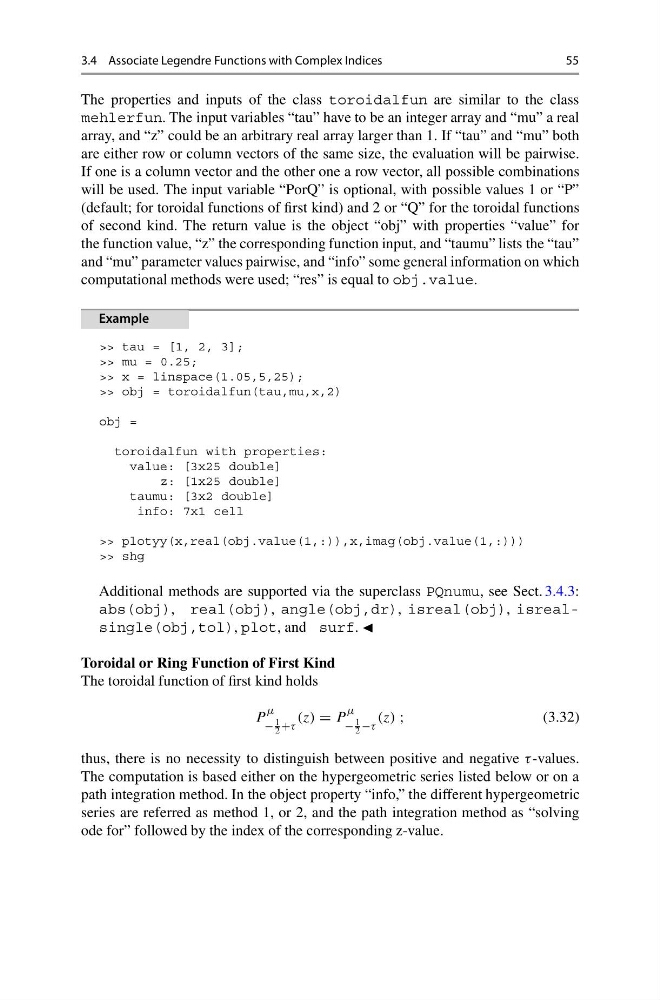
The properties and inputs of the class toroidalfun are similar to the class
mehlerfun. The input variables “tau” have to be an integer array and “mu” a real
array, and “z” could be an arbitrary real array larger than 1. If “tau” and “mu” both
are either row or column vectors of the same size, the evaluation will be pairwise.
If one is a column vector and the other one a row vector, all possible combinations
will be used. The input variable “PorQ” is optional, with possible values 1 or “P”
(default; for toroidal functions of first kind) and 2 or “Q” for the toroidal functions
of second kind. The return value is the object “obj” with properties “value” for
the function value, “z” the corresponding function input, and “taumu” lists the “tau”
and “mu” parameter values pairwise, and “info” some general information on which
computational methods were used; “res” is equal to obj.value.
Example
>> tau = [1, 2, 3];
>> mu = 0.25;
>> x = linspace(1.05,5,25);
>> obj = toroidalfun(tau,mu,x,2)
obj =
toroidalfun with properties:
value: [3x25 double]
z: [1x25 double]
taumu: [3x2 double]
info: 7x1 cell
>> plotyy(x,real(obj.value(1,:)),x,imag(obj.value(1,:)))
>> shg
Additional methods are supported via the superclass PQnumu, see Sect. 3.4.3:
abs(obj), real(obj), angle(obj,dr), isreal(obj), isrealsingle(obj,tol), plot, and surf.
Toroidal or Ring Function of First Kind
The toroidal function of first kind holds
P
μ
−
1
2 +τ
(z) = P
μ
−
1
2 −τ
(z) ;
(3.32)
thus, there is no necessity to distinguish between positive and negative τ -values.
The computation is based either on the hypergeometric series listed below or on a
path integration method. In the object property “info,” the different hypergeometric
series are referred as method 1, or 2, and the path integration method as “solving
ode for” followed by the index of the corresponding z-value.
55
The properties and inputs of the class toroidalfun are similar to the class
mehlerfun. The input variables “tau” have to be an integer array and “mu” a real
array, and “z” could be an arbitrary real array larger than 1. If “tau” and “mu” both
are either row or column vectors of the same size, the evaluation will be pairwise.
If one is a column vector and the other one a row vector, all possible combinations
will be used. The input variable “PorQ” is optional, with possible values 1 or “P”
(default; for toroidal functions of first kind) and 2 or “Q” for the toroidal functions
of second kind. The return value is the object “obj” with properties “value” for
the function value, “z” the corresponding function input, and “taumu” lists the “tau”
and “mu” parameter values pairwise, and “info” some general information on which
computational methods were used; “res” is equal to obj.value.
Example
>> tau = [1, 2, 3];
>> mu = 0.25;
>> x = linspace(1.05,5,25);
>> obj = toroidalfun(tau,mu,x,2)
obj =
toroidalfun with properties:
value: [3x25 double]
z: [1x25 double]
taumu: [3x2 double]
info: 7x1 cell
>> plotyy(x,real(obj.value(1,:)),x,imag(obj.value(1,:)))
>> shg
Additional methods are supported via the superclass PQnumu, see Sect. 3.4.3:
abs(obj), real(obj), angle(obj,dr), isreal(obj), isrealsingle(obj,tol), plot, and surf.
Toroidal or Ring Function of First Kind
The toroidal function of first kind holds
P
μ
−
1
2 +τ
(z) = P
μ
−
1
2 −τ
(z) ;
(3.32)
thus, there is no necessity to distinguish between positive and negative τ -values.
The computation is based either on the hypergeometric series listed below or on a
path integration method. In the object property “info,” the different hypergeometric
series are referred as method 1, or 2, and the path integration method as “solving
ode for” followed by the index of the corresponding z-value.