

3.4 Associate Legendre Functions with Complex Indices
49
+ 2
μ √
π
cos
1
2 (ν + μ)π
Γ (
ν+μ
2 + 1)
Γ (
ν−μ+1
2
)
x (1 − x
2 )
μ/2
(3.24d)
× 2 F 1
ν + μ
2
+ 1,
μ − ν + 1
2
;
3
2
; x
2
.
If μ is not an integer, the Legendre functions of first and second kind are related via
Eq. (3.12b). Therefore, in case the hypergeometric series expansion of Q
μ
ν should
not converge, Q
μ
ν will be calculated from the pair (P
μ
ν , P
−μ
ν ). Either μ is an integer
or this pair is not converged, and the corresponding differential equation of the
hypergeometric function will be directly solved.
Hypergeometric Series: Programming Hints
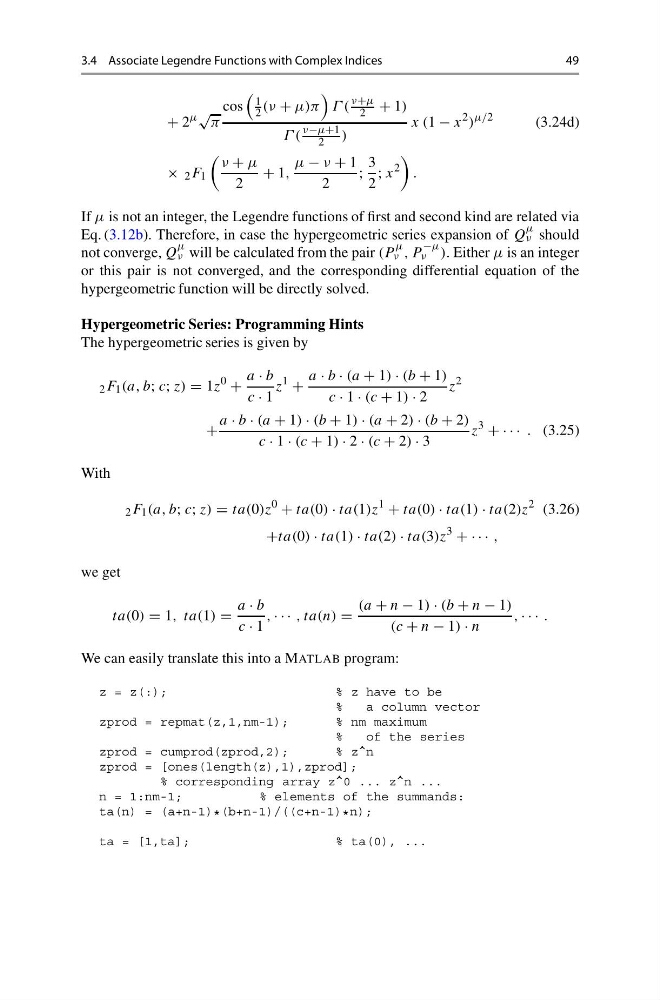
The hypergeometric series is given by
2 F 1 (a, b; c; z) = 1z
0
+
a · b
c · 1
z
1
+
a · b · (a + 1) · (b + 1)
c · 1 · (c + 1) · 2
z
2
+
a · b · (a + 1) · (b + 1) · (a + 2) · (b + 2)
c · 1 · (c + 1) · 2 · (c + 2) · 3
z
3
+ · · · . (3.25)
With
2 F 1 (a, b; c; z) = ta(0)z
0
+ ta(0) · ta(1)z
1
+ ta(0) · ta(1) · ta(2)z
2 (3.26)
+ta(0) · ta(1) · ta(2) · ta(3)z
3
+ · · · ,
we get
ta(0) = 1, ta(1) =
a · b
c · 1
, · · · , ta(n) =
(a + n − 1) · (b + n − 1)
(c + n − 1) · n
, · · · .
We can easily translate this into a MATLAB program:
z = z(:);
% z have to be
%
a column vector
zprod = repmat(z,1,nm-1);
% nm maximum
%
of the series
zprod = cumprod(zprod,2);
% z^n
zprod = [ones(length(z),1),zprod];
% corresponding array z^0 ... z^n ...
n = 1:nm-1;
% elements of the summands:
ta(n) = (a+n-1) * (b+n-1)/((c+n-1) * n);
ta = [1,ta];
% ta(0), ...
49
+ 2
μ √
π
cos
1
2 (ν + μ)π
Γ (
ν+μ
2 + 1)
Γ (
ν−μ+1
2
)
x (1 − x
2 )
μ/2
(3.24d)
× 2 F 1
ν + μ
2
+ 1,
μ − ν + 1
2
;
3
2
; x
2
.
If μ is not an integer, the Legendre functions of first and second kind are related via
Eq. (3.12b). Therefore, in case the hypergeometric series expansion of Q
μ
ν should
not converge, Q
μ
ν will be calculated from the pair (P
μ
ν , P
−μ
ν ). Either μ is an integer
or this pair is not converged, and the corresponding differential equation of the
hypergeometric function will be directly solved.
Hypergeometric Series: Programming Hints
The hypergeometric series is given by
2 F 1 (a, b; c; z) = 1z
0
+
a · b
c · 1
z
1
+
a · b · (a + 1) · (b + 1)
c · 1 · (c + 1) · 2
z
2
+
a · b · (a + 1) · (b + 1) · (a + 2) · (b + 2)
c · 1 · (c + 1) · 2 · (c + 2) · 3
z
3
+ · · · . (3.25)
With
2 F 1 (a, b; c; z) = ta(0)z
0
+ ta(0) · ta(1)z
1
+ ta(0) · ta(1) · ta(2)z
2 (3.26)
+ta(0) · ta(1) · ta(2) · ta(3)z
3
+ · · · ,
we get
ta(0) = 1, ta(1) =
a · b
c · 1
, · · · , ta(n) =
(a + n − 1) · (b + n − 1)
(c + n − 1) · n
, · · · .
We can easily translate this into a MATLAB program:
z = z(:);
% z have to be
%
a column vector
zprod = repmat(z,1,nm-1);
% nm maximum
%
of the series
zprod = cumprod(zprod,2);
% z^n
zprod = [ones(length(z),1),zprod];
% corresponding array z^0 ... z^n ...
n = 1:nm-1;
% elements of the summands:
ta(n) = (a+n-1) * (b+n-1)/((c+n-1) * n);
ta = [1,ta];
% ta(0), ...