

260
23 Coordinate Systems
23.1 Separability in Three Dimensions
For a three dimensional system it can be shown that the Laplace–Beltrami operator
Δ can be separated in 11 different curvilinear coordinates. For each of these
coordinates the potential V (r) has to fulfill certain properties that the Schrödinger
equation becomes separable, thus can be mapped on three one-dimensional differential equations.
For all orthogonal curvilinear coordinates q j in three dimensions the following
conditions hold:
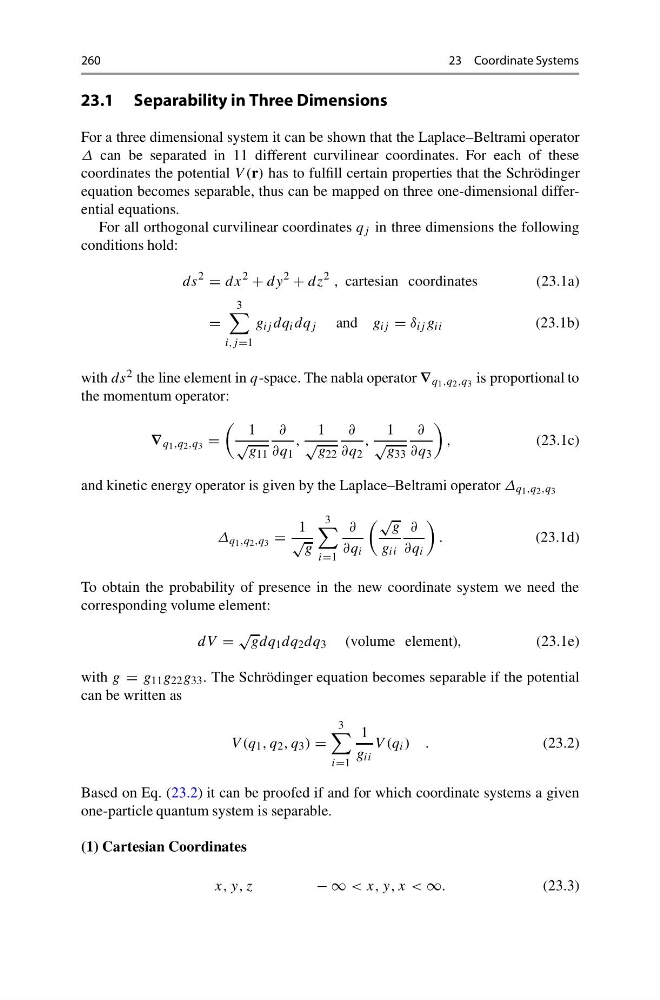
ds
2
= dx
2
+ dy
2
+ dz
2 , cartesian coordinates
(23.1a)
=
3
i,j =1
g ij dq i dq j and g ij = δ ij g ii
(23.1b)
with ds 2 the line element in q-space. The nabla operator ∇ q 1 ,q 2 ,q 3 is proportional to
the momentum operator:
∇ q 1 ,q 2 ,q 3 =
1
√
g 11
∂
∂q 1
,
1
√ g 22
∂
∂q 2
,
1
√
g 33
∂
∂q 3
,
(23.1c)
and kinetic energy operator is given by the Laplace–Beltrami operator Δ q 1 ,q 2 ,q 3
Δ q 1 ,q 2 ,q 3 =
1
√
g
3
i=1
∂
∂q i
√
g
g ii
∂
∂q i
.
(23.1d)
To obtain the probability of presence in the new coordinate system we need the
corresponding volume element:
dV =
√
gdq 1 dq 2 dq 3 (volume element),
(23.1e)
with g = g 11 g 22 g 33 . The Schrödinger equation becomes separable if the potential
can be written as
V (q 1 , q 2 , q 3 ) =
3
i=1
1
g ii
V (q i ) .
(23.2)
Based on Eq. (23.2) it can be proofed if and for which coordinate systems a given
one-particle quantum system is separable.
(1) Cartesian Coordinates
x, y, z
− ∞ < x, y, x < ∞.
(23.3)
23 Coordinate Systems
23.1 Separability in Three Dimensions
For a three dimensional system it can be shown that the Laplace–Beltrami operator
Δ can be separated in 11 different curvilinear coordinates. For each of these
coordinates the potential V (r) has to fulfill certain properties that the Schrödinger
equation becomes separable, thus can be mapped on three one-dimensional differential equations.
For all orthogonal curvilinear coordinates q j in three dimensions the following
conditions hold:
ds
2
= dx
2
+ dy
2
+ dz
2 , cartesian coordinates
(23.1a)
=
3
i,j =1
g ij dq i dq j and g ij = δ ij g ii
(23.1b)
with ds 2 the line element in q-space. The nabla operator ∇ q 1 ,q 2 ,q 3 is proportional to
the momentum operator:
∇ q 1 ,q 2 ,q 3 =
1
√
g 11
∂
∂q 1
,
1
√ g 22
∂
∂q 2
,
1
√
g 33
∂
∂q 3
,
(23.1c)
and kinetic energy operator is given by the Laplace–Beltrami operator Δ q 1 ,q 2 ,q 3
Δ q 1 ,q 2 ,q 3 =
1
√
g
3
i=1
∂
∂q i
√
g
g ii
∂
∂q i
.
(23.1d)
To obtain the probability of presence in the new coordinate system we need the
corresponding volume element:
dV =
√
gdq 1 dq 2 dq 3 (volume element),
(23.1e)
with g = g 11 g 22 g 33 . The Schrödinger equation becomes separable if the potential
can be written as
V (q 1 , q 2 , q 3 ) =
3
i=1
1
g ii
V (q i ) .
(23.2)
Based on Eq. (23.2) it can be proofed if and for which coordinate systems a given
one-particle quantum system is separable.
(1) Cartesian Coordinates
x, y, z
− ∞ < x, y, x < ∞.
(23.3)