

226
19 Bernoulli and Euler Polynomials
19.1 Bernoulli Numbers and Bernoulli Polynomials
19.1.1 Equations
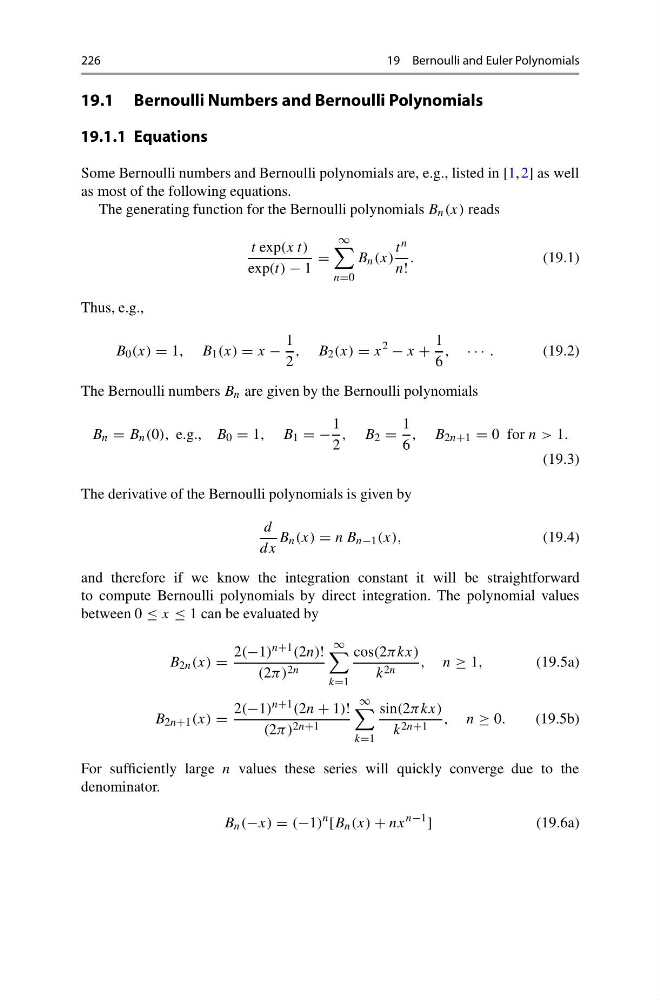
Some Bernoulli numbers and Bernoulli polynomials are, e.g., listed in [1, 2] as well
as most of the following equations.
The generating function for the Bernoulli polynomials B n (x) reads
t exp(x t)
exp(t) − 1
=
∞
n=0
B n (x)
t n
n!
.
(19.1)
Thus, e.g.,
B 0 (x) = 1, B 1 (x) = x −
1
2
, B 2 (x) = x
2
− x +
1
6
, · · · .
(19.2)
The Bernoulli numbers B n are given by the Bernoulli polynomials
B n = B n (0), e.g., B 0 = 1, B 1 = −
1
2
, B 2 =
1
6
, B 2n+1 = 0 for n > 1.
(19.3)
The derivative of the Bernoulli polynomials is given by
d
dx
B n (x) = n B n−1 (x),
(19.4)
and therefore if we know the integration constant it will be straightforward
to compute Bernoulli polynomials by direct integration. The polynomial values
between 0 ≤ x ≤ 1 can be evaluated by
B 2n (x) =
2(−1) n+1 (2n)!
(2π) 2n
∞
k=1
cos(2πkx)
k 2n
, n ≥ 1,
(19.5a)
B 2n+1 (x) =
2(−1) n+1 (2n + 1)!
(2π) 2n+1
∞
k=1
sin(2πkx)
k 2n+1 , n ≥ 0.
(19.5b)
For sufficiently large n values these series will quickly converge due to the
denominator.
B n (−x) = (−1)
n
[B n (x) + nx
n−1
]
(19.6a)
19 Bernoulli and Euler Polynomials
19.1 Bernoulli Numbers and Bernoulli Polynomials
19.1.1 Equations
Some Bernoulli numbers and Bernoulli polynomials are, e.g., listed in [1, 2] as well
as most of the following equations.
The generating function for the Bernoulli polynomials B n (x) reads
t exp(x t)
exp(t) − 1
=
∞
n=0
B n (x)
t n
n!
.
(19.1)
Thus, e.g.,
B 0 (x) = 1, B 1 (x) = x −
1
2
, B 2 (x) = x
2
− x +
1
6
, · · · .
(19.2)
The Bernoulli numbers B n are given by the Bernoulli polynomials
B n = B n (0), e.g., B 0 = 1, B 1 = −
1
2
, B 2 =
1
6
, B 2n+1 = 0 for n > 1.
(19.3)
The derivative of the Bernoulli polynomials is given by
d
dx
B n (x) = n B n−1 (x),
(19.4)
and therefore if we know the integration constant it will be straightforward
to compute Bernoulli polynomials by direct integration. The polynomial values
between 0 ≤ x ≤ 1 can be evaluated by
B 2n (x) =
2(−1) n+1 (2n)!
(2π) 2n
∞
k=1
cos(2πkx)
k 2n
, n ≥ 1,
(19.5a)
B 2n+1 (x) =
2(−1) n+1 (2n + 1)!
(2π) 2n+1
∞
k=1
sin(2πkx)
k 2n+1 , n ≥ 0.
(19.5b)
For sufficiently large n values these series will quickly converge due to the
denominator.
B n (−x) = (−1)
n
[B n (x) + nx
n−1
]
(19.6a)