

17.1 Laguerre Polynomials
213
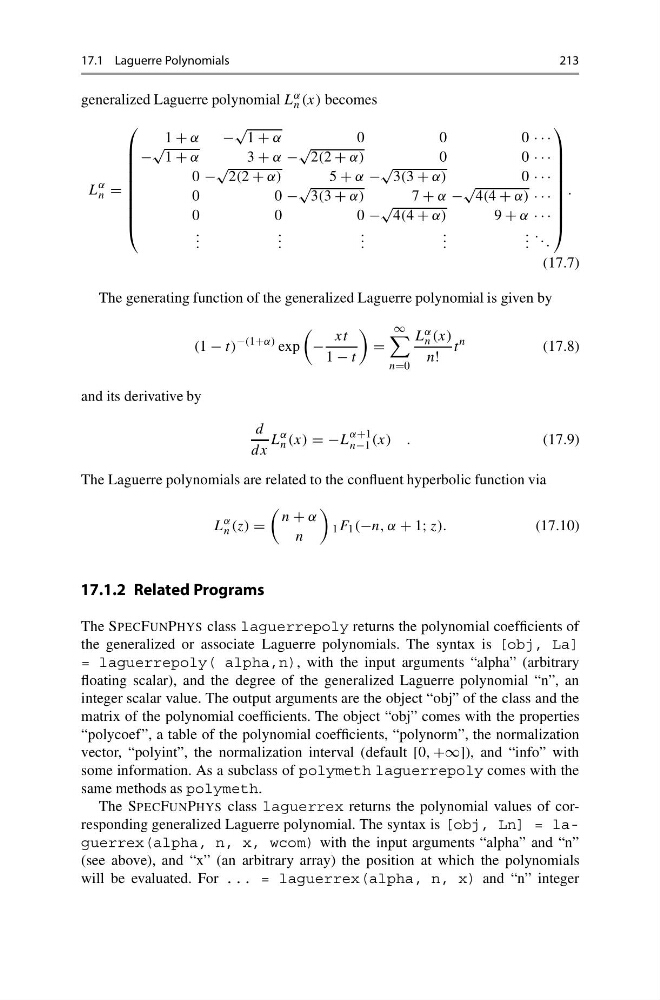
generalized Laguerre polynomial L α
n (x) becomes
L
α
n =
⎛
⎜
⎜
⎜
⎜
⎜
⎜
⎜
⎜
⎝
1 + α
−
√
1 + α
0
0
0· · ·
−
√
1 + α
3 + α −
√
2(2 + α)
0
0· · ·
0 −
√
2(2 + α)
5 + α −
√
3(3 + α)
0 · · ·
0
0−
√
3(3 + α)
7 + α −
√
4(4 + α) · · ·
0
0
0−
√
4(4 + α)
9 + α · · ·
. . .
. . .
. . .
. . .
. . .
. . .
⎞
⎟
⎟
⎟
⎟
⎟
⎟
⎟
⎟
⎠
.
(17.7)
The generating function of the generalized Laguerre polynomial is given by
(1 − t)
−(1+α) exp
−
xt
1 − t
=
∞
n=0
L α
n (x)
n!
t
n
(17.8)
and its derivative by
d
dx
L
α
n (x) = −L
α+1
n−1 (x) .
(17.9)
The Laguerre polynomials are related to the confluent hyperbolic function via
L
α
n (z) =
n + α
n
1 F 1 (−n, α + 1; z).
(17.10)
17.1.2 Related Programs
The SPECFUNPHYS class laguerrepoly returns the polynomial coefficients of
the generalized or associate Laguerre polynomials. The syntax is [obj, La]
= laguerrepoly( alpha,n), with the input arguments “alpha” (arbitrary
floating scalar), and the degree of the generalized Laguerre polynomial “n”, an
integer scalar value. The output arguments are the object “obj” of the class and the
matrix of the polynomial coefficients. The object “obj” comes with the properties
“polycoef”, a table of the polynomial coefficients, “polynorm”, the normalization
vector, “polyint”, the normalization interval (default [0, +∞]), and “info” with
some information. As a subclass of polymeth laguerrepoly comes with the
same methods as polymeth.
The SPECFUNPHYS class laguerrex returns the polynomial values of corresponding generalized Laguerre polynomial. The syntax is [obj, Ln] = laguerrex(alpha, n, x, wcom) with the input arguments “alpha” and “n”
(see above), and “x” (an arbitrary array) the position at which the polynomials
will be evaluated. For ... = laguerrex(alpha, n, x) and “n” integer
213
generalized Laguerre polynomial L α
n (x) becomes
L
α
n =
⎛
⎜
⎜
⎜
⎜
⎜
⎜
⎜
⎜
⎝
1 + α
−
√
1 + α
0
0
0· · ·
−
√
1 + α
3 + α −
√
2(2 + α)
0
0· · ·
0 −
√
2(2 + α)
5 + α −
√
3(3 + α)
0 · · ·
0
0−
√
3(3 + α)
7 + α −
√
4(4 + α) · · ·
0
0
0−
√
4(4 + α)
9 + α · · ·
. . .
. . .
. . .
. . .
. . .
. . .
⎞
⎟
⎟
⎟
⎟
⎟
⎟
⎟
⎟
⎠
.
(17.7)
The generating function of the generalized Laguerre polynomial is given by
(1 − t)
−(1+α) exp
−
xt
1 − t
=
∞
n=0
L α
n (x)
n!
t
n
(17.8)
and its derivative by
d
dx
L
α
n (x) = −L
α+1
n−1 (x) .
(17.9)
The Laguerre polynomials are related to the confluent hyperbolic function via
L
α
n (z) =
n + α
n
1 F 1 (−n, α + 1; z).
(17.10)
17.1.2 Related Programs
The SPECFUNPHYS class laguerrepoly returns the polynomial coefficients of
the generalized or associate Laguerre polynomials. The syntax is [obj, La]
= laguerrepoly( alpha,n), with the input arguments “alpha” (arbitrary
floating scalar), and the degree of the generalized Laguerre polynomial “n”, an
integer scalar value. The output arguments are the object “obj” of the class and the
matrix of the polynomial coefficients. The object “obj” comes with the properties
“polycoef”, a table of the polynomial coefficients, “polynorm”, the normalization
vector, “polyint”, the normalization interval (default [0, +∞]), and “info” with
some information. As a subclass of polymeth laguerrepoly comes with the
same methods as polymeth.
The SPECFUNPHYS class laguerrex returns the polynomial values of corresponding generalized Laguerre polynomial. The syntax is [obj, Ln] = laguerrex(alpha, n, x, wcom) with the input arguments “alpha” and “n”
(see above), and “x” (an arbitrary array) the position at which the polynomials
will be evaluated. For ... = laguerrex(alpha, n, x) and “n” integer